

Cartoon Network has less than 50,000 viewers in 2026
The once-iconic channel is being quietly phased out as Warner Bros. shifts new shows to Tubi, Hulu, and Prime Video.
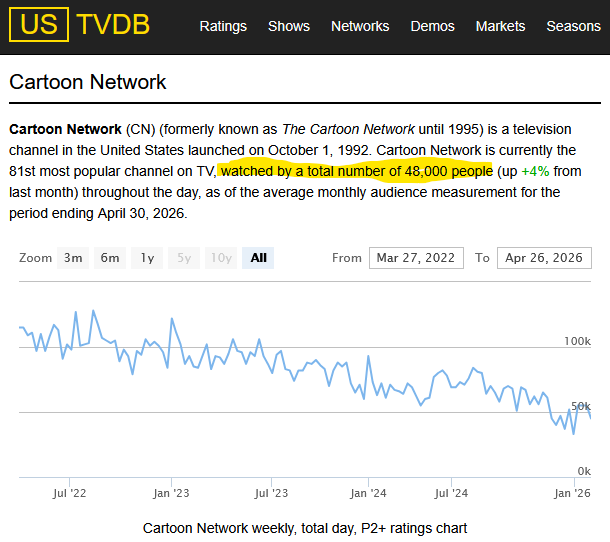
Cartoon Network, once the defining destination for a generation of kids, is now averaging fewer than 50,000 viewers per day in 2026.
According to recent industry tracking, the network is pulling in roughly 48,000 total viewers across the entire day, a number that would have been unthinkable even a decade ago. For context, that is roughly the population of a small town, and it represents a catastrophic collapse for a channel that routinely drew hundreds of thousands to over a million viewers during its peak years.
This is not an isolated dip. It is the latest chapter in the slow, steady death of linear kids’ television. Cartoon Network is not being abruptly shut down. Instead, it is being quietly phased out by degrees, and the evidence suggests that Cartoon Network Studios may soon exist only as a production brand under the Warner Bros. Animation umbrella rather than as a true television channel.
Kids’ linear TV viewership has dropped by more than half since 2019
The fall of Cartoon Network is part of a much larger trend. Kids’ cable networks across the board have lost the vast majority of their audience over the past decade. From their peaks in the mid-2010s, when channels like Cartoon Network routinely drew close to a million viewers on a good day, the entire category has hemorrhaged viewers.
Between 2019 and 2021 alone, overall kids’ linear TV viewership dropped by more than 50 percent, according to multiple industry reports. Cartoon Network has been hit particularly hard. Once a powerhouse that could reliably pull 800,000 to over a million viewers in prime time during its glory years, the network now struggles to crack even 50,000 daily viewers on many days.
Ad revenue tells the same story. According to S&P Global Market Intelligence data, annual ad revenue for Cartoon Network and Adult Swim combined fell by 83 percent from 2014 to 2024.
The reasons are straightforward and well-documented. Kids today discover and consume content on their own terms. YouTube, TikTok, Netflix, Disney+, and free ad-supported streamers like Tubi offer instant, on-demand access without the rigid schedules of linear television. Parents, many of whom grew up with cable, are also more comfortable letting their children use tablets and phones rather than fighting over the family TV remote.
Adult Swim, the network’s late-night block, still performs relatively better than the daytime kids’ programming, but the core Cartoon Network brand that defined after-school and weekend mornings is now a shell of its former self.
Cartoon Network is being shut down by degrees
Warner Bros. Discovery‘s approach to Cartoon Network in recent years has been described by some insiders as a slow, managed decline rather than an abrupt shutdown. The linear channel still exists on cable packages, but its infrastructure and visibility have been steadily dismantled.
The network’s historic Burbank studio, long the creative heart of Cartoon Network Studios, was vacated in August 2024 as part of broader cost-cutting and restructuring. Cartoon Network Studios was folded under Warner Bros. Animation leadership, and many of the studio’s functions were consolidated, further weakening the connection between the brand and its on-the-ground production.

The official Cartoon Network website, once a vibrant hub for games, videos, and show information, has gone largely dark, with most content either removed or redirected to Warner Bros. Discovery’s streaming platforms. Many classic and recent shows have also been yanked from Max, the company’s flagship streamer, reducing visibility even further.
Meanwhile, the network’s massive archive of past programming has been quietly redistributed. A significant portion of the Cartoon Network library now lives on Tubi, the free ad-supported streamer, and MeTV Toons, a retro-focused linear channel that has become a de facto home for older Warner Bros. animation. This redistribution keeps the content available to fans but strips the original Cartoon Network channel of its role as the primary destination.
Cable carriage has also eroded. DirecTV did not include Cartoon Network in its new $34.99 entertainment package, though it did keep Adult Swim. Sling TV has also moved the channel out of its cheaper Orange package and into a more expensive tier.
These moves paint a picture of a brand being phased out methodically. The linear channel still technically airs reruns and occasional promotional blocks, but its role as a cultural and creative force has been reduced to almost nothing.
New Cartoon Network shows are being punted to other streamers
The clearest sign that Cartoon Network as a linear destination is fading is where its new and revived content is actually premiering.
The brand-new anime series Yokoso Scooby-Doo!, the franchise’s first original anime series featuring Matthew Lillard and Frank Welker reprising their roles as Shaggy and Scooby, debuted exclusively on Tubi in North America. Cartoon Network will air it internationally, but U.S. audiences get it first, and often only, on the free streamer.
The new season of The Amazing World of Gumball, subtitled The Wonderfully Weird World of Gumball, premiered on Hulu.
Adventure Time spin-offs, including Adventure Time: Side Quests and Fionna and Cake, have been routed to Hulu and Disney+.
The Steven Universe spin-off Lars of the Stars went straight to Amazon Prime Video.
This pattern has become the new normal. Warner Bros. Discovery appears to have concluded that the economics of linear kids’ television no longer make sense for ambitious new programming. Instead, the company is treating Cartoon Network’s intellectual property as flexible assets that can be placed wherever the best deal or audience exists.
The Paramount Skydance acquisition scrapped the WBD corporate split
The situation is further complicated by massive upheaval at the parent company. Warner Bros. Discovery had originally planned to separate into two publicly traded companies, with one focused on streaming and studios and another focused on linear networks. Under that structure, Cartoon Network and Adult Swim would have fallen on the linear side, while Cartoon Network Studios would have remained with the Warner Bros. Animation group.
That plan was effectively scrapped when Paramount Skydance prevailed in a months-long bidding war for the entire company. Paramount Skydance’s $110.9 billion all-cash offer, valuing WBD shares at $31 each, was approved by the WBD board on February 26, 2026 and by shareholders on April 24, 2026. The deal is expected to close in Q3 2026, pending regulatory approval, with David Ellison set to lead the combined company.
The acquisition leaves Cartoon Network Studios as just another production label under the broader Warner Bros. Animation banner, with no meaningful tie to the linear channel.
Looney Tunes content is also being shopped to outside distributors
The pattern extends beyond Cartoon Network Studios. Warner Bros. has increasingly offloaded even its iconic Looney Tunes properties to third-party distributors rather than handling theatrical or major streaming releases itself.
Films like Coyote vs. Acme and The Day the Earth Blew Up: A Looney Tunes Movie were either shelved for tax purposes or sold to smaller distributors such as Ketchup Entertainment instead of receiving full Warner Bros. theatrical support. This further illustrates the company’s shift away from treating its animation assets as core linear or even in-house theatrical priorities.
What this means for the future
Cartoon Network as a brand still exists, and Adult Swim continues to provide some stability. But the days when the channel was a must-watch destination for new original series are clearly over. The studio that once produced Dexter’s Laboratory, The Powerpuff Girls, Adventure Time, Regular Show, Steven Universe, and countless other cultural touchstones is now primarily a production engine feeding content to whichever platform offers the best deal.
For longtime fans, this feels like the end of an era. Cartoon Network Studios may continue to produce great animation under the Warner Bros. Animation umbrella, but the linear channel that gave those shows their cultural home is fading into the background. With fewer than 50,000 viewers on any given day, a vacated Burbank studio, a dark website, content yanked from Max, and the archive scattered across Tubi and MeTV Toons, the writing is on the wall. Cartoon Network as a television channel is being slowly phased out, while the animation brand lives on in a very different form.
The broader industry shift toward streaming, short-form video, and on-demand content has simply made the old linear model unsustainable for kids’ programming. Warner Bros. Discovery’s corporate maneuvers, the failed split, the Paramount Skydance acquisition, and the outsourcing of new content, have only accelerated what was already an inevitable decline.
Article compiled and edited by Derek Gibbs (entertainment editor) and the Clownfish TV newsroom.
D/REZZED is part of Clownfish TV. For more news, views, and rants on gaming and tech, visit clownfishtv.com. Watch the show on YouTube at @ClownfishTV where new episodes drop daily. Subscribe to the Clownfish TV podcast on Apple Podcasts, Spotify, iHeart, and wherever else you get your podcasts. Sign up for the free newsletter at more.clownfishtv.com.
Hat Tips:
USTVDB and Nielsen, recent Cartoon Network and Adult Swim viewership data
Axios and Bloomberg Businessweek, reporting on Warner Bros. Discovery’s disinvestment in Cartoon Network and the closure of its Burbank studio
S&P Global Market Intelligence, ad revenue data for Cartoon Network and Adult Swim from 2014 to 2024
Variety and Deadline, coverage of the Paramount Skydance acquisition of Warner Bros. Discovery
Animation Magazine and Collider, coverage of Yokoso Scooby-Doo!, Gumball, Adventure Time, and Steven Universe spin-off distribution deals on Tubi, Hulu, and Prime Video
The Hollywood Reporter, Cartoon Brew, and Cord Cutters News, details on Looney Tunes distribution and cable carriage changes