

Gen X bankrolls geek fandom. They actually buy stuff.
Hasbro just made $200 million in a single day off the Magic: The Gathering Final Fantasy set, almost entirely from buyers in their 30s and 40s.

Hollywood has spent the past ten years chasing an audience that does not buy anything.
The Roblox generation does not buy collectibles. The Fortnite generation does not buy comics.
Gen Z and Gen Alpha rent everything through streaming and free-to-play and TikTok, and the corporations that own the legacy IPs have been bending themselves into pretzels trying to capture them.
Meanwhile, the actual customers, the Gen X and tail-end Boomer fans who grew up with these IPs as toy lines and Saturday morning cartoons and trips to the comic shop on Wednesdays, are sitting on disposable income they earned through 25 years of real careers, waiting to spend it on the IPs they love.
And the corporations that have figured out who is actually paying for the merch are winning. The corporations that haven’t are bleeding.
The $200 million day Hasbro is not going to shut up about
On June 13, 2025, Wizards of the Coast released the Magic: The Gathering Final Fantasy Universes Beyond set. By the end of that day, per Hasbro CEO Chris Cocks on the company’s Q2 2025 investor call, the set had generated $200 million in revenue.
In one day.
It became the best-selling Magic set in the game’s 32-year history before retail even opened on day two.
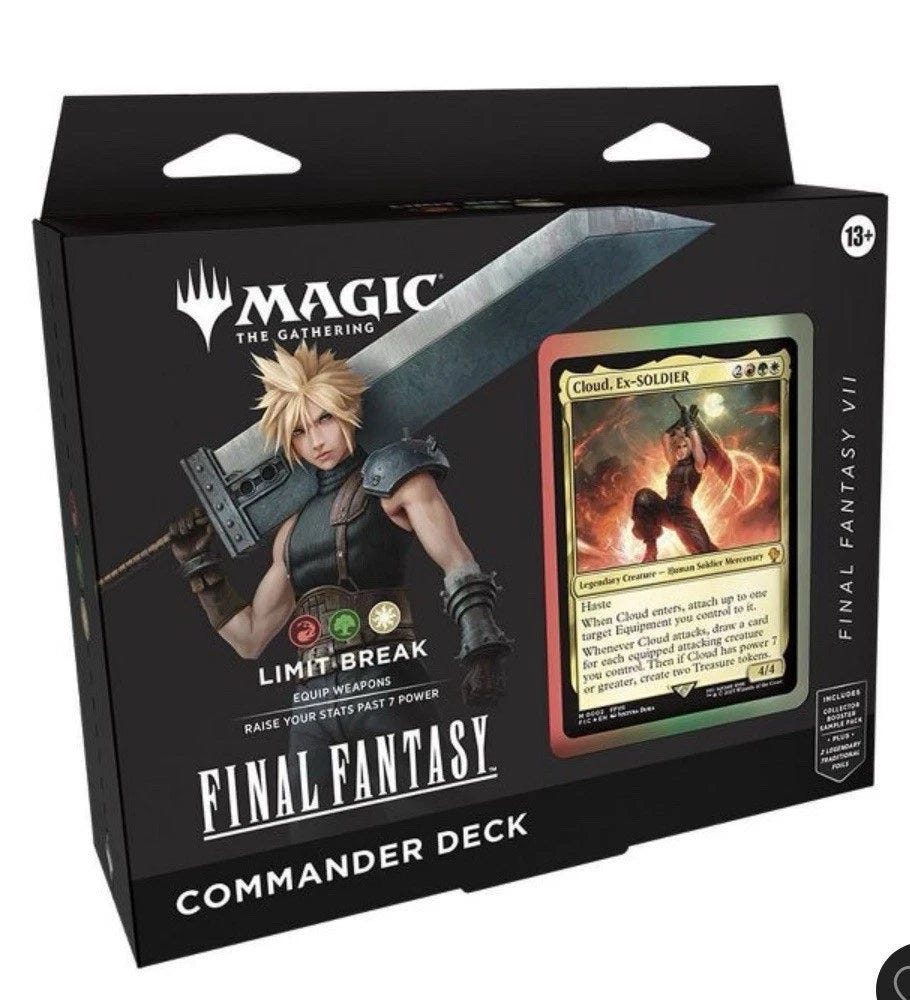
Per Cocks, the set drove a 40 percent year-over-year increase in unique Magic players in the first half of 2025. MTG revenue grew 23 percent year-over-year in Q2 (from $336 million in Q2 2024 to $412 million in Q2 2025) and was up 32 percent year-to-date by the time the Q2 numbers landed.
The Universes Beyond strategy, where Magic licenses other companies’ IPs onto Magic cards, is now formally half of all future Magic releases per Wizards lead designer Mark Rosewater speaking on the Q1 2025 earnings call.
The Final Fantasy buyers were not children. TCGPlayer marketplace data shows the average buyer of a Final Fantasy set Collector’s Edition Commander deck was spending $510 per deck. Individual borderless singles like Buster Sword ($107), Sephiroth, Fabled SOLDIER ($90), and Cloud, Midgar Mercenary ($63) were trading at price points that require an established adult disposable-income lifestyle, not allowance money.
The same Hasbro report disclosed that the Consumer Products segment (which is mostly toys) was DOWN 16 percent in the same quarter. Toys to children are flat to declining. Cards and collectibles to adults are up 23-32 percent.
Hasbro is paying attention.
Hasbro literally has a strategy called Aging Up
In Hasbro’s 2025 proxy filing with the SEC (DEF 14A), the company laid out its five core strategic building blocks. One of them is titled, in plain English, “Aging Up.“
The full strategy statement: “Expand our consumer base and drive play and collectible experiences for fans of all ages, recognizing that consumers aged 13 and above are gaining purchase share.“
That language is in a public SEC filing. Hasbro is telling its shareholders that the kids’ toy market is a smaller part of its future than the adult collector market. The company that owns Transformers, G.I. Joe, Star Wars toy licenses, Marvel toy licenses, My Little Pony, Power Rangers, Dungeons & Dragons, and Magic: The Gathering has gone on record saying: adults are now where the money is.
Hasbro launched its direct-to-consumer platform Hasbro Pulse in 2019 specifically to sell limited-edition premium collectibles to adult fans. The Hasbro Retro Collection, which packages new Transformers and G.I. Joe figures in vintage 1980s-style cardboards, hits 90 percent sell-through rates within initial retail windows per a March 2026 toy industry market report.
The Gen X and millennial fans grew up with these IPs. They have houses. They have offices. They have shelves that need filling. Hasbro figured this out and built an entire business strategy around it.
Mattel knows MOTU toys are the business. The movie was the loss leader.
The He-Man Masters of the Universe live-action film opened on June 5, 2026 to $29 million domestic on a reported $170 to $200 million production budget. By any normal Hollywood metric, that movie is a flop on the order of John Carter.
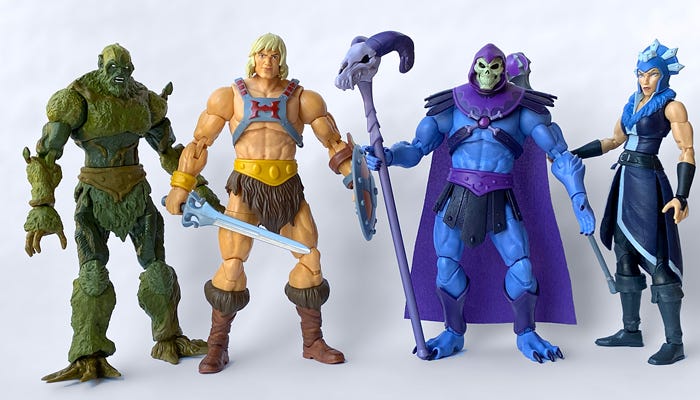
Meanwhile, Mattel’s Masters of the Universe Masterverse toy line, which has been running quietly since 2021, has been doing 90 percent or better sell-through rates at retail per the same toy industry market report. Walmart Collector Con moves Masterverse figures within minutes of going live. New variants like the Vintage Collection Faker hit retail at $21.74 and sell out before noon.
The He-Man toys are the actual business. The He-Man movie was the marketing campaign for the toys. Mattel almost certainly expected the movie to underperform versus its budget. What Mattel cared about was getting He-Man back into pop culture conversation, getting parents to remember the IP, getting their kids to walk past a Masterverse Skeletor at Target and ask “what’s that.” The movie’s job was to be the funnel. The toys are the conversion.
This is the same playbook Mattel ran with Barbie in 2023, except that one worked at both ends. The movie was a blockbuster AND the toys sold like crazy. The Barbie playbook works in both directions. The He-Man playbook works in one direction. Either way, Mattel is profiting on the toy side.
Star Wars merchandise has done $29 billion. The new films have not.
Per License Global‘s 2026 brand saga report, the Star Wars franchise has generated approximately $29.057 billion in merchandise sales since its 1977 debut. That number dwarfs the total box office gross of all Star Wars films combined.
Disney is acutely aware of this. In March 2026, Disney Consumer Products announced its global “Star Wars: Most Wanted“ campaign, a year-long retail program with ongoing product drops from Hasbro, LEGO, POP MART, Moose Toys, Mattel, Jada Toys, and Displate through 2026.
The campaign was unveiled at New York Toy Fair 2026 with Jon Favreau himself onstage. Favreau said: “For many fans my age, the toys were how we lived Star Wars between movies.“
The “Star Wars: Most Wanted” campaign is the most explicit acknowledgment Disney has ever made that the merchandise pillar is the actual economic engine of the Star Wars franchise. The films and shows exist to keep the IP relevant enough that adult collectors keep buying Black Series action figures and Vintage Collection rereleases.
The Acolyte cost Disney roughly $180 million to produce and got canceled. The Mandalorian and Grogu is currently underperforming at the box office. Both projects targeted new audiences. Both projects either lost money or hemorrhaged goodwill from the existing fan base. The merchandise pillar kept the lights on while the streaming pillar struggled.
DC Comics is winning by serving older readers
In Q4 2025, DC Comics took the top spot in the direct comic book market for the first time in over a decade per ICv2. DC ended Q4 2025 with 32.6 percent market share versus Marvel’s 29.6 percent. The cause was the DC Absolute line, an alternate-universe imprint that launched in late 2024 with explicit goals: lower entry friction, ignore 80 years of continuity, write characters in a more contemporary register, and let lapsed older readers come back without homework.
The Absolute line locked 9 of the top 10 spots for comics sold in November 2025 per ICv2. The buyers are people who read Batman in the 1980s and 1990s, drifted away from comics during the convoluted Crisis-and-counter-Crisis era, and are now returning because DC made an on-ramp specifically for them.
Per ICv2 CEO Milton Griepp at New York Comic Con 2025: comic book sales were up 27 percent year-over-year in 2025, after rising 13.3 percent in 2024. The comic shop industry is having its best run since the 1990s speculator boom. The cause is not new young readers, despite some optimistic press framing.
Per Bleeding Cool‘s coverage of Griepp’s NYCC presentation: “Gen X are the new Wednesday Warriors.“
The adult comic reader is the customer.
DC figured this out.
Marvel has been slow on the uptake and is losing market share as a direct result.
What the data actually says about who spends
A March 2026 toy collectibles market report put real numbers on the disposable income gap. The adult collector cohort (the millennial and Gen X buyers who grew up on 80s and 90s franchises) spent an estimated average of $480 per year on collectibles in 2025. The teen demographic spent an estimated $120 per year. The adult cohort buys 4x as much per capita as the teen cohort.
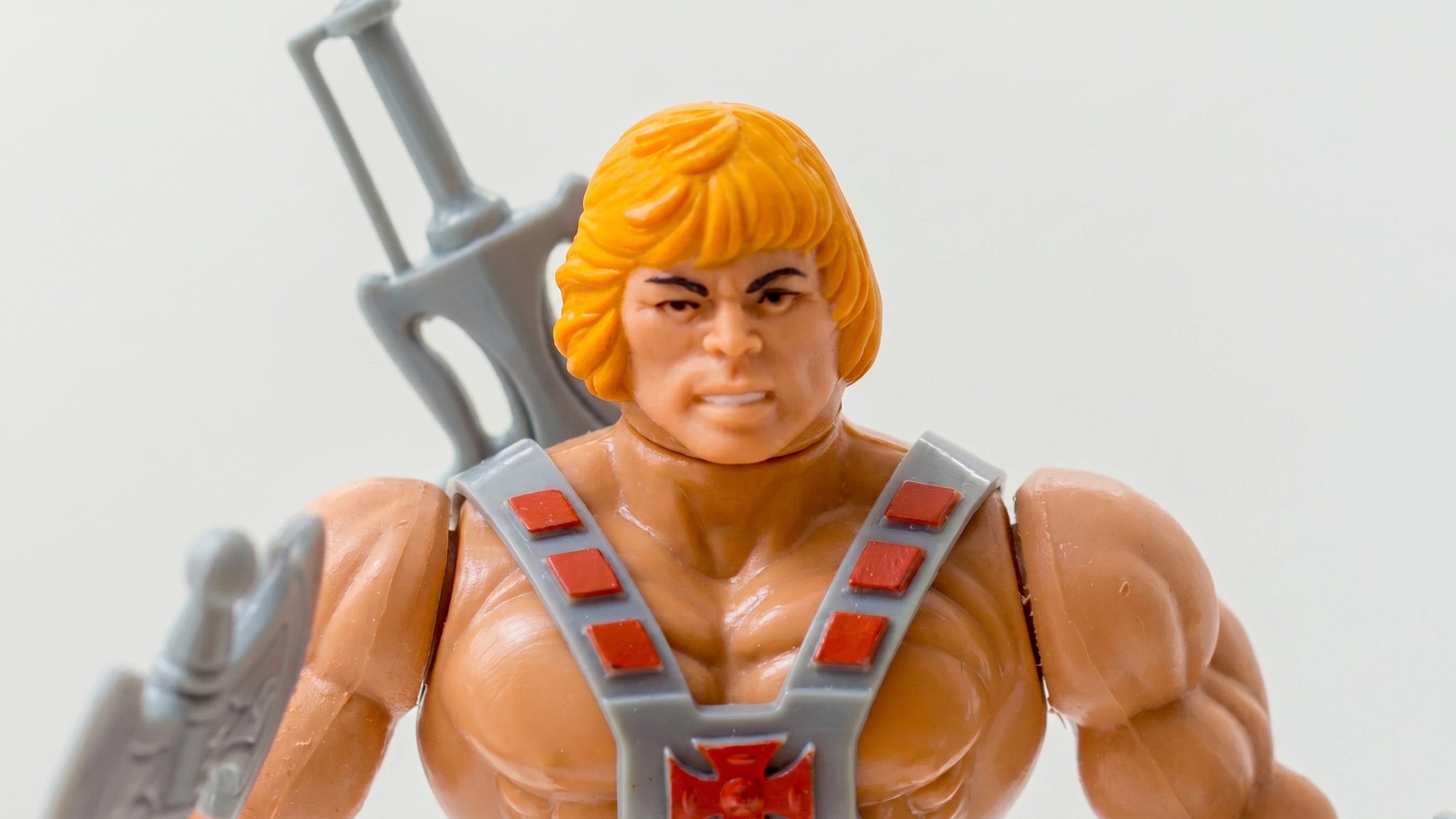
The same report noted that the Hasbro Retro Collection and Mattel Masterverse lines are consistently hitting sell-through rates above 90 percent in their initial retail windows. That sell-through rate is industry-leading. The product flies off shelves because the buyers have been waiting for it.
The math is brutal. The adult collector cohort has:
Higher household income (median ~$98,000 for ages 35-44 per BLS, vs ~$48,000 for under 25)
Lower student debt servicing pressure
Established discretionary spending budgets
Existing collecting habits formed across 25-40 years
Emotional attachment to specific IPs that AAA marketing cannot manufacture
The Gen Z and Gen Alpha cohorts have:
TikTok, YouTube, and Roblox subscriptions
Free-to-play habits formed in childhood
Limited disposable income
No existing attachment to legacy IPs unless their parents introduced them
Minimal interest in physical products
Hasbro and Mattel and Wizards of the Coast have done the math. Disney is still figuring it out. Marvel Comics is on the slow lane to figuring it out. Warner Bros Discovery is staring at Mike De Luca and Pam Abdy and asking when the Superman halo profit shows up.
The Boomer fans meme
There is a recurring discourse on TikTok and Reddit and the broader Gen Z online ecosystem where younger fans complain about “the Boomer fans“ ruining modern Star Wars or Marvel or whatever else. The framing is that older fans are gatekeeping, complaining about new stories, refusing to embrace change, and generally being a drag on the franchises they used to love.
The framing has some truth to it. Older fans can be insufferable about their nostalgia. The “I want my Star Wars back” discourse is real and sometimes embarrassing.
But the framing also misses the part where the Boomer fans bankroll the entire fandom. The MTG Final Fantasy set sold $200 million in a day because 40-year-olds bought it. The Mandalorian Season 1 was a streaming hit because Gen X subscribed to Disney+. The Black Series action figures sell out at Walmart because middle-aged collectors are camping the retailer apps. The new DC Absolute line is winning the direct market because 50-year-olds are buying Batman again.
The Roblox kids are not paying for any of this. They are downloading free Star Wars-themed avatars on Fortnite and moving on. When they grow up, MAYBE they will become the next collector generation. Or maybe they will not. Either way, the corporations that need revenue THIS quarter cannot wait 15 years to find out.
The companies that get it
Hasbro gets it. The “Aging Up” strategy is in the SEC filing. The MTG Universes Beyond pipeline is the proof. Hasbro Pulse is the direct sales channel. The Retro Collection is the nostalgia product. The Q2 2025 results are the receipt.
Mattel gets it. The Masterverse line was running profitably long before the He-Man movie. The Barbie playbook of using mass-audience media to sell collectibles to adults is the modern Mattel formula. The MOTU toys did not need the movie to do well. The movie just made them do EVEN better.
Disney is starting to get it. The Star Wars: Most Wanted campaign is the closest the company has come to publicly admitting the merch pillar is the actual business model.
The companies that are still chasing the Roblox audience while alienating the adult collector audience are the ones in trouble. Marvel Studios’ theatrical underperformance over the past five years is the canary. The Acolyte cancellation is the canary. The Mandalorian and Grogu opening weekend is the canary. The legacy media companies that mistake the next-generation audience for the current customer base are bleeding through the pivot.
The closer
The fans calling for “Star Wars back” or “Marvel back” or “Magic back” are not nostalgia-poisoned reactionaries. They are paying customers asking the companies who own these IPs to stop pretending the next generation is already here, and to start serving the customer base that is here right now, with money to spend, ready to buy.
Hasbro and Mattel figured this out. They are growing.
The companies that haven’t are watching the customers they used to have walk into Wizards of the Coast events and drop $510 on a single Commander deck while complaining that Disney+ doesn’t make anything they want to watch anymore. The disposable income is real. The brand loyalty is real. The decisions about what to spend it on are happening in real time.
The Boomer fans are not the problem. They are the customer. The companies that figure out which one of those two framings is true are the ones that survive the next decade.
Want more Clownfish TV? Subscribe to our Substack for the free newsletter, become a Reefer for paid exclusive shows and articles, or watch the show on YouTube where new episodes drop daily. Subscribe to the Clownfish TV podcast on Apple Podcasts, Spotify, iHeart, and wherever else you get your podcasts.
Hat Tips:
Hasbro 2025 SEC DEF 14A Proxy Filing, primary verified source for the formal “Aging Up” strategy language including the full statement “Expand our consumer base and drive play and collectible experiences for fans of all ages, recognizing that consumers aged 13 and above are gaining purchase share”
Hasbro Q2 2025 8-K Earnings Filing / Investing.com transcript / GameRant (July 23, 2025), verified Chris Cocks investor call quote that Magic: The Gathering Final Fantasy generated $200 million in revenue in a single day and became the best-selling MTG set in history, plus the 23 percent MTG revenue growth Q2 YoY ($336M to $412M) and the 40 percent year-over-year unique Magic players increase in H1 2025
Hasbro Q3 2025 8-K Earnings Filing, verified 33 percent year-to-date Wizards of the Coast and Digital Gaming Segment revenue growth and the Consumer Products segment 9 percent decline showing the divergence between adult collectibles growth and traditional toy decline
TCGPlayer Marketplace (June-December 2025), verified specific MTG Final Fantasy singles pricing including Buster Sword borderless ($107.20), Sephiroth Fabled SOLDIER ($89.93), Cloud Midgar Mercenary ($63.34), and Commander Collector’s Edition Deck Displays ($510)
Wargamer (May 2026), verified Magic the Gathering lead designer confirmation that 50 percent of all future Magic sets will be Universes Beyond crossovers per Q1 2025 Hasbro earnings call, plus the Marvel Spider-Man set release date September 26, 2025 and the Marvel Super Heroes set release June 26, 2026
DataIntelo Toy Collectibles Market Research Report 2034 (March 2026), verified $480 per year adult collector cohort spending versus $120 per year teen cohort spending, plus the Hasbro Retro Collection and Mattel Masterverse line 90 percent sell-through rate context
ToyNewsI (March 2025), verified Walmart Collector Con Masters of the Universe Masterverse Vintage Collection Faker pricing at $21.74 and the broader Mattel adult collector strategy context
License Global (January-March 2026), verified Star Wars merchandise lifetime sales at approximately $29.057 billion and the “Star Wars: Most Wanted” 2026 global campaign announcement including the Jon Favreau onstage quote
Bleeding Cool / ICv2 (October 2025), verified comic shop direct market 27 percent year-over-year sales increase in 2025, the Milton Griepp NYCC quote “Gen X are the new Wednesday Warriors,” and the broader direct market growth from 2019 baseline
ICv2 (January 2026), verified DC Comics taking the Q4 2025 direct market top spot with 32.6 percent share versus Marvel’s 29.6 percent, the Absolute Universe imprint taking 9 of top 10 November 2025 sales spots, and the DC K.O. event and Batman/Deadpool crossover context
Variety / Deadline (August 2024 and June 2026), verified Star Wars Acolyte cancellation after one season at approximately $180 million production cost, plus the Mandalorian and Grogu underperformance context
Bureau of Labor Statistics / PwC consumer outlook (2025), verified US median household income data showing the 35-44 demographic at approximately $98,000 versus the under-25 demographic at approximately $48,000