

Is Disclosure Day actually Spielberg’s sequel to Close Encounters of the Third Kind?
Steven Spielberg’s first new film in four years opens June 12, 2026, on what would have been the 50th anniversary year of Close Encounters of the Third Kind.
Steven Spielberg‘s Disclosure Day opens in theaters on Friday, June 12, 2026, less than 10 days from now. The Universal Pictures release stars Emily Blunt and Josh O’Connor, with Colin Firth, Wyatt Russell, Colman Domingo, and Eve Hewson in supporting roles. It is Spielberg’s first new feature since 2022’s The Fabelmans, and his first UFO movie since 2005’s War of the Worlds.
Fans now think it might be something more than a new movie.
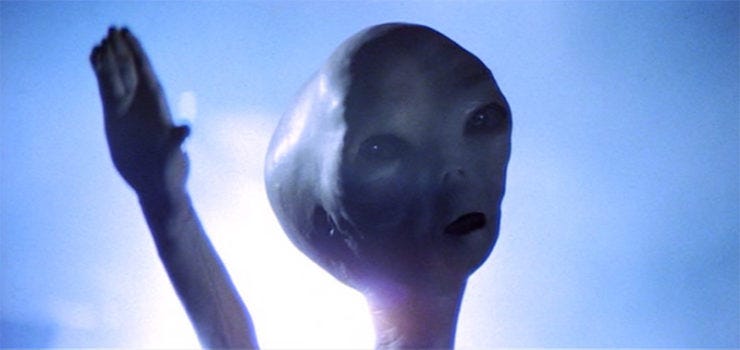
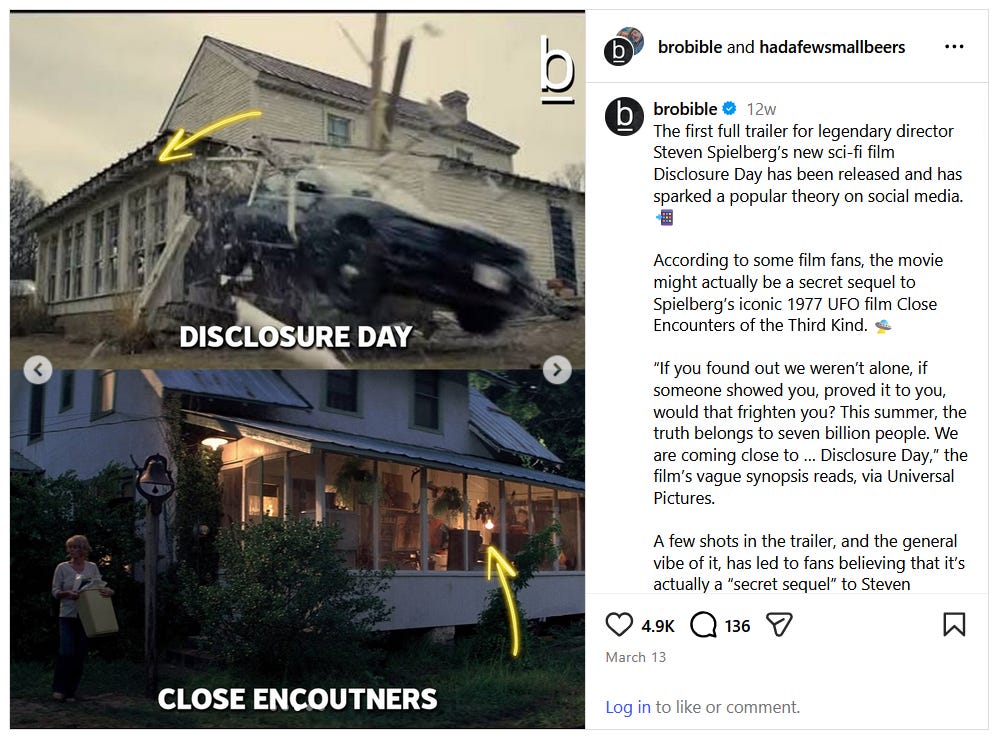
For months, online speculation has been building that Disclosure Day is a secret sequel to Spielberg’s 1977 sci-fi classic Close Encounters of the Third Kind. The evidence has been accumulating in pieces. The UFO design in the trailers looks nearly identical to the 1977 mothership. The alien faces visible in the latest trailer match the originals. The release date lines up with the 50th anniversary of the original. The working title was “The Dish,” a phrase with obvious Close Encounters resonance.
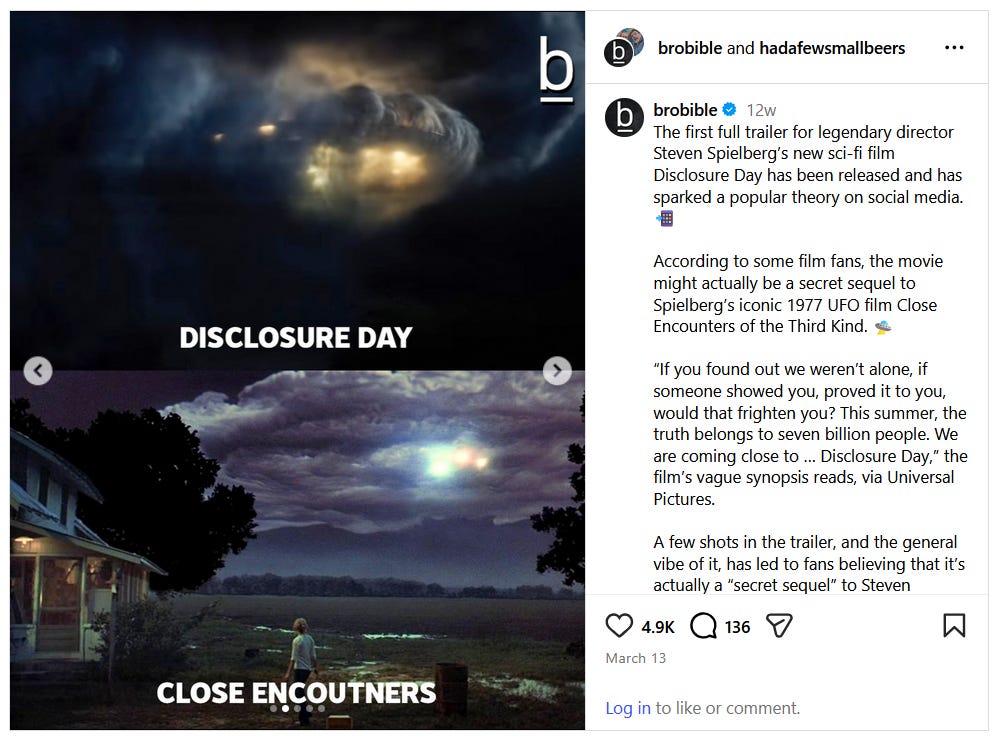
And Josh O’Connor, the film’s whistleblower lead, has now publicly confirmed that Disclosure Day “answers some questions“ raised by Close Encounters.
That is about as close to confirmation as Spielberg fans are likely to get before opening weekend. The director himself has refused to confirm or deny the theory, but the evidence is now substantial enough that even the trade press is taking it seriously.
The film also arrives in the middle of the most intense U.S. government UAP disclosure push in modern history. The timing is either a coincidence or, depending on how you read Spielberg, the entire point.
What we know about the plot
The film’s official premise is deliberately mysterious. Universal’s logline reads: “If you found out we weren’t alone, if someone showed you, proved it to you, would that frighten you? This summer, the truth belongs to 7 billion people. We are coming close to Disclosure Day.“
From the trailers and verified production details, here is what is publicly known.
Josh O’Connor plays Daniel Kellner, a cybersecurity administrator at a high-tech company called Wardex. Kellner is the custodian of incriminating data he has pilfered from his former employer, and he wants to release it globally. “People have a right to know the truth,“ his character says in the trailer. “It belongs to 7 billion people.“
Emily Blunt plays a Kansas City television meteorologist. In a scene that has been heavily featured in the marketing, Blunt’s character begins speaking a clicking alien language on the air, mid-broadcast, with no apparent control over what she is saying.
Colin Firth plays the shadowy leader of what appears to be the same organization Kellner stole the data from. He communicates primarily through telepresence, suggesting his character is operating from a hidden location.
Eve Hewson plays Jane, Kellner’s girlfriend, who learns that he can understand the alien language Blunt’s character is speaking.
The trailers include direct references to Roswell, the 1947 New Mexico incident that founded modern American UFO mythology. A UFO emerges from cloud cover in a desert location in shots that fans have called nearly identical to Close Encounters‘s climactic Devils Tower sequence.
The script is by David Koepp, a longtime Spielberg collaborator who wrote Jurassic Park: The Lost World and War of the Worlds. The story is credited to Spielberg himself.
The Close Encounters sequel evidence
The fan theory that Disclosure Day is a secret Close Encounters sequel has been building since the first trailer dropped in December 2025. Each subsequent trailer and image release has added evidence.
MovieWeb has tracked the design parallels in detail. The mothership reveal in the latest trailer shows a UFO with a bank of bright glowing lights outlining its silhouette, emerging from a cloud bank in a dusty desert setting. The shot is composed almost identically to the famous Devils Tower mothership reveal from 1977. The new UFO is more oblong than the original’s circular design, but the visual language is unmistakable.
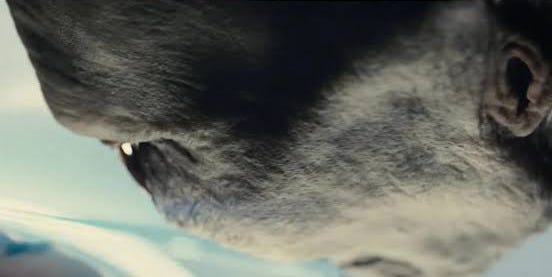
The aliens visible in the latest trailer have facial features that match the original’s almost exactly. Spielberg used physical effects and prosthetic makeup in 1977, and Disclosure Day appears to be honoring that aesthetic in a way no other modern alien film has bothered to do.
The release date is the strongest circumstantial evidence. Close Encounters premiered on December 14, 1977. A June 2026 release puts Disclosure Day in the same year as the 50th anniversary commemoration. The original is also returning to theaters this year as part of that anniversary.
Josh O’Connor‘s confirmation that the film “answers some questions“ raised by Close Encounters is the closest the cast or crew has come to publicly acknowledging the connection. He stopped short of calling it a direct sequel, but the implication of answering open questions from a previous film is, in industry terms, a strong tell.
Spielberg himself has refused to confirm or deny the theory in any interview to date. The closest he has come was a quiet 2023 conversation that may have been the seed of the entire project.
The future humans theory
In 2023, Spielberg appeared on The Late Show with Stephen Colbert and discussed his ongoing fascination with UFOs and UAPs. During that interview, he proposed a theory that has now been quoted in nearly every preview piece written about Disclosure Day.
Spielberg suggested that UAPs may not be alien spacecraft from distant galaxies at all. They may be “us 500,000 years into the future“ returning as “anthropologists“ to document a pivotal century in human history.
The “Future Humans” framework is one of the most popular theories among modern UFO researchers, partly because it explains certain features of UAP reports that traditional extraterrestrial-visitor frameworks struggle with. The objects’ apparent indifference to physical laws. Their consistent appearance near nuclear facilities, which would be the most historically significant artifacts of the late 20th and early 21st centuries from a future-anthropology perspective. Their tendency to observe rather than communicate or interfere.
If Disclosure Day is built around the future humans theory, it would explain almost every plot detail that has leaked. Why an organization led by a shadowy figure would be hiding the truth. Why a meteorologist might suddenly speak a language she cannot consciously understand. Why a whistleblower would feel an obligation to release proof to “7 billion people.” Why a Close Encounters sequel would be the natural vehicle for it.
And why the most successful living director in American film history would come out of a four-year break to make this specific movie.
The UAP disclosure context that makes the timing matter
Disclosure Day is not arriving in a vacuum. It is arriving during the most active period of U.S. government UAP transparency activity in history.
In July 2023, former intelligence officer David Grusch testified to Congress that the U.S. government has secretly recovered crashed UAPs and the bodies of “non-human pilots.” The Pentagon denied his claims. Congress kept investigating anyway.
The Schumer-Rounds UAP Disclosure Act of 2023 forced the government to begin reviewing classified UAP material for public release. Pentagon reports have confirmed repeated UAP incidents near U.S. nuclear facilities, a pattern documented in declassified materials.
In 2026, the House Oversight Committee under chairman James Comer and Rep. Eric Burlison opened an investigation into a cluster of deaths and disappearances of scientists connected to U.S. nuclear, aerospace, and UFO research programs. At least 11 people are on that list, including retired Air Force Major General William Neil McCasland, who was nicknamed the “UFO general” before he disappeared from his Albuquerque home in February. The most recent name added to the list is Melissa Casias, a Los Alamos National Laboratory worker whose remains were found in a New Mexico forest on May 28 of this year.
Whether any of those cases are actually connected to UAP programs is the subject of active congressional inquiry. President Trump has called the situation “pretty serious stuff.“ The FBI has been asked for briefings but has not yet publicly responded.
In the middle of all of that, Steven Spielberg is releasing a film called Disclosure Day.
The timing is either incidental or surgical. Spielberg started developing the project in the early 2020s, before the most recent disclosure push intensified. But he is the most culturally aware filmmaker of his generation, and the title of the film is taken directly from the language of the modern UFO disclosure community. Coincidence is doing a lot of work in that framing.
The early reactions
The first press screenings have produced some of the strongest critical reactions of Spielberg’s late career.
Steven Weintraub at Collider wrote: “In a shock to absolutely no one, Steven Spielberg has delivered another towering home run with Disclosure Day. I could go on and on about what I loved, but I was lucky enough to see the movie knowing almost nothing, and I strongly recommend you do the same.“
Critic Simon Thompson wrote: “Disclosure Day is profound and deeply human with a stellar Williams score. Emotional and intelligent, it’s the perfect companion piece to E.T. and Close Encounters. Superb performances across the board but Emily Blunt is wondrous.“
Multiple critics have called it “Spielberg’s best film in 20 years.” The John Williams score has been praised across early reviews. Emily Blunt’s performance is being mentioned in early awards-season conversations.
The “companion piece to E.T. and Close Encounters” framing from Thompson is significant. He stopped short of calling it a direct sequel, but the language indicates that whatever Disclosure Day is, it is built to live in the same conceptual universe as Spielberg’s previous alien films.
What this all means
For Spielberg fans, Disclosure Day is the most anticipated release of summer 2026 outside of the Spider-Man: Brand New Day and Avengers: Doomsday tentpoles. It is his return to the genre that built his career, with the writer who has been his most trusted collaborator across four decades, on a project he has been quietly developing for years.
For UAP disclosure followers, the film is either an honest engagement with the most important cultural question of the moment or a Hollywood reframe that turns a real political conversation into popcorn entertainment. Either reading is defensible. Both audiences are likely to leave the theater satisfied for different reasons.
For the broader movie audience, Disclosure Day is the rare original sci-fi film with major star power that has not been pre-sold to death by spoilers and trailer reveals. The premise is mysterious by design. The director has spent months refusing to confirm the obvious sequel theory. The cast has been similarly tight-lipped. June 12 will be the first time most viewers see what the film actually is.
In a year of legacy IP failures, controversial reboots, and franchise fatigue, Spielberg has delivered something with the same shape as his original UFO film and what looks like genuine new ideas underneath. The early word is that it works.
The truth, as Universal’s marketing keeps reminding us, is supposed to belong to 7 billion people.
We will find out what truth Spielberg is actually willing to share starting Friday, June 12, 2026.
Until then, keep your eyes to the skies.
Article compiled and edited by Derek Gibbs (entertainment editor) and the Clownfish TV newsroom.
D/REZZED is part of Clownfish TV. For more news, views, and rants on gaming, tech, and pop culture, visit clownfishtv.com. Watch the show on YouTube at @ClownfishTV where new episodes drop daily. Subscribe to the Clownfish TV podcast on Apple Podcasts, Spotify, iHeart, and wherever else you get your podcasts. Sign up for the free newsletter at more.clownfishtv.com.
Hat Tips:
Universal Pictures / Amblin Entertainment, official Disclosure Day press materials including June 12, 2026 theatrical release, cast confirmations, and verified logline language
MovieWeb (multiple articles, April-May 2026), verified Close Encounters sequel theory reporting including the UFO design analysis and the alien facial features comparison
World of Reel (April 29, 2026), Jordan Ruimy’s verified Josh O’Connor “answers some questions” quote and the Close Encounters thematic connection
Space.com (March 16, 2026), Jeff Spry’s verified analysis of the Daniel Kellner / Wardex plot details and the Emily Blunt alien language scene
The Hollywood Reporter (May 27, 2026), first reactions roundup including Steven Weintraub (Collider) and Simon Thompson verified quotes
Gold Derby (May 2026), verified reference to the 2023 Spielberg interview with Stephen Colbert including the “us 500,000 years into the future” anthropologists quote
People Magazine (December 16, 2025), verified first trailer announcement including the Universal logline and cast confirmation
The Independent and AOL (December 2025 and May 2026), verified fan reaction coverage including the Roswell trailer reference and the UFO emergence scene
Parade (May 2026), Patti Greco’s verified “Future Human” theory analysis including the 50th anniversary timing context
Entertainment Weekly (December 2025 and May 2026), verified first teaser coverage and Debbie Day’s reporting on the Emily Blunt mid-broadcast scene
Wikipedia, Close Encounters of the Third Kind (December 14, 1977 release date), Steven Spielberg filmography, David Koepp credits, and broader UFO/UAP disclosure timeline
2023 David Grusch congressional UAP testimony and Schumer-Rounds UAP Disclosure Act archive coverage
House Oversight Committee (April 20, 2026), official press release from Reps. James Comer and Eric Burlison requesting FBI, DoD, DOE, and NASA briefings on the missing scientists cluster