

Is this the "end" of Xbox? A Duke Nukem creator warns of a "meteor" wiping out studios and jobs
A Duke Nukem creator warns of a “meteor” of Xbox layoffs. Now Microsoft’s CEO says the quiet part out loud: Xbox loses money, and even gets monetized more on YouTube than by Microsoft. With studio closures looming, RAM prices exploding, and consoles nearing $1,000, is gaming heading for another 1983-style crash?
The doom talk around Xbox just got a lot more credible, because it’s no longer only insiders saying it. Microsoft’s own CEO basically admitted Xbox has been a money-loser the company has been quietly propping up for years.
Pair that with a veteran developer warning of “meteor”-level layoffs, exploding hardware prices, and a brutal stretch of industry cuts, and a scary question follows: is gaming heading for another crash like the one that nearly killed it in the 1980s? Let’s dig in.
The warning that started it
First, the prediction that lit the fuse.
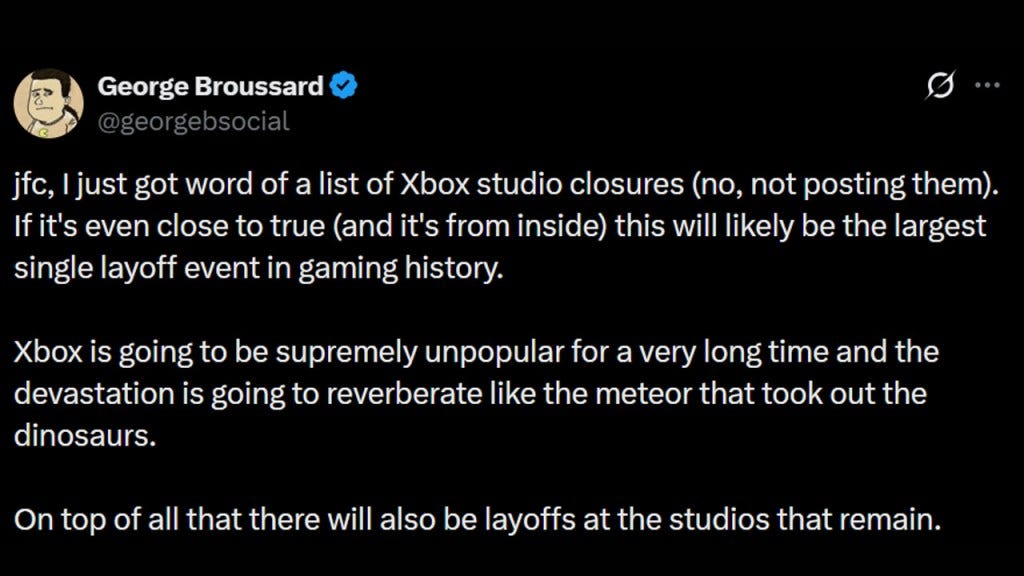
George Broussard, co-creator of Duke Nukem and a genuine industry veteran, posted on X that he’d seen a list of Xbox studio closures and that the coming cuts would “likely be the largest single layoff event in gaming history.” His viral line: “Xbox is going to be supremely unpopular for a very long time and the devastation is going to reverberate like the meteor that took out the dinosaurs.” He added that even surviving studios will see layoffs.
Broussard isn’t a journalist, he’s a connected veteran speaking from claimed inside contacts, so treat the specifics as unconfirmed rumor. But his 2025 Xbox warnings broadly panned out, and this time, the company’s own boss is echoing the underlying problem.
The CEO says the quiet part out loud
This is the new bombshell, and it’s the part that should worry Xbox fans most.
On the Hard Fork podcast, Microsoft CEO Satya Nadella was unusually candid about Xbox’s finances. His words: “The challenge we have is we’ve not been monetizing [Xbox]. In fact, if anything, we’ve been subsidizing that entertainment.”
Then came the kicker, delivered with a chuckle: “In fact, there’s more monetization of Xbox games happening on YouTube than at Microsoft.” Let that sink in, the CEO is saying creators make more money off Xbox games on YouTube than Xbox does. He capped it with the mission statement driving all the cuts: “Now we have to turn this into a sustainable business.”
When the CEO of the company openly says a division has been subsidized rather than profitable, that’s not a rumor anymore. That’s the boss confirming the patient is sick, and signaling the cure is going to hurt.
Why this is happening: the Game Pass trap
Here’s the financial logic underneath the bloodbath, because it’s genuinely important.
The “Xbox Reset” memo from Xbox leadership disclosed a $500 million revenue decline over five years and a slim 3% profit margin. And the core problem is baked into Xbox’s own strategy: Game Pass.
When Xbox puts its first-party games on Game Pass on day one, subscribers play them without buying them. So even an acclaimed, heavily-played game can look “unprofitable” on its studio’s balance sheet, because the sale never happened, it got absorbed into a monthly subscription. That’s the math reportedly getting studios cut. Nadella’s “we’ve been subsidizing it” is the polite version of “this model isn’t paying for itself.”
Which studios are reportedly at risk
This is the human cost, and these are beloved teams.
Per various unconfirmed reports, several Xbox studios are said to be fighting for survival, some reportedly negotiating to buy back their independence rather than be shut down. Names that keep surfacing: Compulsion Games (South of Midnight), Undead Labs (State of Decay 3), Double Fine (Tim Schafer’s studio), and Ninja Theory (Hellblade). Reports also point to cuts across ZeniMax (Bethesda’s parent), with mainly the Fallout and Elder Scrolls teams considered safe. None of these closures are confirmed, but the uncertainty alone is brutal for the developers living under it.
The scary historical echo: 1983
Now to the big question your gut is asking. With all these layoffs, are we watching another video game crash like 1983? Let’s look at what that actually was.
The Video Game Crash of 1983 was the closest gaming ever came to dying. Industry revenue cratered from about $3.2 billion in 1983 to just $100 million in 1985, a staggering 97% collapse. Companies folded. Atari alone lost over $500 million and famously buried millions of unsold cartridges (including the rushed-out E.T.) in a New Mexico desert.
What caused it? A few things that rhyme uncomfortably with today: the market was oversaturated with consoles and games, quality control collapsed as publishers flooded shelves with rushed junk, consumers lost trust, and cheaper PCs pulled players away. The industry was declared dead, until Nintendo revived it in 1985 with the NES and strict quality control.
So… is this another crash?
Here’s the honest answer, and it’s reassuring but not entirely comforting.
Most experts say no, this isn’t a 1983-style crash, at least not yet. And the reason is specific: a real crash means a collapse in demand, people stop buying games. That’s not happening. The industry pulled in over $200 billion recently; people are playing and buying more than ever. Academic researchers studying the current layoffs explicitly call it a “supply-side” crisis, a brutal industry contraction and correction, not a demand collapse. Modern gaming’s diversification (mobile, PC, indie, multiple platforms) makes a 97% wipeout almost impossible.
But here’s the uncomfortable part. The causes of 1983 do echo today: bloated budgets, a flood of live-service clones chasing the same trends, oversaturation, and over-expansion (Microsoft buying tons of studios it’s now cutting). The thing dying isn’t gaming, it’s a particular bubble, the era of infinite money, endless studio acquisitions, and unsustainable spending. It’s less “the industry is collapsing” and more “the industry is having a painful, overdue correction that’s costing thousands of people their jobs.”
The perfect storm
And this is where it all converges into something genuinely rough.
The layoffs aren’t happening in a vacuum, they’re hitting at the exact moment several other crises are piling on:
Console prices are skyrocketing. A leaked report pegged the upcoming PS6 at potentially over $1,000, and Xbox and PlayStation have both already raised prices.
RAM prices are exploding. A “memory cartel” lawsuit alleges the three big manufacturers inflated RAM prices by up to 700%, driving up the cost of every PC, GPU, and console.
The layoffs keep coming. Over 10,000 gaming jobs were cut in 2023 and 8,000+ in 2024, with the trend rolling into 2026.
So you’ve got studios closing, hardware getting unaffordable, components in a price crisis, and a CEO admitting the whole division loses money, all at once. That’s not a single meteor. That’s a perfect storm: rising costs, shrinking margins, and a business model that stopped adding up, all landing together.
The bottom line
Here’s the honest read of where things stand.
Is this the literal “end of Xbox”? No, that’s the dramatic framing. Microsoft isn’t going anywhere, it owns Call of Duty, Minecraft, and Fallout, and Game Pass survives. What’s ending is the strategy, the era of bottomless spending and studio hoarding, now that the CEO has confirmed it was never paying for itself.
Is it another 1983 crash? Also no, demand is strong and the industry is far too big and diversified to collapse 97%. But is it a real, painful reckoning, the bursting of a bubble, made worse by a perfect storm of price hikes and a broken model? Absolutely, and that’s bad enough. Thousands of talented developers are paying the price for years of unsustainable corporate bets.
The dinosaurs didn’t see their meteor coming. This time, everyone can see the storm rolling in, the layoffs, the prices, the CEO quietly admitting the math never worked. Gaming will survive it, it always does. But the version of the industry that comes out the other side is going to look very different, and a lot of good people won’t be along for the ride. That’s the real tragedy under all the meteor talk.
Want More Clownfish TV?
This article was brought to you in part by The Reefers of more.clownfishtv.com. Free subscribers get articles like this one in their inbox. Paid subscribers get the full Clownfish TV podcast feed, livestreams, and members-only episodes that never hit YouTube.
D/REZZED is part of Clownfish TV. For more news, views, and rants on gaming, tech, and pop culture, watch @ClownfishTV on YouTube and find the podcast on Apple Podcasts, Spotify, and iHeart.
Article compiled and edited by Derek Gibbs (entertainment editor) and the Clownfish TV newsroom.
Hat Tips:
Satya Nadella on the Hard Fork podcast, via GeekWire and Massively Overpowered (June 2026), verified for the “we’ve been subsidizing that entertainment” and “more monetization of Xbox games happening on YouTube than at Microsoft” quotes, and the “turn this into a sustainable business” framing
George Broussard via Push Square and Wolf’s Gaming Blog (June 30, 2026), verified for the “largest single layoff event in gaming history” and “meteor that took out the dinosaurs” quotes, and the connected-veteran-not-journalist sourcing context
Wikipedia and the National Videogame Museum (2026), verified for the 1983 crash facts (the $3.2B-to-$100M / 97% revenue collapse, the oversaturation and quality-control causes, the E.T. burial, Atari’s $500M+ losses, and the NES revival)
ACM “From the Atari Shock to a Modern Crisis” study and Game Rant (2024-2025), verified for the supply-side-crisis-not-demand-crash framing, the 10,000+ (2023) and 8,000+ (2024) layoff figures, the diversification-prevents-collapse analysis, and the $200B+ industry revenue
Prior reporting (this outlet) (June 2026), for the PS6 over-$1,000 leak, the RAM-cartel lawsuit and 700% price-spike allegation, and the Xbox Reset memo’s $500M/3% figures