

Japan asked why a happy-family McDonald’s ad caused a Western meltdown
In May 2026, a Japanese woman named Tsumugi tweeted a 2023 McDonald’s Japan anime ad and asked her overseas followers why it had caused a controversy in the West. Her post drew over 20 million views.
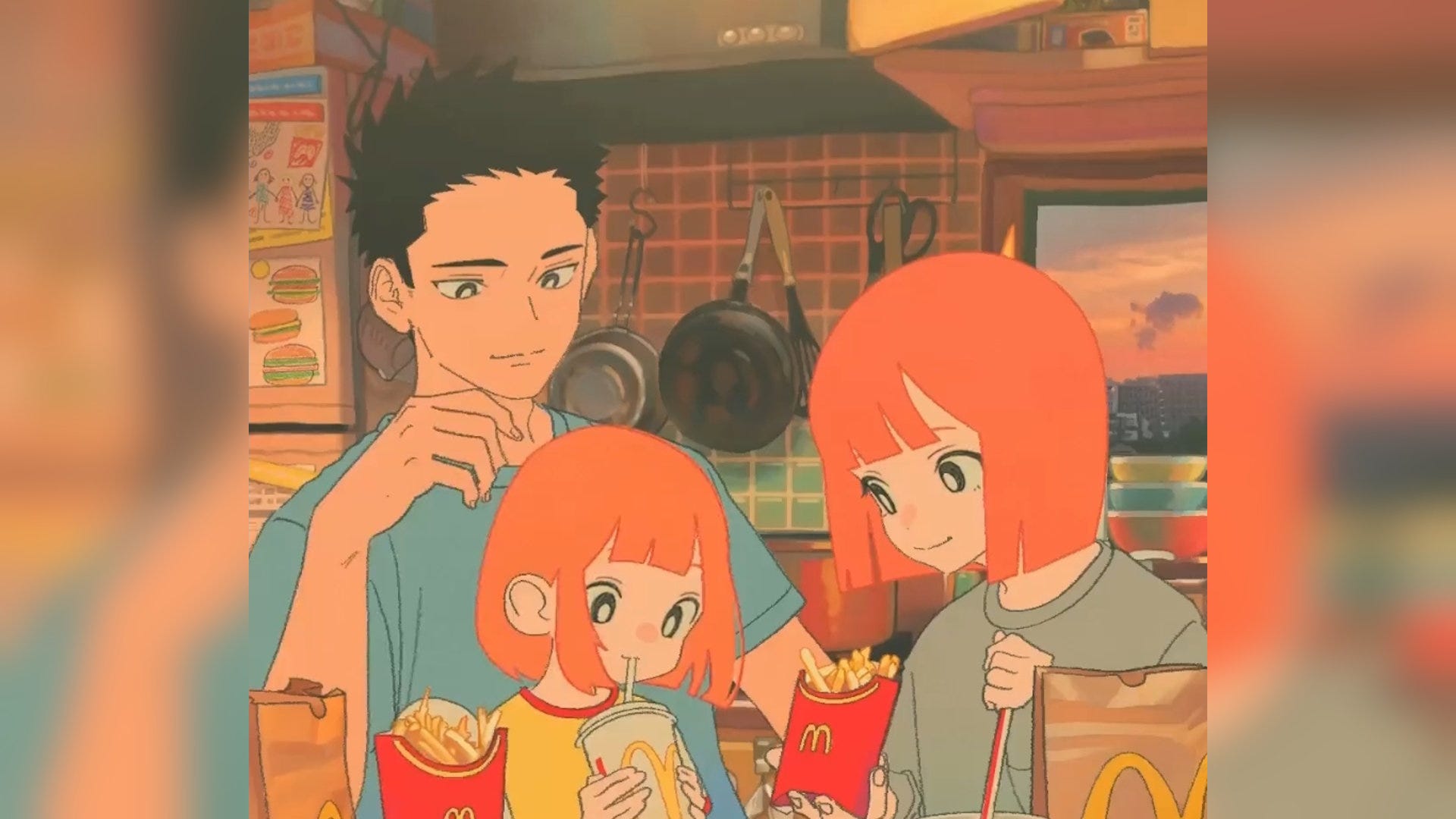
In late May 2026, a Japanese woman named Tsumugi posted a 2023 McDonald’s Japan anime commercial to her X account and asked, in genuine confusion, why this ad had caused such a fight in the West when it dropped two years earlier.
The ad runs 21 seconds. It shows a mom, a dad, and their young anime-style daughter sharing a meal of chicken nuggets and french fries together at home. The little girl sits on her father’s lap. The mom sweetly feeds her a fry. Nostalgic Japanese music called “Akatombo“ (which means “Red Dragonfly”) plays in the background. They smile. They eat. The end.
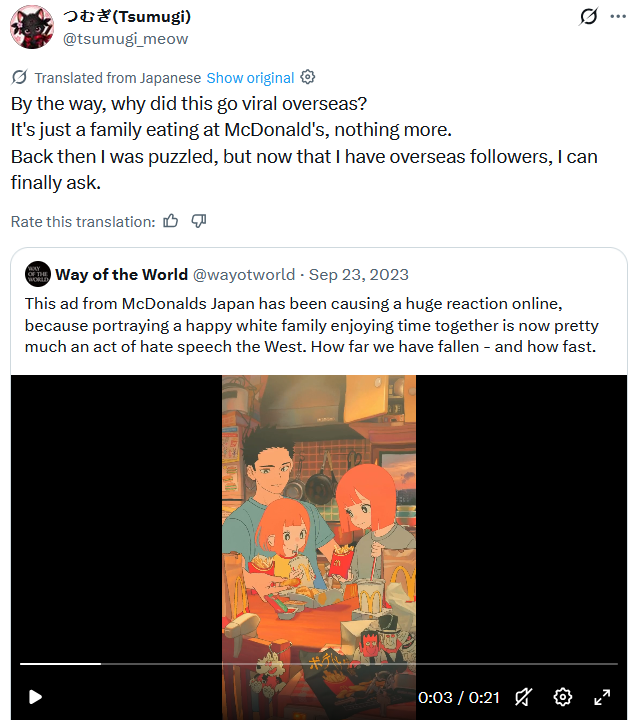
“By the way, why did this go viral overseas?“ Tsumugi wrote in Japanese. “It’s just a normal family eating at McDonald’s. I found it strange back then, but now that I have overseas followers I can ask.“
Her post went viral. Over 20 million views. 52,900 likes. 2,203 replies before she had to turn them off because she could not keep up.
The replies were a window into something larger than Tsumugi expected. They were a window into what the Western internet had become.
The original 2023 controversy
To understand why Tsumugi was confused, you have to understand what happened the first time.
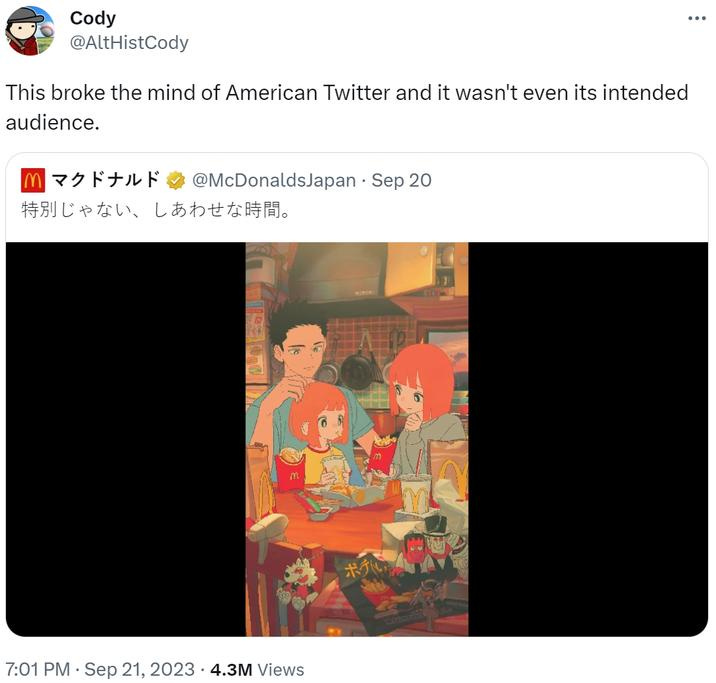
McDonald’s Japan released the 21-second commercial on September 20, 2023 as part of a broader campaign celebrating the everyday Japanese family. The animated, wholesome, completely unremarkable family meal scene was the centerpiece.
In Japan, it was just an ad. In the West, it became a culture-war flashpoint within 48 hours. By the end of the week, the clip had pulled over 70 million impressions on American Twitter alone.
User @AltHistCody summed up the moment in a now-iconic September 2023 post: “This broke the mind of American Twitter, and it wasn’t even its intended audience.“
A British political commentator posting under the handle @wayotworld quoted the ad on September 23, 2023, and wrote: “This ad from McDonalds Japan has been causing a huge reaction online, because portraying a happy white family enjoying time together is now pretty much an act of hate speech the West. How far we have fallen, and how fast.“
That post got 17,408 likes, 1,624 reposts, and 28 million views.
User @Bolverk15 joked: “Billions will be born.“
User @dyingscribe wrote, in a reply that got widely shared: “I swear to god, the flip that switched in me that made me want a daughter is crazy.“
What followed was less of a debate and more of a chain reaction.
Right-leaning accounts amplified the framing that the ad was being attacked in the West for showing a “normal” family without diversity boxes checked.
Left-leaning accounts attacked the right-leaning accounts for celebrating an “all-white” anime family.
Anti-anti-woke accounts attacked the anti-woke accounts for treating Japan as a conservative paradise.
Anti-anti-anti-woke accounts attacked the anti-anti-woke accounts for missing the point.
Almost nobody was talking about the actual hamburgers.
McDonald’s Japan was running an actual campaign
The animated family ad was not a one-off. It was part of a broader McDonald’s Japan marketing campaign celebrating the everyday Japanese family. After the family ad went viral, McDonald’s Japan dropped a follow-up animated spot featuring three young boys eating together at a McDonald’s. That one also went viral on American Twitter for many of the same reasons.
The pattern was deliberate. McDonald’s Japan understood that wholesome, family-focused, slice-of-life advertising worked in Japan because it was true to how their customers actually ate at McDonald’s. They were not making a political statement. They were selling chicken nuggets to families.
The campaign continued through 2024 and 2025 with additional animated spots showing parents and kids, friends meeting up after school, and similar family-and-friends moments.
None of them caused the same scale of Western controversy as the original September 2023 ad, but the brand voice stayed consistent. McDonald’s Japan kept making the kind of ads McDonald’s Japan had always made.
What the ad’s critics actually said in 2023
The honest version of the 2023 backlash is more nuanced than either side claimed.
The most direct accusations against the ad itself, that it was “creepy,” that it lacked diversity, that it was “not inclusive enough,” that the family was suspiciously “too white” for a Japanese commercial, did exist. But they were thinner on the ground than the viral framing suggested. Most of the heat came from the meta-argument, not the original critique.
What did exist consistently was the broader sentiment that the right-wing celebration of the ad was suspicious. As one user put it in 2023: “Why are there so many bigots and literal Nazis on this cute little McDonald’s ad? All the homophobic right-wingers who treat Japan like some conservative utopia are coming out of the woodwork.“
The original ad’s defenders saw the response as confirmation of everything they had been saying about Western media for years. The original ad’s critics saw the celebration as a thin cover for racial nostalgia. Both sides walked away convinced the other side had proven them right.
McDonald’s Japan, for its part, kept selling hamburgers. The company never publicly addressed the Western controversy.
The contrast that made the 2023 fight make sense
The clearest explanation for why the McDonald’s Japan ad caused such a reaction came not from the ad itself but from what American McDonald’s had been doing in the same period.
In 2020, during the height of the post-George-Floyd cultural moment, McDonald’s USA’s official social media accounts posted a video featuring a transgender person with the on-screen text: “Black trans women have a very simple message: stop killing us.“
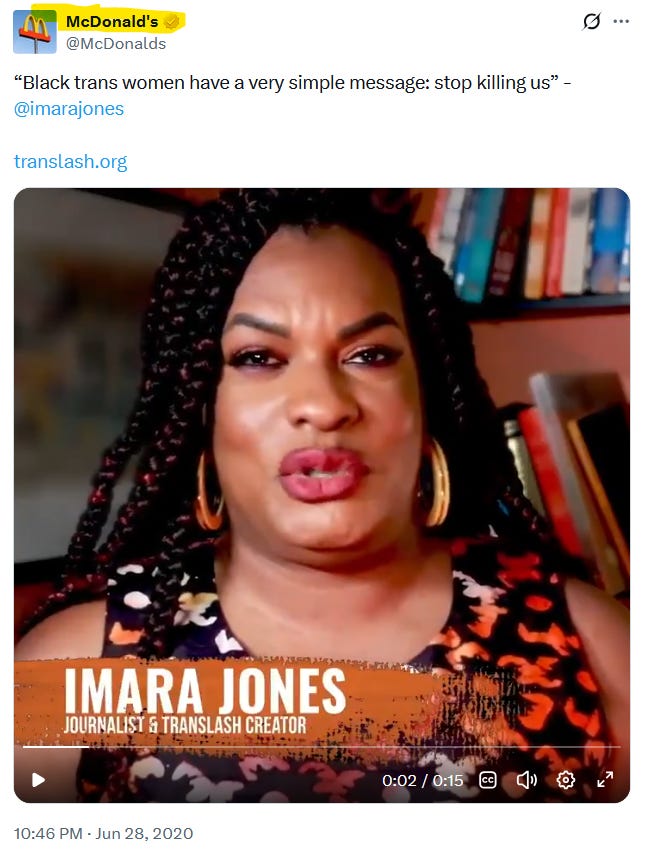
The 2020 American McDonald’s post was a deliberate corporate political statement. The 2023 Japanese McDonald’s ad was a 21-second cartoon about a family eating fries. Both ads came from the same global hamburger company. They could not have been more different in tone, intent, or content.
For Americans on the political right, the contrast was the whole story. The same company that had run explicit political content in the United States had returned to making simple, wholesome, apolitical advertising in Japan. They saw the gap as confirmation that American corporate advertising had been captured by political messaging that the Japanese market had been spared.
For Americans on the political left, the contrast was beside the point. The 2020 ad was about violence against trans people. The 2023 ad was about a family. Comparing them missed the moral weight of the 2020 statement.
The 2023 controversy happened because the same artifact, the simple family ad, was being viewed through two completely incompatible cultural lenses at the same time.
What Tsumugi got back when she asked
Two years later, when Tsumugi asked her overseas followers to explain what had happened, the answers were remarkably consistent.
“Our ads in America are so loud, abrasive, and quite frankly degenerate, that seeing a happy family having a meal together caused a scene,“ wrote user @EmperorZetta. That reply got 3,255 likes.
“Nostalgia for a time before everything was a political message,“ wrote @jman666054. “Before it was deemed to be unacceptable to just be yourself. It went viral because it’s just a happy family.“
“Families are demonized in the west,“ wrote @PnishdMythMason. “You’d never get an ad like this in the west.“
“I’m gonna be real here, if ads in my country (Australia) were anything like Japan’s ads, I’d actually find some joy in watching them,“ wrote @dantesleg. “Japanese ads are great I love them, but there are some online that ruin everything by making it political or some form of social issue.“
“Because our McDonald’s ads are just bizarre and not something anyone can relate to at all, frequently not even talking about any food whatsoever,“ wrote @PulpoNewman. “Your McDonald’s ads show a regular family, something incomprehensible to American corporate advertisers.“
The most compressed version came from user @AllbonesJones:
“It was just an ordinary glass of water, why did these people trapped in the desert care so much about it?“
A Japanese reply summed up the sentiment from inside Japan. User @Riala39 wrote, in Japanese: “The era has come where what used to be normal and obvious gets attacked.“
Tsumugi posted a follow-up thanking everyone and apologizing for not being able to reply to all the messages. “There are so many replies I can’t keep up,“ she wrote. “I never expected this much reaction.“
What this says about Western advertising
The honest answer to Tsumugi’s question is that most Western corporate advertising in the 2020s has shifted away from the kind of wholesome, simple, family-focused commercial that the McDonald’s Japan campaign represents.
American McDonald’s commercials in 2023 and beyond have leaned into celebrity tie-ins, regional partnerships, viral menu hacks, and what executives call “cultural moments.” Almost none of them depict a typical family eating together. The genre simply has not been a major part of the American McDonald’s marketing playbook for almost a decade.
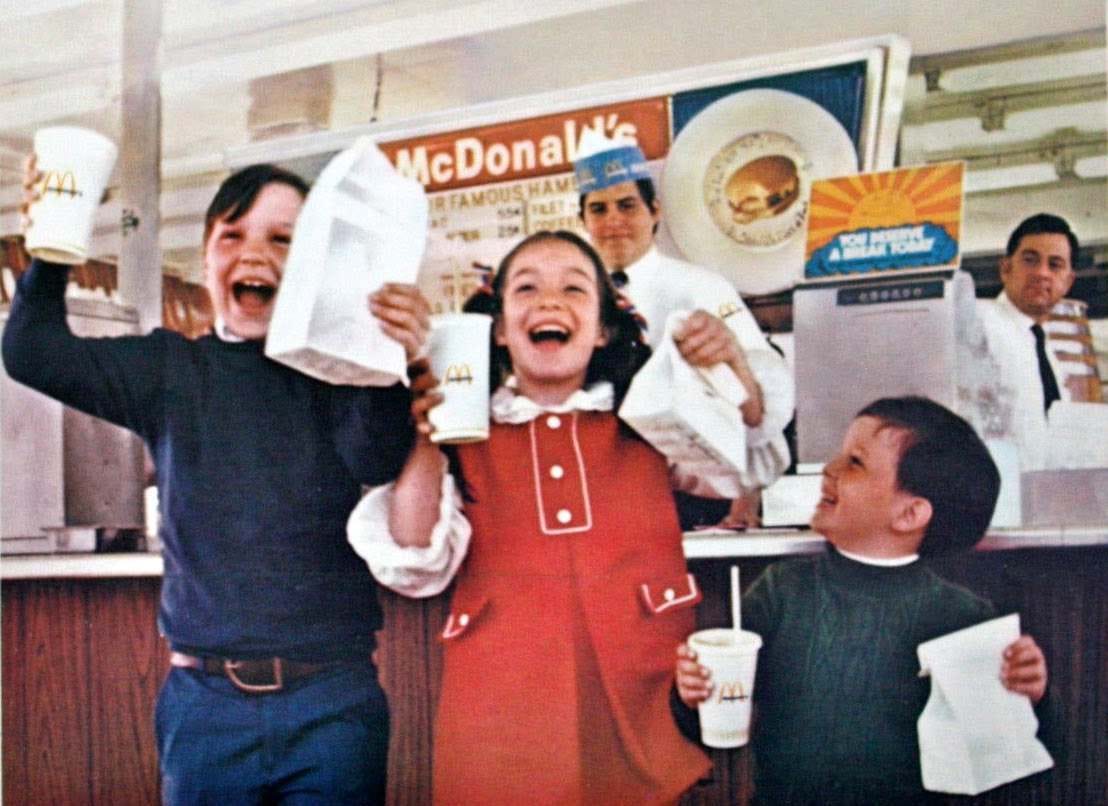
The same shift has happened across most major Western consumer brands. Family-focused advertising still exists, particularly during holidays, but it usually now includes explicit signaling about modern family structures, diversity, or specific cultural messages.
The simple, wholesome, unremarkable family meal commercial that was standard in American advertising for 50 years has become rare enough that when it shows up in Japanese advertising, it reads to Western audiences as either a relief or a provocation, depending on which side of the culture-war fence the viewer is sitting on.
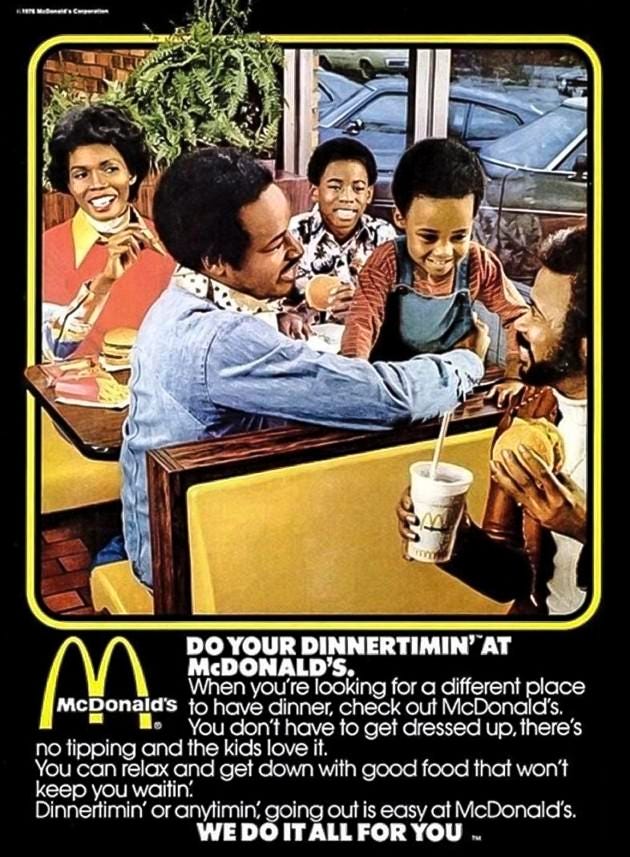
That is not a story about McDonald’s. It is a story about what happens when the cultural ground shifts under an entire genre of advertising, and the gap between what was once normal and what is currently acceptable becomes wide enough to drive culture-war fights every time the old normal pops back up.
The bigger picture
The reason Tsumugi’s question landed so hard in 2026 is that it came from outside the Western argument entirely.
Western internet users have been having this fight with each other for years. Each side knows the other side’s positions. Each side knows the other side’s debate moves. The argument has hardened into a script.
Tsumugi is a regular Japanese woman who loves cats and wanted to make overseas friends. She saw an old ad, remembered it had caused trouble in the West, and asked, in good faith, what the trouble had been about.
The answers she got back were the most honest version of the conversation that either side has produced in years, precisely because they were addressed to someone who was not already in the fight. The defenders of the ad did not have to argue with anti-woke accounts. The critics of the ad did not have to argue with right-wing accounts. Everyone was just trying to explain to a confused Japanese woman why her perfectly normal ad had caused a fight 7,000 miles away.
The explanation kept coming back to the same thing. In the West, in 2023, an ad showing a wholesome family eating together was no longer culturally neutral. It had become a political statement, whether the company that made it intended one or not.
McDonald’s Japan was not trying to make a political statement. McDonald’s Japan was trying to sell hamburgers to families.
Tsumugi understood that immediately. The Western internet had to be reminded.
Article compiled and edited by Derek Gibbs (entertainment editor) and the Clownfish TV newsroom.
Watch Clownfish TV on YouTube at @ClownfishTV where new episodes drop daily. Subscribe to the Clownfish TV podcast on Apple Podcasts, Spotify, iHeart, and wherever else you get your podcasts. Sign up for the free newsletter at more.clownfishtv.com.
Hat Tips:
X / Twitter (May 23, 2026), verified primary post from @tsumugi_meow including the 20+ million views, 52,900 likes, 2,203 replies, and follow-up acknowledgment of Clownfish TV coverage
X / Twitter (May 23, 2026), verified reply quotes from @EmperorZetta, @jman666054, @PnishdMythMason, @dantesleg, @PulpoNewman, @AllbonesJones, @DarkeyeDruid, @GoodwoodAlpha, and @Riala39 capturing the spectrum of overseas explanations
X / Twitter (September 2023), verified original posts and quotes from @wayotworld, @AltHistCody, @dyingscribe, @Bolverk15, @lizcourserants, @Valentine414RB, @YellowFlashGuy, @thatstarwarsgrl, and others documenting the original 2023 McDonald’s Japan ad controversy
Evie Magazine (September 22, 2023), Nicole Dominique’s verified reporting on the 21-second runtime, the September 20, 2023 release date, the visual scene details, the 70 million American Twitter impressions, and the follow-up three-boys ad
McDonald’s Japan, original September 2023 commercial release including the “Akatombo” musical accompaniment and the broader family-focused campaign
McDonald’s USA, verified 2020 social media post regarding Black trans women, used here as comparative context
Clownfish TV “Japan CONFUSED” YouTube coverage of the Tsumugi viral post
Verified archival coverage of the September 2023 right-leaning vs. left-leaning Twitter framing of the original ad