

If you have a sense that McDonald’s got way more expensive over the past few years, you are not wrong. The numbers are worse than most people remember.
A McChicken that cost about $1.29 in 2019 now sells for around $3.89 at the average U.S. location, according to data from TheStreet that pulled archived menu pages. That is a 201% increase in five years.
A medium order of fries went from $1.79 to $4.19 in the same period, a 134% jump.
The famous Big Mac, depending on which dataset you trust, rose from $3.99 to between $5.29 and $7.49 at average U.S. locations, an increase between 21% and 87%.
The U.S. inflation rate over the same five years was roughly 21%.
McDonald’s prices did not just keep up with inflation. They lapped it.
The pandemic broke the pricing model
For decades, McDonald’s was the most reliable cheap meal in America. A burger, fries, and a drink for under $5. The Dollar Menu launched in 2002. The McChicken was a buck. The McDouble was around a dollar. The whole business model was built on the promise that hungry people on a budget had somewhere to go.
That model started cracking during the pandemic.
Between 2019 and 2024, McDonald’s says the average price of items across its U.S. menu rose 40%. The company has blamed the increase on rising labor costs, paper and packaging costs, and food supply chain pressures, all of which spiked sharply in 2020 and 2021 and have not fully come back down.
That 40% increase is twice the rate of overall U.S. inflation in the same period. Even the McDonald’s-friendly numbers showed the chain getting expensive faster than the rest of the economy.
Franchisees absorbed some of the increases. But 95% of U.S. McDonald’s locations are owned by independent franchise operators who set their own prices, and most of them passed the costs to customers.
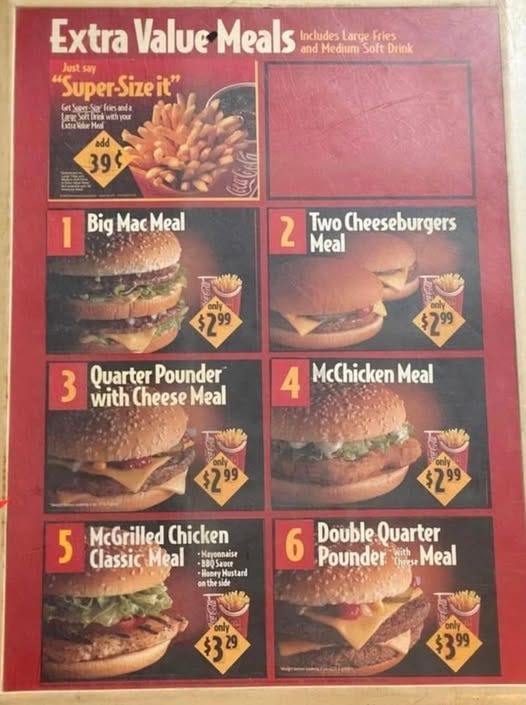
By 2022, the gap between what customers remembered McDonald’s costing and what it actually cost had become a full-blown internet phenomenon. People started posting screenshots of receipts. A Boise, Idaho Quarter Pounder meal that cost $16.10 went viral. A Connecticut Big Mac meal that hit $18 in 2023 broke containment and ended up on cable news.
McDonald’s tried to defend the math
In May 2024, the price story had gotten bad enough that McDonald’s U.S. President Joe Erlinger published a public letter pushing back against viral claims that prices had doubled.
“The average price of a Big Mac in the U.S. was $4.39 in 2019,” Erlinger wrote. “Despite a global pandemic and historic rises in supply chain costs, wages and other inflationary pressures in the years that followed, the average cost is now $5.29. That’s an increase of 21%, not 100%.”
The letter was technically accurate. It also conceded that some menu items had increased far more than the Big Mac. Medium fries had jumped 44% by McDonald’s own data, from $2.29 to $3.29. McNuggets meals had climbed 28%. Average menu prices were up 40% overall.
The defense did not really work. Customers had stopped caring about the corporate math. They cared about what their wallet did at the register.
The customers stopped showing up
The clearest sign that McDonald’s had pushed prices too far came in the financial data.
In Q1 2025, McDonald’s reported that U.S. comparable store sales dropped 3.6% year over year. Global sales declined 1%. CEO Chris Kempczinski told analysts on the earnings call that traffic from low-income customers at quick-service restaurants industry-wide had fallen “nearly double digits” compared to the same quarter the year before.
In plain English, the people who used to eat at McDonald’s because it was cheap had started eating somewhere else, or at home.
McDonald’s CFO Ian Borden said on the same call that the company would be “prudent and thoughtful” about any further price increases for the rest of 2024.
That was the moment the recovery plan started.
The $5 Meal Deal was Phase One
In June 2024, McDonald’s launched a limited-time $5 Meal Deal. The offer included a McDouble or McChicken, small fries, four-piece McNuggets, and a small drink. The whole thing for $5, the kind of price most customers had not seen in a decade.
It was a hit. The company extended the deal through the rest of 2024, then through 2025, and most recently through summer 2026.
The McValue platform was Phase Two
On January 7, 2025, McDonald’s launched a permanent budget menu called McValue. It included the $5 Meal Deal as an anchor, plus a “Buy One, Add One for $1“ offer that let customers add a second item for a dollar when they bought any qualifying full-price item.
The McValue platform drove a 2.4% same-store sales increase by Q3 2025, according to company data. Customers came back. The math started working again.
Phase Three landed in April 2026
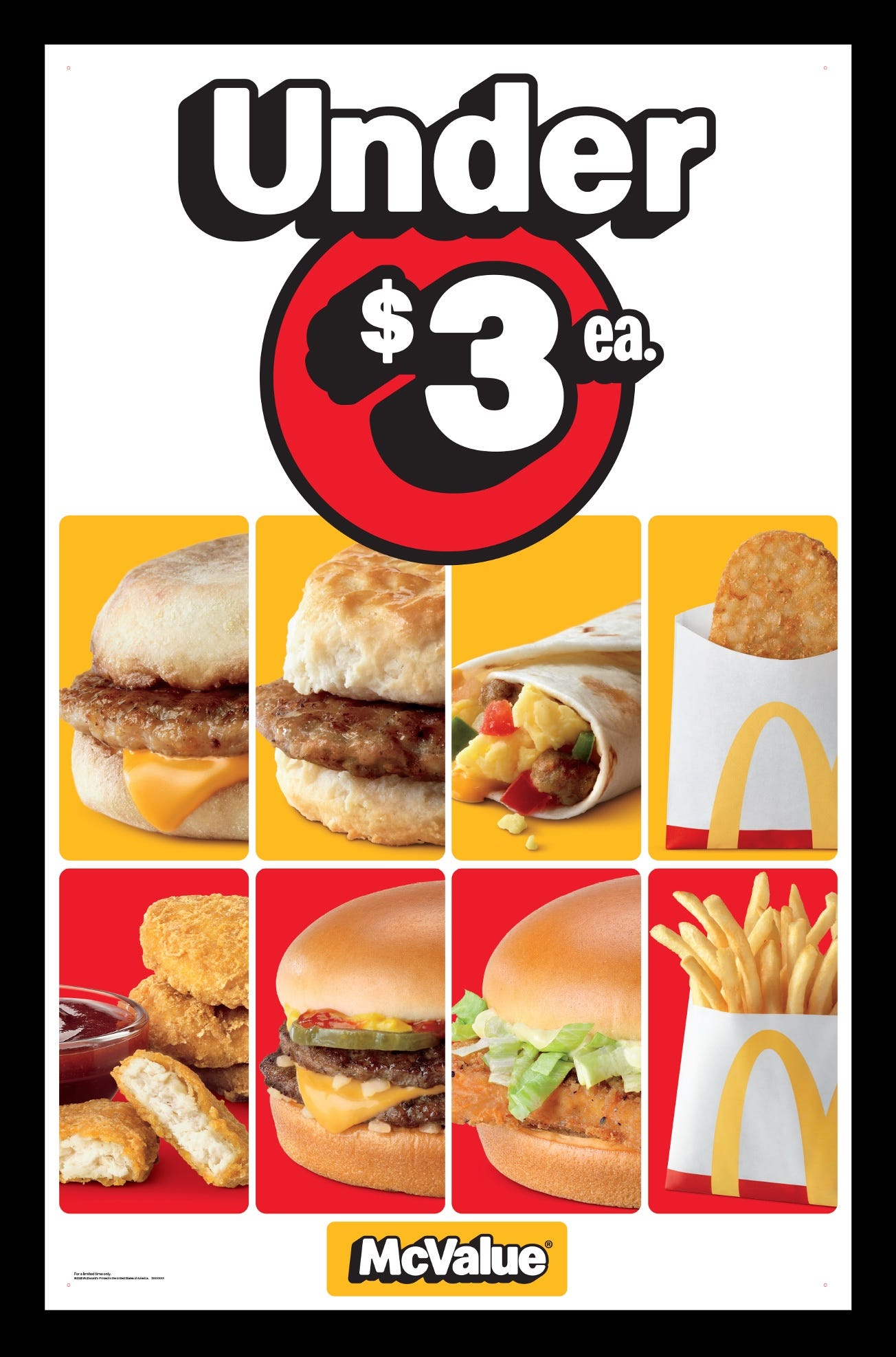
On April 21, 2026, McDonald’s expanded McValue with two more anchors. A standardized nationwide Under $3 Menu with ten items, including breakfast options like the Sausage McMuffin and lunch options like the McDouble. Plus a $4 Breakfast Meal Deal.
For the first time in years, McDonald’s is leading its national marketing with the promise of food under $3. Some of those items already cost less than $3 in some parts of the U.S., but standardizing it nationally is a strategic shift.
Alyssa Buetikofer, McDonald’s USA Chief Marketing Officer, framed the change in the launch announcement. “Value at McDonald’s isn’t a moment. It’s a journey we’ve been building together over time.”
In the language of corporate marketing, that translates to: we know we got too expensive, and we are fixing it.
The pattern is bigger than McDonald’s
The price story is not just a McDonald’s story.
Popeyes, Chipotle, Taco Bell, and Jimmy John’s all raised prices in 2025 at more than double the national rate of inflation, according to industry analysis. Most of them are now rolling out value menus and bundled deals to win back customers, following the McDonald’s playbook in reverse.
Wendy’s, Starbucks, Target, Walgreens, Walmart, and Amazon have all announced price cuts on thousands of items in the past year, each one driven by the same realization. Customers reached their breaking point. Sales suffered. The fix is to bring the prices back down.
McDonald’s is the most visible example because the chain is the most visible. The Big Mac is the unit of measurement that economists use to compare prices across countries. The McChicken is the cheap-meal benchmark for millions of Americans. When McDonald’s gets expensive, everyone notices.
What it cost then vs. what it costs now
For the casual reader, the receipts are the clearest version of the story.
A 2018 McChicken cost about $1.00. The 2025 McChicken averages around $3.10. That is the same sandwich, served the same way, in the same restaurant chain, more than three times more expensive in seven years.
A 2014 McDouble cost about $1.19. The 2026 McDouble averages around $4.59. Almost four times the original price.
A 2019 Big Mac Meal cost $7.29. The 2026 Big Mac Meal averages $9.29 by McDonald’s own count, and $10.49 in many urban markets per recent Reddit screenshots.
McDonald’s says these numbers reflect inflation, labor costs, and supply chain pressures. The customers say their grocery bills have not tripled in seven years, and they have stopped going.
The math will sort itself out one way or the other. The McValue menu and the $3 anchor menu are McDonald’s making a serious bet that the customers will come back if the prices come back. Whether that bet pays off is what the next four quarters of earnings calls will tell us.
For now, if you want to feel old, remember that the McChicken used to cost a dollar. And if you want to feel younger, the $5 Meal Deal exists specifically so you can buy one again.
Article compiled and edited by Derek Gibbs (entertainment editor) and the Clownfish TV newsroom.
Clownfish TV is your source for news, views, and rants on gaming, tech, and pop culture. Watch the show on YouTube at @ClownfishTV where new episodes drop daily. Subscribe to the Clownfish TV podcast on Apple Podcasts, Spotify, iHeart, and wherever else you get your podcasts. Sign up for the free newsletter at more.clownfishtv.com.
Hat Tips:
McDonald’s Corporate (May 29, 2024), Joe Erlinger’s verified “Pricing Myths vs Facts” public letter and the official 2019-2024 price comparison data
CNN Business (May 29 and June 25, 2024), reporting on the $18 Big Mac viral moment, Erlinger’s letter, and the CEO Kempczinski earnings call comments
Newsweek and TheStreet (May 30, 2024), verified TheStreet analysis showing McChicken at $1.29 to $3.89 (201% increase), medium fries $1.79 to $4.19 (134% increase), and Big Mac $3.99 to $7.49 (87.7% increase)
The Takeout and AOL (December 2025), updated 2025 McChicken ($3.10) and McDouble ($4.59) pricing data and inflation comparison
The Washington Post (May 2025), Big Mac 21% increase analysis and franchisee pricing context
Bureau of Labor Statistics and Washington Times reporting on food-away-from-home inflation rates: 7% (2023), 4% (2024), 3.8% (2025)
McDonald’s Q1 2025 earnings release and TheStreet (February 2026), verified 3.6% U.S. comparable store sales decline and low-income traffic data
Good Morning America and McDonald’s Corporate (November 2024), $5 Meal Deal extension and McValue platform launch announcement
McDonald’s Corporate (April 2, 2026), Under $3 Menu and $4 Breakfast Meal Deal launch announcement and Alyssa Buetikofer verified quote
Fox Business (January and April 2026), McValue platform 2.4% same-store sales increase and Entrepreneur Franchise 500 ranking
Reader’s Digest and Washington Times (April 2026), additional McValue rollout details
EatThis (May 2024), Big Mac Index historical pricing data including 2013 ($4.18) and 2019 ($4.71) reference points