

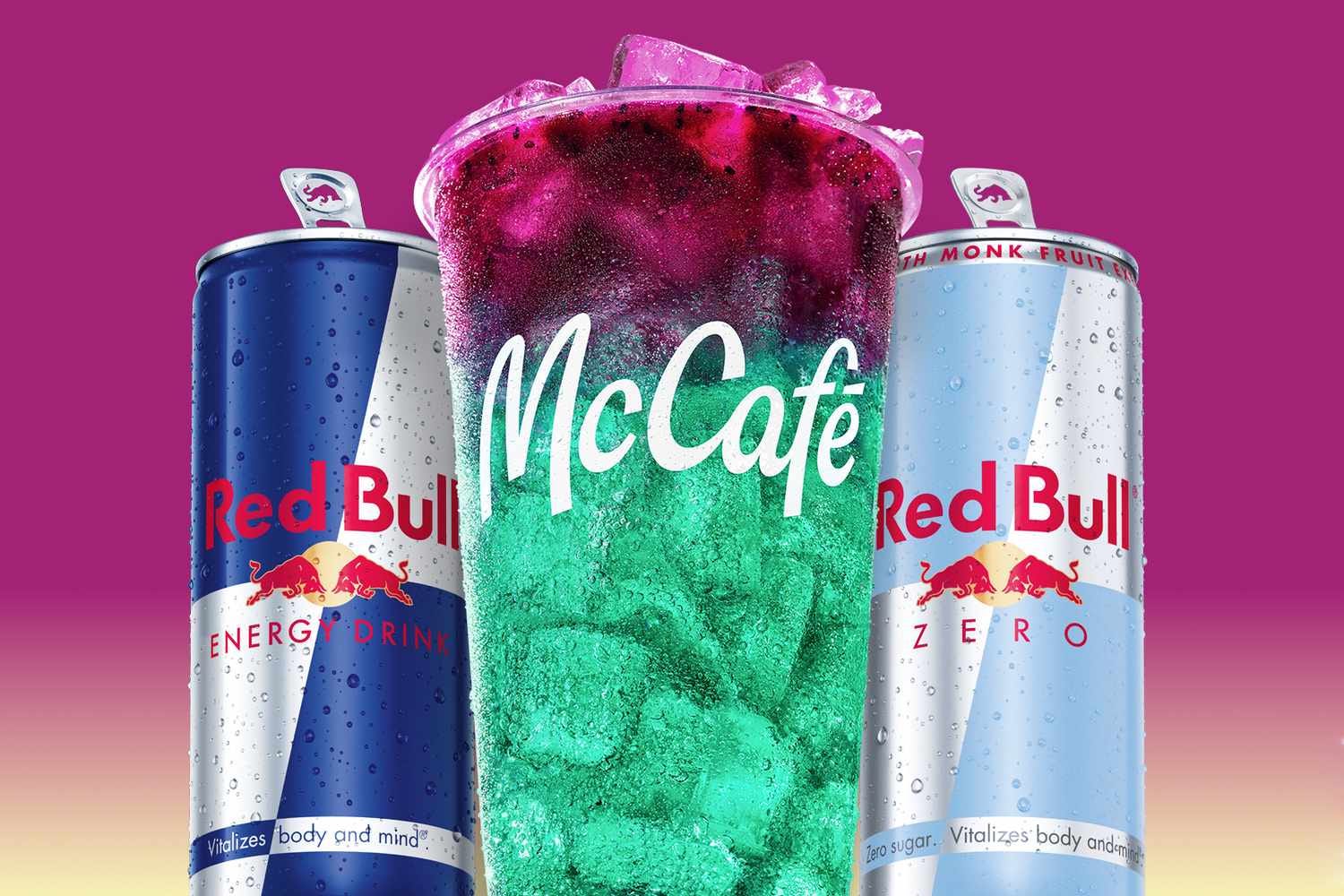
The Red Bull Dragonberry Energizer went nationwide August 17, marking McDonald’s entry into energy drinks and Red Bull’s first move into fast food. It arrives as the chain works to pull customers back after a soft quarter.
McDonald’s is selling energy drinks for the first time.
The Red Bull Dragonberry Energizer launched nationwide on August 17, combining Red Bull’s base flavor with blue raspberry syrup and freeze-dried dragonfruit. Customers can swap in Red Bull Zero for a reduced-sugar version, and participating locations now sell plain 8.4-ounce cans as well.
It’s a first for both companies. McDonald’s has never carried an energy drink, and Red Bull has never been on a fast food menu.
What else is on the drinks menu
The Red Bull launch came bundled with a broader beverage push.
New arrivals include the Vanilla Swirl, pairing vanilla with a choice of Coca-Cola, Diet Coke, or Coke Zero Sugar under a layer of cold foam, plus Orange Dream with Fanta. Reduced-sugar crafted sodas featuring Diet Dr Pepper, Dr Pepper Zero Sugar, and Sprite Zero Sugar are rolling out where available.
That follows the crafted sodas and Refreshers lines the chain introduced earlier, which company leadership credits with driving the expansion.
Why McDonald’s is doing this now
The business context is the more interesting part of the announcement.
McDonald’s US business posted slower-than-expected sales growth in the second quarter, after a value-deal push that did not deliver the traffic the company wanted. Beverages are a logical response, since drinks carry strong margins and give people a reason to stop in outside meal times.
Chief Marketing and Customer Experience Officer Alyssa Buetikofer pointed to the crafted sodas and Refreshers as evidence of demand, saying customers had responded well to the Dragonberry Energizer in US testing. She ended her statement with a line worth noting: “And we’re just getting started.”
The energy drink category has been one of the few reliably growing corners of beverages, dominated by convenience stores and grocery. A chain with roughly 13,500 US locations entering it is a meaningful move into that market.
The caffeine question
Worth stating accurately, because energy drinks in fast food raise it immediately.
The Dragonberry Energizer contains 80 mg of caffeine, which McDonald’s compares to a cup of instant coffee. That is well below a standard 8.4-ounce Red Bull’s typical level and considerably below a large coffee.
The FDA identifies roughly 400 mg per day as a generally safe ceiling for adults, while noting that sensitivity varies. Pediatric health groups have long advised against energy drinks for children, a position that applies regardless of where the drink is sold, and putting one on a menu built around family visits is what makes the question worth raising.
At 80 mg, this is a modest amount of caffeine in a brightly colored drink. Whether that reassures anyone depends on how much the branding matters relative to the milligrams.
Article compiled and edited by Derek Gibbs (entertainment editor) and the Clownfish TV newsroom.
D/REZZED is part of Clownfish TV. For more news, views, and rants on gaming, tech, and pop culture, subscribe at clownfishtv.com. Watch the show on YouTube at @ClownfishTV where new episodes drop daily. Subscribe to the Clownfish TV podcast on Apple Podcasts, Spotify, iHeart, and wherever else you get your podcasts.
Hat Tips:
McDonald’s USA press release (August 11, 2026), verified as the primary source for the August 17 nationwide launch, the drink’s composition, the Red Bull Zero substitution, the 8.4-ounce cans, Alyssa Buetikofer’s full quote, the Vanilla Swirl and Orange Dream additions, the reduced-sugar crafted sodas, and the roughly 13,500 US restaurants
Fox Business (August 2026), verified for the slower-than-expected second-quarter US sales growth, the value-deal push falling short, and the beverage expansion as a traffic-driving strategy
ABC News (August 2026), verified for the 80 mg caffeine content and McDonald’s instant-coffee comparison, the FDA’s approximately 400 mg daily guidance for adults with varying sensitivity, and pediatric concerns about energy drinks for children