

Netflix stock falls 8% because watchtime is declining
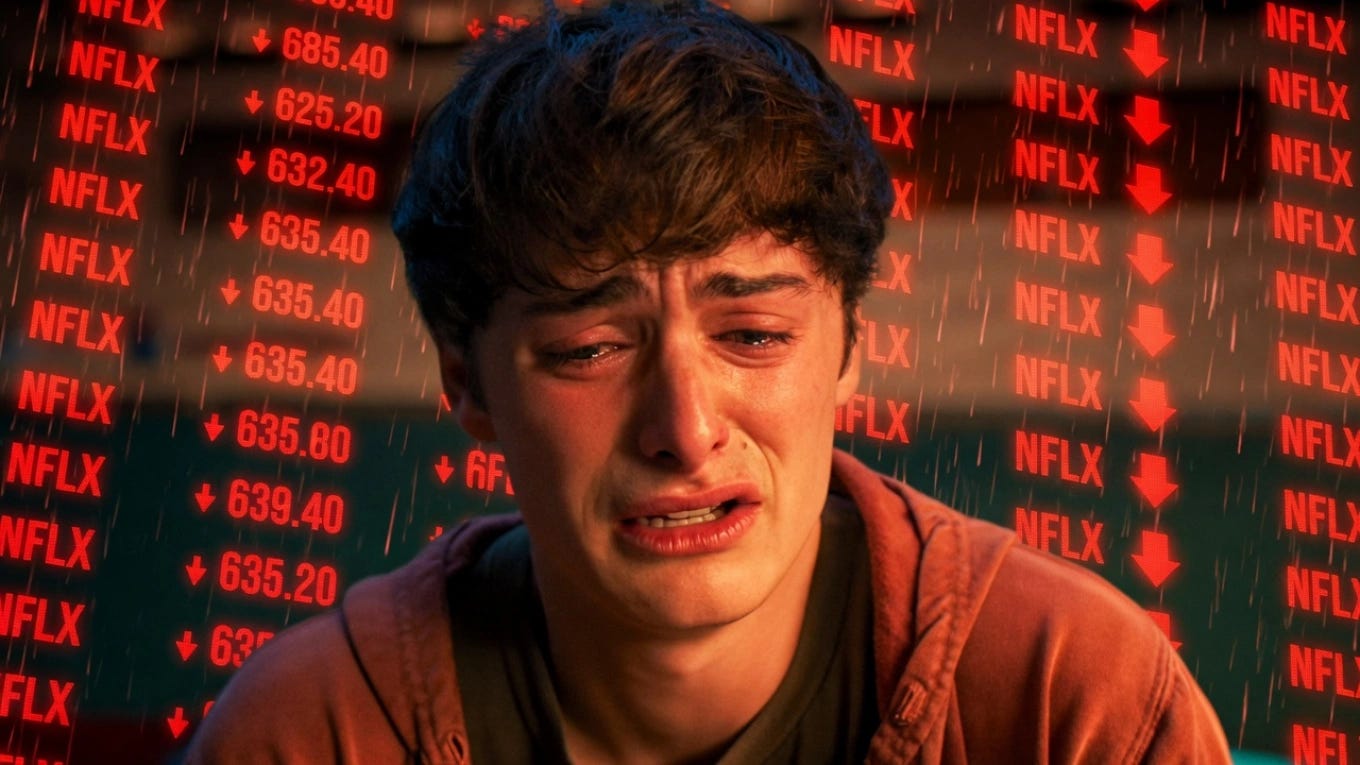
Netflix posted $12.56 billion in revenue, up 13%, and $3.4 billion in profit. Shares dropped more than 8% anyway. The problem: people are watching 97 billion hours, up just 2%. Revenue is growing six times faster than viewing, and Netflix is about to report viewing half as often.
Netflix beat on profit, came in a hair under on revenue, and watched its stock fall more than 8% in after-hours trading Thursday.
The results weren’t the problem. The gap was.
The numbers
Revenue hit $12.56 billion, up 13%, just under Wall Street’s $12.58 billion estimate. Earnings came in at 80 cents per share against a forecast of 79. Net profit was $3.4 billion. The company last reported 325 million subscribers.
Every region posted double-digit revenue growth. EMEA cleared $4 billion for the quarter. Latin America and Asia-Pacific each cleared $1.5 billion. US revenue rose 10%, and that only partially reflects March’s price increase.
Then the other number.
Engagement grew 2%
Members watched more than 97 billion hours in the first half of 2026. That’s up 2% year over year.
Revenue: up 13%. Viewing: up 2%.
Netflix is extracting six times more money growth than watching growth, through price hikes and advertising. That works. It works right up until the people paying more notice they aren’t watching more.
Wall Street noticed first.
“All hours are not created equal”
Co-CEO Greg Peters took the question directly.
“There is not a linear relationship between view hours and revenue and profit because all hours are not created equal,” he told analysts. “All hours don’t provide the same kind of value to the business. We remain focused on continuing to grow that number and better understanding how we are doing at delivering member value. Member love is critical to our business.”
He’s not wrong on the mechanics. An hour of an ad-tier viewer in a market with a mature ads business is worth more than an hour of somebody rewatching Suits.
It’s still a company explaining why its biggest number matters less than it used to.
Netflix is going to report engagement less often
Here’s the part buried in the release.
Starting in 2027, Netflix will publish its engagement reports annually instead of twice a year. The stated reason is to “keep the focus” on its “primary financial metrics” — revenue and operating profit.
Engagement growth slows to 2%, and the engagement report gets cut in half.
The company will still publish title-by-title view hours and the weekly Top 10 across 90-plus countries, so this isn’t a blackout. But the direction is the direction.
The sophomore slump question
Analysts also pressed on second seasons underperforming across several Netflix shows.
Co-CEO Ted Sarandos said the falloff has “actually slightly improved this year relative to last year” and that shows are “performing well within our bands of expectation.” He called the trend common across Hollywood and said there are no plans to change the release strategy.
What Netflix is doing about it
Content spend goes up 10% to $20 billion in 2026. The ad tier now reaches 250 million monthly active viewers and expands to 15 more countries. Ad revenue is still forecast to double to $3 billion.
There’s a redesigned homepage, a vertical video feed called Clips, podcasts, sports rights, and content from French broadcaster TF1.
Netflix Playground, its games offering for kids 8 and under, has tripled daily players since launching in April and lifted kids’ engagement 600% year over year.
The live-events math is the interesting one: live accounted for six of the top 10 new member sign-up days over the past five years, but it’s 5% of the content budget and 1% of view hours. It doesn’t get watched. It gets people to subscribe.
Guidance
Netflix narrowed its 2026 revenue forecast to $51 billion to $51.4 billion, with a 31.5% full-year operating margin. Q3 guidance: revenue up 11.7% to $12.86 billion, net income of $3.45 billion, and a 33.2% operating margin.
On acquisitions, after the $83 billion bid for Warner Bros. Discovery’s studio and streaming assets collapsed earlier this year, Sarandos held the line: “We’re primarily builders, not buyers, and that remains the case today.”
The company denied interest in Lionsgate and says it never discussed IMAX. It did buy Ben Affleck’s AI startup InterPositive, and it’s among the parties circling Letterboxd.
On a free tier
Asked whether Netflix would launch a free ad-supported service, Peters said it would consider it but has “no near-term plans.”
“A free offering could make sense in some markets, but we have to be thoughtful about cannibalization of paid tiers,” he said, adding that a scaled ads business in a given country is “an important enabling factor to make those economics work.”
Netflix is currently testing free trials with non-rejoining former members in several countries.
Revenue is up 13% and viewing is up 2%. Ask again in a year, when the engagement report comes out once.
Want More Clownfish TV?
This article was brought to you in part by The Reefers of more.clownfishtv.com. Free subscribers get articles like this one in their inbox. Paid subscribers get the full Clownfish TV podcast feed, livestreams, and members-only episodes that never hit YouTube.
D/REZZED is part of Clownfish TV. For more news, views, and rants on gaming, tech, and pop culture, watch @ClownfishTV on YouTube and find the podcast on Apple Podcasts, Spotify, and iHeart.
Article compiled and edited by Derek Gibbs (entertainment editor) and the Clownfish TV newsroom.
Hat Tips:
TheWrap (July 16, 2026), the primary reporting, verified Netflix’s second-quarter revenue of $12.56 billion up 13% against Wall Street’s $12.58 billion forecast, earnings of 80 cents per share versus a 79-cent estimate, $3.4 billion net profit, shares falling more than 8% in after-hours trading, the last disclosed total of 325 million subscribers, double-digit revenue growth in all regions with EMEA surpassing $4 billion and Latin America and Asia-Pacific each surpassing $1.5 billion, 10% US revenue growth partially reflecting March’s price increase, members watching more than 97 billion hours in the first half of 2026 up just 2% year over year against 1.5% growth in 2025, Greg Peters’ “all hours are not created equal” remarks, Ted Sarandos’ comments that second-season falloff has “slightly improved this year relative to last year” and is “performing well within our bands of expectation,” and the shift from bi-annual to annual engagement reports starting in 2027 to “keep the focus” on revenue and operating profit while continuing title-by-title data and weekly Top 10 lists in more than 90 countries
TheWrap (July 16, 2026), verified the guidance and strategy — the narrowed 2026 revenue forecast of $51 billion to $51.4 billion with a 31.5% operating margin, ad revenue expected to double to $3 billion, third-quarter guidance of 11.7% revenue growth to $12.86 billion with $3.45 billion net income and a 33.2% operating margin, content spend rising 10% to $20 billion, the ad-supported tier reaching more than 250 million monthly active viewers and expanding to 15 additional countries, live events accounting for six of the top 10 new member sign-up days over five years while representing 5% of the content budget and 1% of view hours, the homepage redesign and “Clips” vertical video feed, the TF1 partnership, Netflix Playground tripling daily players since its April launch and lifting kids’ engagement 600% year over year, and roughly 300 titles using GenAI workflows in 2026 with the largest concentration in post-production
TheWrap (2026), verified the M&A and free-tier positions — the collapse of Netflix’s $83 billion bid for Warner Bros. Discovery’s studio and streaming assets, Sarandos’ statement that “we’re primarily builders, not buyers, and that remains the case today” and that the company has “a very high bar to do any big M&A,” Netflix distancing itself from Lionsgate acquisition reports and never having discussed an IMAX acquisition, its acquisition of Ben Affleck’s InterPositive, its interest among suitors for Letterboxd, and Greg Peters’ comments that a free ad-supported offering “could make sense in some markets” but with “no near-term plans” and concerns about “cannibalization of paid tiers,” alongside confirmation that Netflix is testing free trials with non-rejoining new members in several countries