

Nintendo's sales went 61.5% digital, but that number counts less than it sounds like
Nintendo reported 61.5% of software revenue was digital in the quarter ending June 30. But the figure includes DLC and online subs and counts key cards as physical, so it’s not a clean digital-vs-physical split.
Nintendo just posted a record for digital sales, and the headline number needs an asterisk.
For the quarter ending June 30, 2026, Nintendo reported that 61.5% of its software revenue came from digital, up from 59.3% a year earlier. Digital revenue hit a record ¥132.7 billion, and the company crossed the two-thirds mark toward an all-digital future, at least on paper.
The paper is the problem. That 61.5% isn’t measuring what most headlines suggest.
What Nintendo’s 61.5% digital figure actually counts
Two caveats change the picture, and Nintendo’s own accounting creates both.
First, it’s a revenue figure, not a count of games sold, and “digital” here includes more than downloaded games. It bundles in DLC and Nintendo Switch Online subscriptions, which inflate the digital side with money that isn’t someone choosing download over cartridge.
Second, and stranger: Nintendo counts game key cards as physical sales. Those are the cartridge-shaped cards that contain a license, not the game, and require a full download to play. They’re physically sold but functionally digital, and they’re padding the physical column.
So the true download-versus-cartridge split is murkier than 61.5/38.5. The real digital share is probably higher in one sense and the physical loyalty stronger in another, depending on which distortion you weigh.
Nintendo says physical isn’t going anywhere
The context for all this is Sony, and Nintendo is pointedly not following it.
Just weeks ago, Sony confirmed it’s ending physical discs for new PlayStation games in 2028, and doubled down on the plan. Nintendo has announced no such move. First-party Nintendo games still ship on cartridges, and the Switch 2 supports both its own carts and original Switch cartridges.
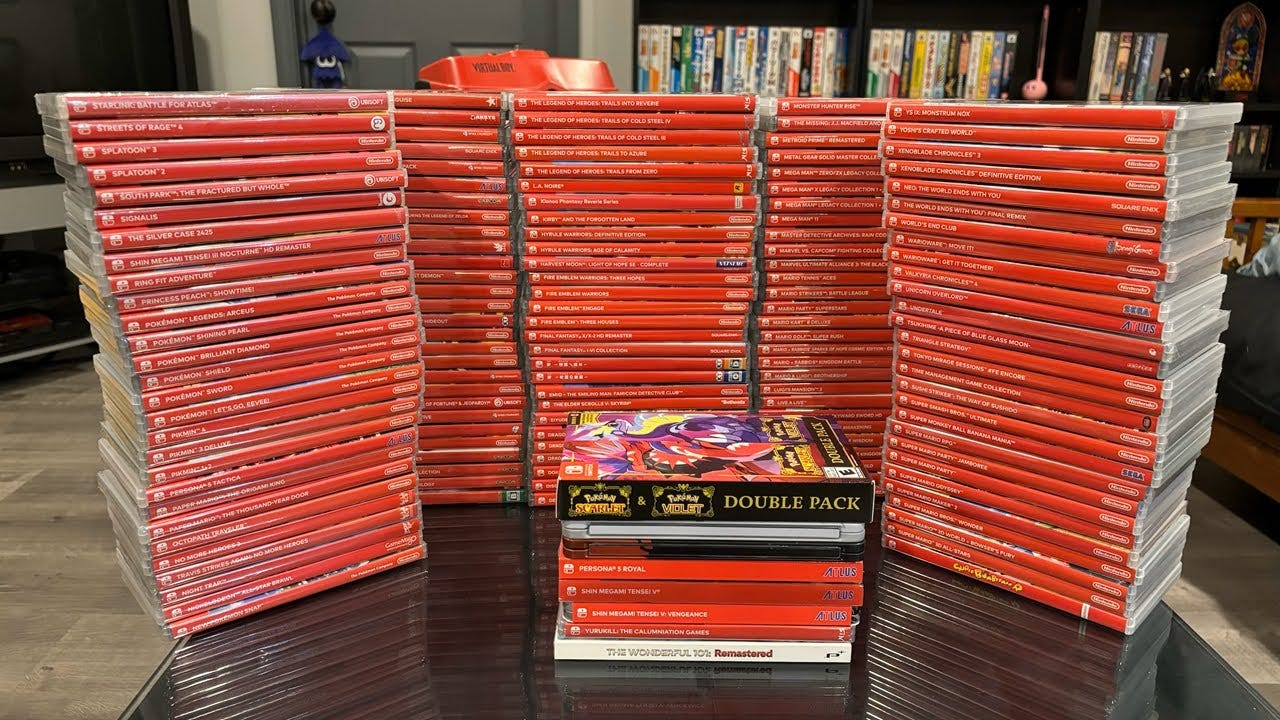
That 38.5% physical share, even softened by the key-card quirk, is a big chunk of the business to walk away from. As one outlet put it, you can’t assume everyone in that group would quietly switch to digital if the option vanished. Nintendo keeping physical looks less like nostalgia and more like not abandoning a third of your buyers.
The rest of Nintendo’s quarter
The digital milestone rode in on a strong report.
The Switch 2 sold another 3.82 million units, bringing its lifetime total to 23.68 million in 13 months, making it the fastest-selling Nintendo console ever through five quarters, ahead of the Wii. Digital software revenue jumped 90% year over year, helped by a weak yen and more downloaded games.
Curiously, revenue actually fell 9.5% for the quarter, while profit soared over 150%, thanks to high-margin software and a roughly $300 million one-time refund on US tariffs.
So the takeaway isn’t “Nintendo is going all-digital.” It’s that digital is growing, the company is being careful about how it counts, and unlike Sony, it’s in no hurry to tell a third of its players their cartridges are obsolete.
Article compiled and edited by Derek Gibbs (entertainment editor) and the Clownfish TV newsroom.
D/REZZED is part of Clownfish TV. For more news, views, and rants on gaming, tech, and pop culture, visit clownfishtv.com. Watch the show on YouTube at @ClownfishTV where new episodes drop daily. Subscribe to the Clownfish TV podcast on Apple Podcasts, Spotify, iHeart, and wherever else you get your podcasts. Sign up for the free newsletter at more.clownfishtv.com.
Hat Tips:
Nintendo Q1 FY2027 Financial Results Explanatory Material (August 6, 2026), verified for the April-June 2026 quarter, the 517.8 billion yen net sales down 9.5%, the operating profit up 150.5%, the ~$300 million IEEPA tariff refund, and the Switch/Switch 2 figures
Niche Gamer (August 6, 2026), verified that the 61.5% is a revenue figure including downloadable retail games, download-only releases, add-on content, and Switch Online subscriptions, that bundled software is counted as hardware, and the software unit-sales breakdown
Kotaku (August 6, 2026), verified for the 59.3%-to-61.5% year-over-year shift, the ¥132.7 billion digital revenue, the game-key-cards-counted-as-physical caveat, and the Switch 2’s 23.68 million lifetime units as fastest-selling Nintendo console
TheGamer (August 6, 2026), verified for the DLC-and-bundle skew in both directions and the argument that the 38.5% physical share is too large to safely abandon
Shacknews (August 6, 2026), verified for the 61.5% digital figure, the prior quarter’s 54.6%, and Nintendo confirming no plans to drop physical media amid the Switch 2 rollout