

No, that frog with eyes in its mouth isn’t AI, it’s a real 1992 photo that stumped scientists
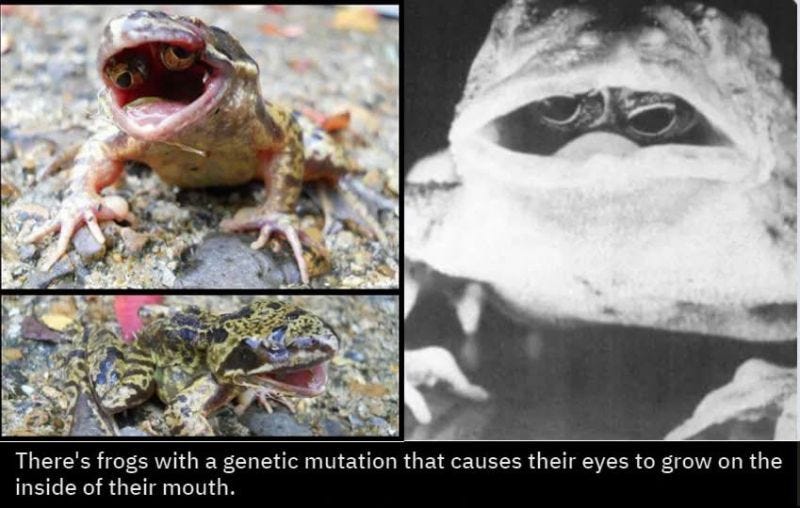
A viral image of a toad with eyes inside its mouth is making the rounds again, and everyone assumes it’s AI. It’s not. It’s a genuine, Snopes-verified photograph from 1992, and the real science behind it is even weirder than a fake would be.
You’ve probably seen the image floating around: a toad with its eyes not on top of its head, but staring out from inside its mouth. And your first thought was almost certainly, “okay, that’s AI.”
Here’s the twist: it’s not. This is a 100% real photograph, taken back in 1992, and it’s been verified by fact-checkers, featured in famous science books, and studied by actual biologists. In an age of AI fakes, this one’s the real deal, and the science behind it is genuinely fascinating.
The story behind the photo
Let’s start with how this incredible image came to be.
The famous photo was taken in 1992 by Canadian photojournalist Scott Gardner. The story goes that a high school student named Deidre in Ontario, Canada found the strange toad in her backyard.
At first, she thought it had swallowed another frog, until she realized those eyes were part of the toad itself. She named it “Gollum.”
Deidre contacted her local newspaper, which dispatched Gardner to check it out. He later admitted he assumed the “toad with eyes in its mouth” call was a prank, but he went anyway.
When the toad finally opened its mouth, there they were: two fully-formed eyes, blinking from inside. Gardner snapped the shot, and it went on to become, in his words, “the most iconic image of my career.”
This is verified, and famous
Here’s why you can trust this one, even in the age of deepfakes.
Gardner’s photo isn’t some random internet upload. It ran in The Hamilton Spectator and spread across Canada and the U.S. More impressively, it earned a place in serious science:
It was featured in famed evolutionary biologist Richard Dawkins’ 1996 book Climbing Mount Improbable.
Legendary naturalist David Attenborough showcased the phenomenon in his BBC documentary Fabulous Frogs.
Fact-checking site Snopes investigated the image and rated it real.
So no, it’s not AI, not Photoshop, not a hoax. It’s a documented biological oddity that predates AI image generators by three decades.
The science: how does a toad get eyes in its mouth?
Here’s the part that’s genuinely wild, and real.
The toad, an ordinary American toad (Bufo americanus), was the victim of an incredibly rare genetic event called a macromutation, a mutation big enough to dramatically change an organism’s body structure.
In most amphibian mutations, this shows up in the legs (extra limbs, missing limbs). But in Gollum’s case, the eye sockets never formed, and the eyes instead developed in the roof of the mouth, a phenomenon scientists call ectopic development (organs forming in the wrong place). A frog expert at the University of Guelph examined the toad and confirmed it was a genuine male American toad, at least two years old.
As for the cause? Scientists aren’t 100% certain, but the leading suspect is a parasitic trematode worm (Ribeiroia ondatrae), a nasty little parasite already known to cause those bizarre limb deformities in frogs and toads.
The surprising twist: this is closer to normal than you’d think
Here’s the fact that flips the whole thing on its head.
You’d assume eyes-in-the-mouth would leave a toad blind and helpless. It didn’t. Gollum could still see just fine, it just had to open its mouth to look around, and it lived a fairly normal life.
But here’s the kicker: eyes retracting into the mouth isn’t actually that far from normal frog behavior. A 2004 study confirmed that many frogs and toads pull their eyes down into their mouth when they swallow, using their eyeballs to help push large food down their throats. So a frog’s eyes and mouth are already anatomically cozier than you’d expect. Gollum’s mutation just… made it permanent.
Why this keeps going viral
Here’s why you’re seeing it now.
This image resurfaces every few years, and in 2026, it hits differently. We’re now so used to AI-generated fakes that our instinct with any bizarre animal photo is to assume it’s artificial. That reflex is exactly why this one is so striking, it looks like a prompt someone typed into an image generator, but it’s a real photo older than most of the internet.
It’s a weirdly perfect reminder that nature was generating nightmare fuel long before the machines learned how.
The toad with eyes in its mouth: real or fake, settled
So here’s the deal.
That unsettling toad photo is completely, verifiably real, a 1992 image by photographer Scott Gardner of an American toad with a rare macromutation that put its eyes inside its mouth. It’s been fact-checked by Snopes, published by Richard Dawkins, and featured by David Attenborough. No AI required.
So the next time it pops up on your feed and someone confidently declares “that’s obviously fake,” you get to be the person who knows better. Nature made this one all on its own, parasitic worm and all, decades before anyone dreamed up an image generator.
Sometimes the real thing is stranger than anything a machine could invent. And honestly? That’s the most unsettling part.
Want More Clownfish TV?
This article was brought to you in part by The Reefers of more.clownfishtv.com. Free subscribers get articles like this one in their inbox. Paid subscribers get the full Clownfish TV podcast feed, livestreams, and members-only episodes that never hit YouTube.
D/REZZED is part of Clownfish TV. For more news, views, and rants on gaming, tech, and pop culture, watch @ClownfishTV on YouTube and find the podcast on Apple Podcasts, Spotify, and iHeart.
Article compiled and edited by Derek Gibbs (entertainment editor) and the Clownfish TV newsroom.
Hat Tips:
Snopes (2014/2026), verified for the fact-check confirming the image is real, the BBC/2014 reporting that the toad was found by children in Ontario in the early 1990s, the macromutation explanation, the trematode-parasite (Ribeiroia ondatrae) suspected cause, and the David Attenborough Fabulous Frogs feature
A-Z Animals and The Travel (2025-2026), verified for the discovery details (high schooler Deidre, the “Gollum” name, the 1992 date, photographer Scott Gardner, publication in The Hamilton Spectator), the University of Guelph examination confirming a male American toad, and the Climbing Mount Improbable feature
A-Z Animals (citing a 2004 northern leopard frog study), verified for the fact that frogs and toads normally retract their eyes into their mouth to help swallow food, contextualizing why the mutation didn’t prevent the toad from seeing or surviving