

Piracy is now the only way to preserve video games, says game archivist
After Sony confirmed it’s killing PlayStation discs, the director of the Video Game History Foundation made a striking admission: right now, piracy is the only working way to preserve games. But he says that’s the industry’s fault, not a solution he’s happy about. Here’s the full story.
The move to an all-digital future just prompted a blunt statement from one of gaming’s leading historians: for now, piracy is the only functioning way to preserve video games.
That’s according to Frank Cifaldi, director of the Video Game History Foundation, and he lays the blame squarely on the game industry itself. Here’s what he said, the legal fight behind it, and why this is a bigger deal than it sounds, though with some important nuance.
What sparked it
Let’s start with the trigger, which ties into a much bigger story.
On July 1, Sony confirmed it will stop producing physical PlayStation discs for new games in 2028, going all-digital. The same announcement included plans to shut down the older PS3 and PS Vita digital stores. For preservationists, that combination, no new discs and shuttered digital storefronts, is a nightmare: it means some games could become legally impossible to access at all.
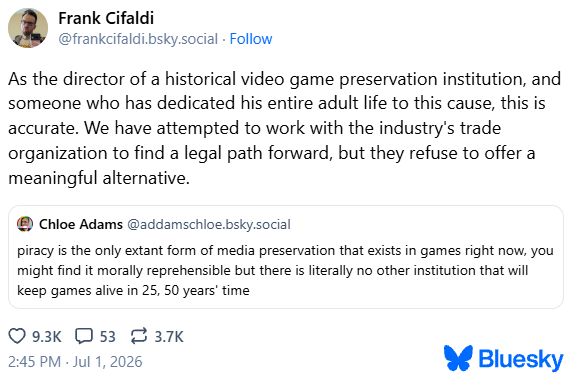
Responding to a social media post that called piracy the “only extant form of media preservation that exists in games right now,” Cifaldi agreed.
The archivist’s blunt admission
Here’s the quote that’s turning heads.
“As the director of a historical video game preservation institution, and someone who has dedicated his entire adult life to this cause, this is accurate,” Cifaldi wrote. In other words: the person whose job is legally preserving games is admitting that, right now, the only method that actually works is the illegal one.
But, crucially, he didn’t frame this as an endorsement of piracy. He framed it as an indictment of the industry for leaving preservationists no legal alternative. “We have attempted to work with the industry’s trade organization to find a legal path forward,” he said, “but they refuse to offer a meaningful alternative.”
The legal fight behind it
Here’s the context that explains his frustration.
This isn’t a new grievance, it’s the result of a years-long legal battle. Museums and archives have fought for narrow exemptions to U.S. copyright law (specifically the DMCA) that would let them legally preserve and provide access to digital-only games for research.
The catch: those efforts have been repeatedly opposed by industry lobby groups, chiefly the Entertainment Software Association (the ESA). A proposed preservation exemption was denied by the U.S. Copyright Office in 2024 following that opposition. So archivists argue they’ve tried the legal route, been blocked by the industry, and are now left with piracy as the only tool that functions.
As Cifaldi’s colleague Phil Salvador put it: the ESA has “repeatedly attempted to block minor, heavily regulated exemptions that would allow legitimate archival institutions” to do preservation work, while offering no alternative of its own.
The important nuance: it’s not a simple “piracy is fine”
Here’s where it’s worth slowing down, because the headline oversimplifies his actual position.
Cifaldi was careful to make two points that complicate the spicy “piracy is the only option” framing:
For professional preservationists, the disc news changes less than you’d think. Most retail games from the last two decades have already been preserved (often, yes, through unofficial means), so museums aren’t panicking about losing, say, Super Mario Bros. The bigger worry is digital-only games that could vanish from storefronts before anyone archives them.
Piracy isn’t actually a real “solution.” Cifaldi explicitly pushed back on the idea that casually downloading a game fixes anything: “Downloading GTA 6 with the hope it’ll run in 50 years is not a preservation solution.” Real preservation needs legal legitimacy, proper archival standards, and institutional access, exactly what the current legal fight is about.
So his point isn’t “piracy is great.” It’s “piracy is the only thing that currently works, and that’s a damning failure the industry needs to fix.”
The ESA’s side
To be fair, here’s the counter-position.
The ESA and its member publishers have generally argued that loosening copy-protection laws, even for archives, risks enabling piracy more broadly and could harm the commercial market for games. Their stance is that circumventing DRM is dangerous ground, and that broad exemptions could be abused beyond legitimate museums.
Preservationists counter that the exemptions they’ve sought are narrow and heavily regulated, aimed only at legitimate institutions, and that the feared harms simply haven’t materialized where similar exemptions exist. It’s a genuine standoff: the industry prioritizes IP control, archivists prioritize access, and so far, no compromise has stuck.
Why this matters for you
Here’s the practical stakes, even if you’re not an archivist.
This isn’t just an academic museum problem. As gaming goes all-digital, the games you buy become licenses that can be switched off, and if a title gets delisted before it’s archived, it can genuinely disappear forever. The concern preservationists are raising is the same one behind movements like Stop Killing Games: in a licensing-only future, “buying” a game doesn’t guarantee it survives.
The difference is that museums need legal legitimacy to do this work at scale, and right now they say they don’t have it. That’s why an archivist is publicly admitting the quiet part: the system is pushing even the good guys toward the gray market.
Game preservation and piracy: where things stand now
The director of a major game-preservation institution just publicly agreed that piracy is currently the only functioning way to preserve games, a genuinely striking thing for an archivist to say out loud. But the nuance matters: he’s not cheering for piracy, he’s condemning an industry that he says blocked every legal alternative and then eliminated physical media anyway.
Whether you side with the preservationists or find the ESA’s IP concerns reasonable, the underlying problem is real and getting worse: as discs die and storefronts close, some games will become legally unpreservable. Everyone seems to agree that’s a problem. What nobody’s agreed on is who fixes it, or how.
Until they do, the people trying to save gaming history say they’re stuck choosing between breaking the law and letting games disappear. That’s not a great place for anyone to be.
Want More Clownfish TV?
This article was brought to you in part by The Reefers of more.clownfishtv.com. Free subscribers get articles like this one in their inbox. Paid subscribers get the full Clownfish TV podcast feed, livestreams, and members-only episodes that never hit YouTube.
D/REZZED is part of Clownfish TV. For more news, views, and rants on gaming, tech, and pop culture, watch @ClownfishTV on YouTube and find the podcast on Apple Podcasts, Spotify, and iHeart.
Article compiled and edited by Derek Gibbs (entertainment editor) and the Clownfish TV newsroom.
Hat Tips:
PC Gamer (Morgan Park) (July 1, 2026), verified for Frank Cifaldi’s agreement that piracy is the “only extant form of media preservation” right now, the “they refuse to offer a meaningful alternative” quote, and the framing that the industry works against legal preservation of its own works
GamesRadar+ and GameSpot (July 1, 2026), verified for Cifaldi’s fuller VGHF statement (the “limited impact on professional preservation” nuance, the “downloading GTA 6 and hoping it’ll run in 50 years is not a preservation solution” quote), the 2024 US Copyright Office denial of a preservation exemption after industry opposition, and the closure of the PS3/PS Vita digital storefronts
Aftermath and Wikipedia (July 1, 2026), verified for VGHF colleague Phil Salvador’s comments on the ESA repeatedly opposing narrow DMCA exemptions, the DMCA anti-circumvention legal background, and the ethical framing of preservation-via-piracy in a licensing-only future