

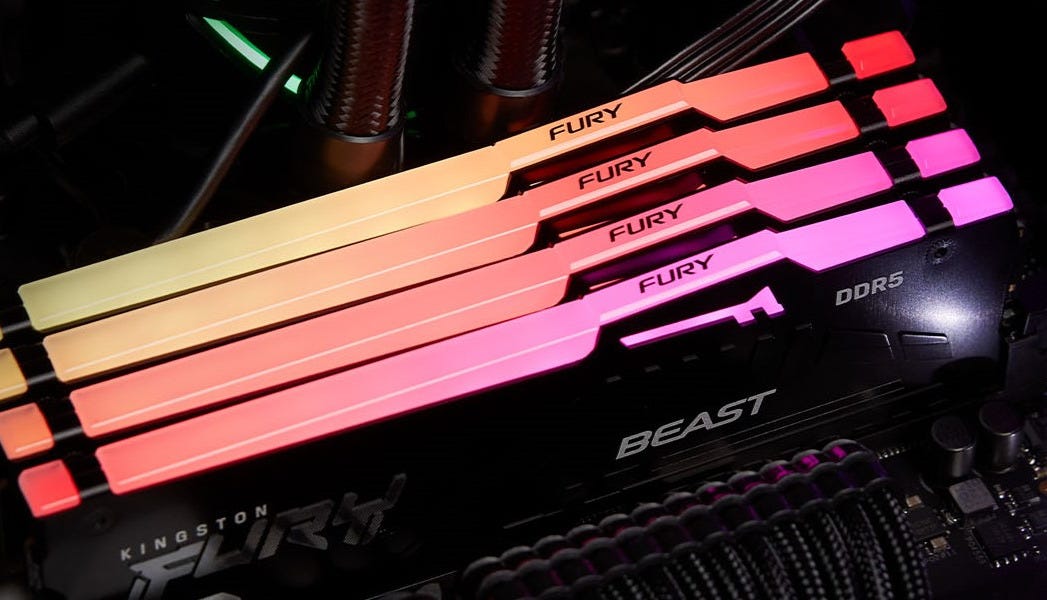
An outlet compared today’s memory pricing against exactly one year ago and found high-capacity DDR5 kits up nearly fivefold. The worst example is up more than ten times its record low.
A 128GB DDR5-6400 memory kit that once bottomed out at $329 now lists at $3,399.
That figure comes from Tom’s Hardware, which pulled average pricing from PCPartPicker for August 2026 and set it against August 2025. Across high-capacity kits, the year-over-year increase runs close to 500%.
The outlet flagged its own limits, calling the data approximate but broadly accurate.
Watch the Clownfish TV podcast on YouTube. Article continues below.
What DDR5 memory costs now
The damage is uneven and it gets worse as capacity climbs.
64GB (2x32GB) DDR5-5600, under $200 last summer, now over $1,100
96GB DDR5-6000, a $189 low a year ago, now around $1,799
128GB DDR5-6400, a $329 low, now $3,399
A smaller kit that cost $72 last year now runs $392
Do the division on the worst one and the headline number is generous. From $329 to $3,399 is not 500%. It is roughly 933%, or more than ten times.
For scale, that single memory kit costs more than a 1TB Steam Deck OLED at $949, a disc Xbox Series X at $799.99, and a PS5 Pro at $899.99 put together. About $750 more, in fact.
DDR4 is no longer the cheaper option
The standard advice when DDR5 gets expensive is to stay on an older platform.
DDR4 has risen too, roughly 120% to 177% across common configurations by one accounting. A 2x32GB DDR4-3200 kit that ran $222 in August 2025 now averages around $614.
The cause is the same on both sides. Manufacturers are winding DDR4 production down rather than keeping it running as a cheap parallel line.
What’s driving the memory shortage
Samsung, SK Hynix, and Micron have been redirecting fabrication capacity toward High Bandwidth Memory for AI accelerators, which pays far better per wafer than the chips going into gaming PCs.
TrendForce contract data shows conventional DRAM prices up roughly 93% to 98% quarter over quarter in Q1 2026, another 60% or so in Q2, with 13% to 18% forecast for Q3. Retail lags contract pricing by a quarter or more, so shelf prices are still catching up to deals struck last winter.
Apacer‘s chief executive has said he expects shortage conditions to hold into at least the middle of 2027.
Why the rate of increase is slowing
There is one piece of apparent good news in the data, and it does not survive inspection.
The rate of increase is finally flattening. The reason is that buyers hit an affordability wall and stopped purchasing.
Two caveats belong on all of this. A list price is not a transaction price, and a $3,399 kit that nobody buys says as much about one retailer’s inventory math as it does about the cost of memory.
The last time a component this ordinary got this interesting, it was graphics cards, and that took about three years to unwind.
Article compiled and edited by Derek Gibbs (entertainment editor) and the Clownfish TV newsroom.
D/REZZED is part of Clownfish TV. For more news, views, and rants on gaming, tech, and pop culture, subscribe at clownfishtv.com. Watch the show on YouTube at @ClownfishTV where new episodes drop daily. Subscribe to the Clownfish TV podcast on Apple Podcasts, Spotify, iHeart, and wherever else you get your podcasts.
Hat Tips:
Tom’s Hardware (August 17, 2026), the PCPartPicker year-over-year comparison and the 128GB kit figure, including the outlet’s own accuracy caveat
Hardware Busters (August 18, 2026), the TrendForce contract pricing figures, the Apacer forecast, and the demand-destruction reading
TechTimes (August 18, 2026), the DDR4 year-over-year range and the 2x32GB DDR4-3200 comparison