

Seth Rogen Calls AI Slop as Peter Jackson Embraces It. One of Them Made 'Sausage Party.'
Hollywood remains split on AI as studios from Disney to Netflix quietly move forward with integration.
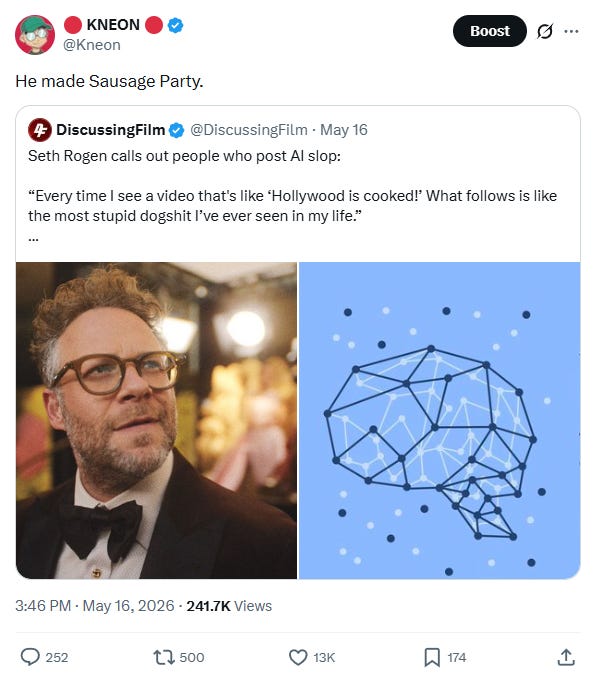
Seth Rogen sharply criticized artificial intelligence in screenwriting this week, calling most AI-generated content “stupid dog (expletive),” while director Peter Jackson welcomed the technology as just another filmmaking tool. The split played out at the Cannes Film Festival and exposed fresh cracks in Hollywood’s ongoing debate over generative AI.

Rogen made the remarks while promoting his new animated film Tangles, a dark comedy about Alzheimer’s co-directed with his wife Lauren Miller Rogen. In a candid interview with Brut, he questioned the purpose of AI in writing.
“Every time I see a video on Instagram that’s like, ‘Hollywood is cooked,’ what follows is the most stupid dog (expletive) I’ve ever seen in my life,” he said. He added that anyone whose first instinct is to use AI instead of going through the writing process should “go do something else.”
Jackson compares AI to King Kong-era effects
Peter Jackson took the opposite view during his Cannes masterclass after receiving an honorary Palme d’Or. The Lord of the Rings director described AI as “just a tool like any other” and compared it to the pioneering stop-motion techniques used in early films like the original King Kong.
“I don’t dislike it at all,” he said, while stressing the need for proper licensing when using actors’ likenesses.

James Cameron sits on Stability AI’s board
James Cameron has struck a more measured tone. The Avatar filmmaker, who sits on the board of Stability AI, has called the idea of generative AI creating performances from scratch “horrifying.” He argues the technology tends to produce an “average” of existing human work rather than true originality.
Cameron has ruled out using generative AI to replace actors in his films but has acknowledged it could help cut costs and speed up certain workflows.
Rogen’s own filmography draws fresh scrutiny
Rogen’s defense of traditional human writing has drawn renewed attention to his own filmography.
The 2016 R-rated animated comedy Sausage Party, which Rogen co-directed, co-wrote, and voiced, drew praise as one of the first mainstream adult animated features. It also faced criticism for its reliance on crude, repetitive humor and what some reviewers called uneven animation quality.

The pattern appeared in live-action work as well. The Green Hornet, the 2011 superhero comedy Rogen co-wrote with Evan Goldberg and starred in as Britt Reid, carried a $120 million budget but drew mixed-to-negative reviews. It grossed $228 million worldwide yet underperformed domestically, with critics citing an uneven script.
More recently, the 2021 HBO Max stop-motion series Santa Inc., which Rogen produced through Point Grey Pictures and voiced as Santa Claus, lasted just one season before cancellation. The eight-episode adult comedy earned some of the lowest ratings in television history on major aggregator sites and faced broad criticism for its execution and crude tone.
Celebrities remain deeply divided over AI
The split extends well beyond Rogen and Jackson. Scarlett Johansson, Cate Blanchett, and Joseph Gordon-Levitt are among more than 700 signatories of the Stealing Isn’t Innovation campaign launched earlier this year. The effort demands that tech companies stop training AI models on copyrighted works without permission and calls for ethical licensing agreements.
On the other side, Demi Moore, serving on the Cannes jury, told industry peers that fighting AI is “a battle we will lose” and urged creators to find ways to collaborate with the technology instead.
Disney, Netflix, and Warner Bros. quietly integrate AI
While public debate rages, major studios have already begun incorporating AI across production pipelines. Disney signed a multi-year deal with OpenAI to license 200 of its characters for use in the Sora video-generation platform. Netflix acquired InterPositive, the AI filmmaking company founded by Ben Affleck, to enhance post-production tools. Warner Bros. Discovery reported that 40 percent of its unscripted content now uses AI in some capacity.
These moves suggest commercial pressures are pushing the industry to adapt faster than many public statements imply.
Rogen’s rejection of AI shortcuts and Jackson’s pragmatic embrace illustrate two legitimate perspectives on the same challenge. One prioritizes the messy, time-intensive human process that has defined storytelling for decades. The other sees new tools as extensions of craft, no different from past technological leaps that once seemed threatening.
The technology is no longer hypothetical. It is already embedded in studio workflows, from script visualization to visual effects to character generation. Studios will keep experimenting, creators will keep adapting, and audiences will ultimately decide what feels authentic.
Article compiled and edited by Derek Gibbs (entertainment editor) and the Clownfish TV newsroom.
D/REZZED is part of Clownfish TV. For more news, views, and rants on gaming and tech, visit clownfishtv.com. Watch the show on YouTube at @ClownfishTV where new episodes drop daily. Subscribe to the Clownfish TV podcast on Apple Podcasts, Spotify, iHeart, and wherever else you get your podcasts. Sign up for the free newsletter at more.clownfishtv.com.
Hat Tips:
Deadline, “Seth Rogen Calls AI Content ‘Stupid Dog (Expletive)’” (May 16, 2026)
Variety, “Seth Rogen Says if You Use AI to Write Scripts, Then ‘You Shouldn’t Be a Writer’” (May 17, 2026)
The Hollywood Reporter, “Peter Jackson Talks Upcoming Projects, AI’s Role in Filmmaking” (May 13, 2026)
Variety, James Cameron interview on AI and Stability AI board role (April 2026)
Deadline, coverage of “Stealing Isn’t Innovation” campaign and celebrity signatories (March 2026)
The Hollywood Reporter, Disney-OpenAI Sora licensing deal and Netflix AI acquisitions (February–May 2026)
Rotten Tomatoes and Wikipedia entries on The Green Hornet (2011) critical and box-office performance
IMDb and Rotten Tomatoes historical ratings data for Santa Inc. (2021)