

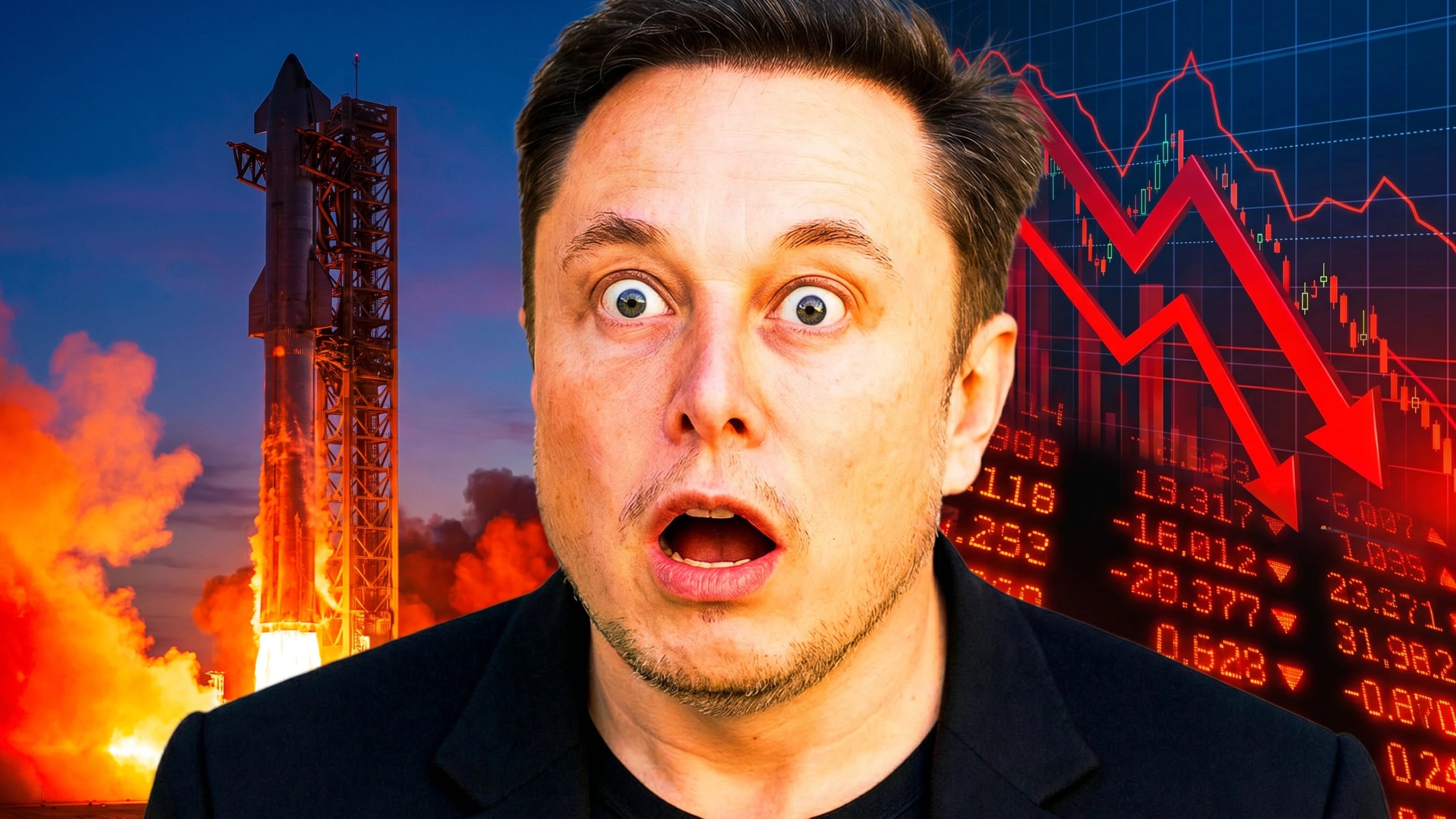
Elon Musk’s rocket company had the biggest IPO in history, spiked to an all-time high, and gave a chunk of it back over two ugly days. “Crash” is a strong word for a stock that’s still green.
SpaceX went public a week ago, shot to the moon, and then did the one thing rockets are supposed to avoid. It came back down.
But before anyone declares a disaster, the number on the screen: SPCX closed June 18 at $185, up 14.3% and $23.15 over five days. Green, not red. That’s not a crash. That’s a stock that ran too hot and let off some steam.
What actually happened to the stock
Here’s the week in order, because the order is the whole story.
SpaceX priced its IPO at $135 a share on June 12, in the largest public offering in history, raising about $75 billion. It opened at $150, popped 19% the first day, and then kept climbing. By June 16 it hit an all-time high of $225.64, a 67% gain in three days, before the company had filed a single earnings report as a public entity.
Then it turned. The stock fell two straight sessions, dropping as much as 10% intraday Thursday before trimming the loss, closing at $185 with after-hours trading nudging it to around $181.60. From the Tuesday peak, that’s about a 20% drop. From the IPO price, it’s still up better than a third, at a market cap near $2.43 trillion, which makes SpaceX the sixth-largest company on Earth even on a bad day.
So the headlines calling it a crash back to Earth are doing a little tabloid stretching. It cooled off. Hard, but off a vertical run that was never going to hold.
Why the rocket stalled
The reversal wasn’t one thing. It was four, stacked up over 48 hours.
On June 16, the same day as the peak, SpaceX announced it was buying Anysphere, the company behind the AI coding tool Cursor, for $60 billion in stock. A company that had just raised $75 billion turning around to spend $60 billion of its own freshly minted shares raised an obvious question about dilution and about how much money this business actually needs.
The next day, the Federal Reserve held interest rates steady, which knocked the broader market and ended SpaceX’s winning streak. June 17 also happened to be the first day options traded on SPCX, which finally gave short sellers a clean way to bet against it. And Bloomberg reported the company was lining up a $20 billion bond offering on top of everything else, partly to refinance a loan due in 2027.
Stack a giant acquisition, a rate hold, the arrival of the shorts, and a fresh debt raise, and a stock priced for perfection does exactly what this one did.
The bull and bear cases are absurdly far apart
This is where it gets strange, because Wall Street cannot agree on what this company is worth, and the gap is enormous.
Start with the tell hiding in plain sight on the stock page: the P/E ratio is blank. A dash. You can’t calculate price-to-earnings on a company that has no earnings to divide by, and SpaceX posted a $4.9 billion net loss for 2025, a reversal from a profitable 2024, driven mostly by its February merger with Musk’s AI outfit xAI, which burns cash at a staggering rate. The only consistently profitable piece of the whole operation is Starlink, the satellite internet business.
So how do you value that? Depends entirely on which analyst you ask. Morningstar cut its fair value estimate to $62 a share after the Cursor deal, which would imply something like 65% downside from where it’s trading and would be an actual crash. On the other end, Arete Research opened coverage at $401, betting Starlink and the AI bolt-ons carry it to a $5 trillion-plus valuation inside a year. Same company, same week, and a price-target spread of more than six to one.
That’s not analysis converging on a number. That’s a coin flip with a trillion dollars riding on it.
So is it crashing or not?
Depends on when you bought, which is the honest answer to almost every IPO question.
If you got in at the $135 offer price, you’re up nicely and a two-day dip is noise. If you chased it at $225 on Tuesday because the line was going up, you’re down 20% and wondering what happened. Both of those people own the same stock.
What’s clear is that the underlying business didn’t change this week. Starlink still makes money, the launch business still set records, and the losses still come from the expensive AI bet Musk strapped on. The stock moved on dilution, debt, and the simple fact that nothing climbs 67% in three days and stays there. Whether the next move is back toward $225 or down toward Morningstar’s $62 is the thing nobody can tell you yet, and anyone who says they can is guessing with conviction.
This article was brought to you in part by The Reefers of more.clownfishtv.com. Subscribers there get the full Clownfish TV podcast feed including livestreams and members-only episodes that don’t make it to the free side, plus articles like this one delivered to their inbox. Free subscribers get the articles. Paid subscribers get everything.
While you’re at it, subscribe to Clownfish TV on YouTube at @ClownfishTV, where new episodes drop daily, and catch the Clownfish TV podcast on Apple Podcasts, Spotify, and iHeart.
Article compiled and edited by Derek Gibbs (entertainment editor) and the Clownfish TV newsroom.
Hat Tips:
Bloomberg (June 18, 2026), verified for SPCX falling 3.6% Thursday, the two-day 8.3% decline, the stock ending its first week up on the IPO price, and the ~$2.4 trillion market cap
Yahoo Finance (June 18, 2026), verified for the second-day drop, the broken three-day winning streak after the Fed rate hold, and the reported $20 billion bond offering
TheStreet and Reuters (June 18, 2026), verified for the $60 billion Anysphere/Cursor acquisition, the ~20% drop from the June 16 peak, and Morningstar cutting fair value to $62
CNBC (June 12, 2026), verified for the $135 IPO price, the 19% first-day gain, the $75 billion raise, and the xAI acquisition context
Multiple analyst notes (June 2026), verified for the Morningstar $62 and Arete Research $401 price targets framing the bull-bear split