

The FDA said Taco Bell lettuce had cyclospora. A day later, it apologized for a false positive.
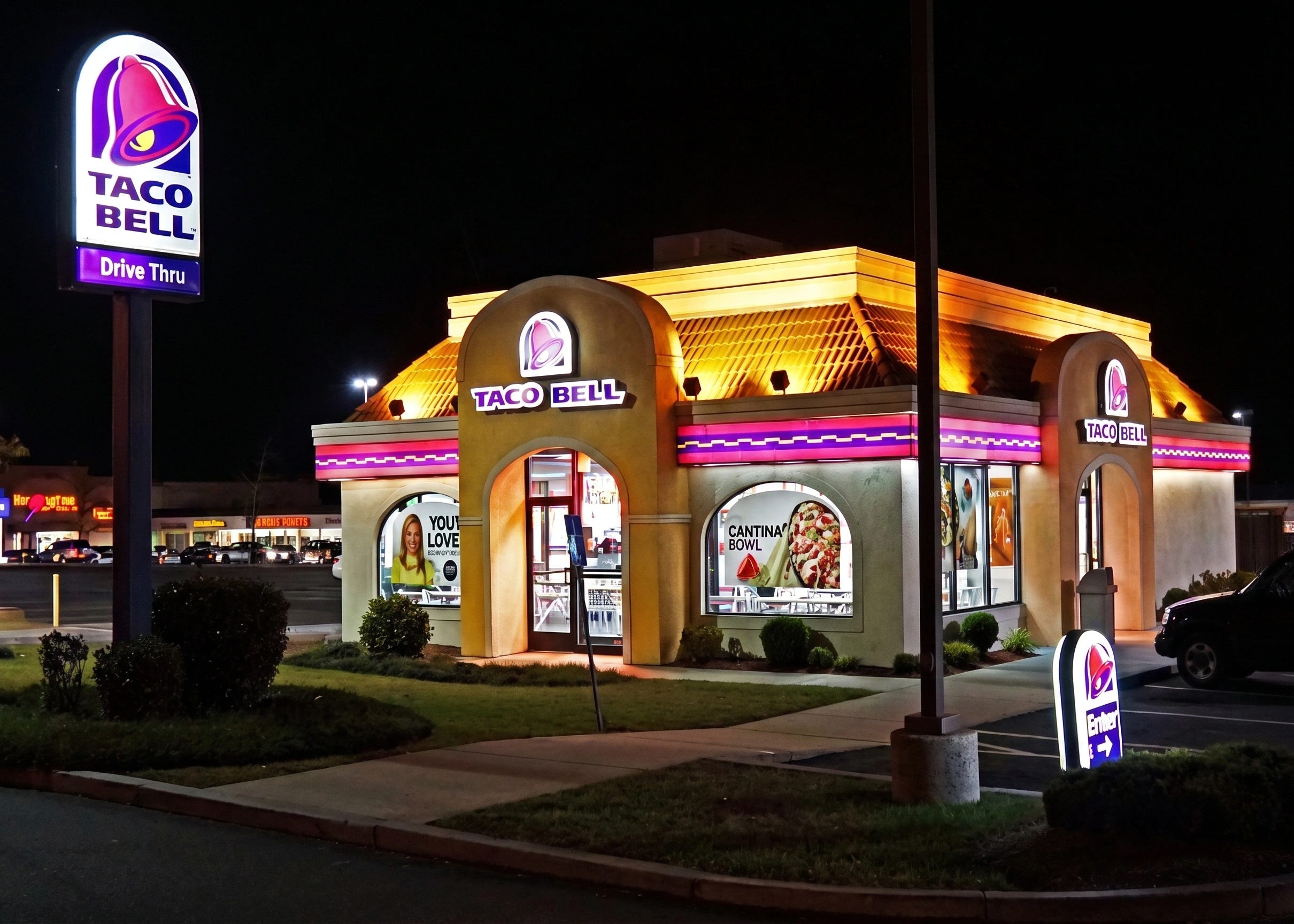
A multistate cyclospora outbreak tied to shredded lettuce at Taco Bell has sickened more than 1,600 people. Then the FDA’s one “confirmed positive” test on the supplier’s lettuce turned out to be a false positive — and the agency apologized. The recall still stands.
The Taco Bell lettuce saga has been a rough one, and over the weekend it got weirder: the FDA flagged the prime suspect’s lettuce as testing positive for a stomach parasite, then apologized roughly a day later because the test was wrong.
Here’s how a food-safety scare turned into a rare federal mea culpa — and why it doesn’t actually clear anyone yet.
How the Taco Bell lettuce outbreak started
The backdrop is a genuine, ongoing outbreak, and it’s not a small one. Health officials are investigating a multistate cyclospora outbreak — the parasite causes cyclosporiasis, whose hallmark symptom is persistent diarrhea, along with cramps, nausea, fatigue, and appetite loss. Per federal figures, the outbreak has sickened more than 1,600 people and hospitalized 94 across five states, with no deaths reported.
The FDA’s traceback investigation converged on a single supplier: Taylor Farms de Mexico, which provided shredded iceberg lettuce to Taco Bell locations in Indiana, Kentucky, Michigan, Ohio, and West Virginia where people ate before getting sick. On Thursday, Taco Bell said it would stop using the supplier.
That Friday, Taylor Farms voluntarily recalled iceberg lettuce sourced from central Mexico — product distributed to 27 states, including Marketside bags sold at Walmart and foodservice shipments through Sysco, the largest foodservice supplier in the country.
Because the lettuce has a shelf life stretching to Aug. 3, regulators warned people to check their fridges.
The “confirmed positive” that wasn’t
Then came the whiplash.
On Saturday, the FDA said a sample of Taylor Farms de Mexico shredded iceberg lettuce, collected through targeted import surveillance, had tested positive for cyclospora. That lot wasn’t part of the original recall; it was detained, and the company scrambled to figure out whether any of it had reached stores or homes. It looked like the smoking gun.
By Sunday night, the gun had vanished. The FDA re-reviewed the sample, determined the result was a false positive, and apologized. In its statement, the agency said that as of July 19, there are no confirmed positive sample results for product testing for cyclospora. In other words, the one lab result that appeared to physically pin the parasite on the lettuce evaporated on a second look.
What Taylor Farms said
Taylor Farms, understandably, took a victory lap. In a statement posted Sunday night that racked up more than a million views, the company led with a blunt headline: “Today, FDA apologized to us.”
The company recapped the reversal in plain terms — that a day earlier the FDA had informed it one of its central-Mexico iceberg products had a “confirmed positive” test for cyclospora, and that it was then told the agency “made a mistake, and this was a false positive.” Taylor Farms emphasized that, at this point, the FDA “has not identified a single positive product test result for Cyclospora.”
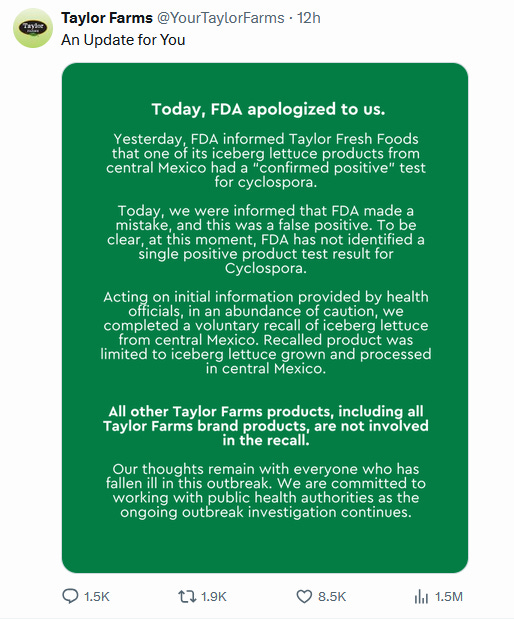
It framed its recall as caution rather than admission, saying it had acted on the initial information from health officials and completed a voluntary recall “in an abundance of caution,” limited to iceberg lettuce grown and processed in central Mexico. The company stressed that all its other products, including everything under the Taylor Farms brand, are not involved in the recall and remain on shelves.
And it closed on the human toll, saying its thoughts remain with everyone who has fallen ill in the outbreak, and that it’s committed to working with public health authorities “as the ongoing outbreak investigation continues.”
Why this isn’t a full exoneration
That last line is the one that matters, because it quietly undercuts the victory lap.
A false lab test is not the same as a clean bill of health. The false positive does not undo the recall — that still stands. And the reason Taylor Farms de Mexico’s lettuce got recalled in the first place wasn’t the lab test; it was the FDA’s traceback epidemiology, which linked sick Taco Bell customers back to that specific supplier. The agency said Sunday it’s still “working with the firm to ensure product implicated in this outbreak has been removed from the market.”
So the state of play is genuinely strange. No lab has confirmed cyclospora inside the product, the one test that seemed to has been retracted with an apology, and yet the recalled lettuce remains the leading suspect because of where sick people ate. The parasite has a source. Officials just haven’t proven it’s in the salad — only that the salad keeps showing up at the scene.
What happens next
For consumers, the practical guidance hasn’t changed: the recall is active, the lettuce has a long shelf life, and anyone holding recalled product should toss or return it. The FDA’s investigation is ongoing, and more than 1,600 people are still recovering from an illness whose origin remains officially unconfirmed.
The FDA owes Taylor Farms an apology for a bad test, and it delivered one. But the smoking gun turning out to be a dud doesn’t close the case — it just means the investigation is back to where it started, with a lot of sick people and a pile of recalled lettuce nobody has fully cleared.
The wild turn isn’t the ending. It’s the middle.
Article compiled and edited by the Clownfish TV newsroom.
D/REZZED is part of Clownfish TV. For more news, views, and rants on gaming, tech, and pop culture, visit clownfishtv.com. Watch the show on YouTube at @ClownfishTV where new episodes drop daily. Subscribe to the Clownfish TV podcast on Apple Podcasts, Spotify, iHeart, and wherever else you get your podcasts. Sign up for the free newsletter at more.clownfishtv.com.
Hat Tips:
U.S. FDA — the five-state Taco Bell outbreak investigation, the Taylor Farms de Mexico traceback, the July 19 “no confirmed positive” statement, and consumer guidance
NBC News (July 19, 2026) — the false-positive finding, the FDA apology, and confirmation the recall stands
Forbes — the timeline of the Saturday positive test and Sunday-night FDA apology
Fox Business — the 1,644 sickened / 94 hospitalized figures, the 27-state distribution, Marketside/Walmart and Sysco details
Food Safety News — recalled product lot details, shelf-life-to-Aug. 3 warning, and foodservice distribution
Taylor Farms (@YourTaylorFarms, July 19, 2026) — the company’s full statement, quoted throughout