

The Odyssey accused by the internet of faking its box office numbers

A theory is spreading on social media that The Odyssey is inflating its record numbers by buying up empty seats and gaming its Rotten Tomatoes score. There’s no proof, and the claims have simple explanations — but studios do have a history of goosing perception.
There’s a theory making the rounds online, and it’s picking up steam: that The Odyssey, Christopher Nolan‘s new epic, isn’t the hit its numbers say it is. That the record-setting opening is smoke and mirrors, propped up by a studio buying its own tickets and a review score that’s been quietly inflated.
We’re not here to tell you whether that’s true.
(It almost certainly isn’t, and we’ll get to why later.)
But it’s worth actually looking at what people are claiming, because writing off every online suspicion as noise is how you miss the ones that turn out to be real.
What the internet is claiming
The accusation has two parts. The first is that The Odyssey‘s box office is fake, with viral posts claiming the studio is buying up theaters and seats to make a struggling movie look sold out. The second is that its Rotten Tomatoes audience score is rigged, and that the real number is far lower than the site displays.
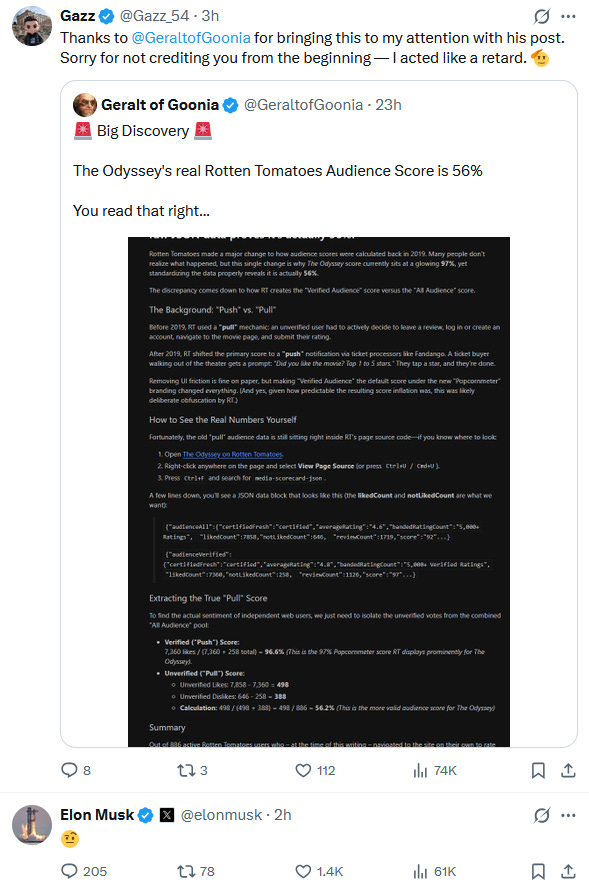
Even Elon Musk is paying attention to this one.
The empty-theater reports
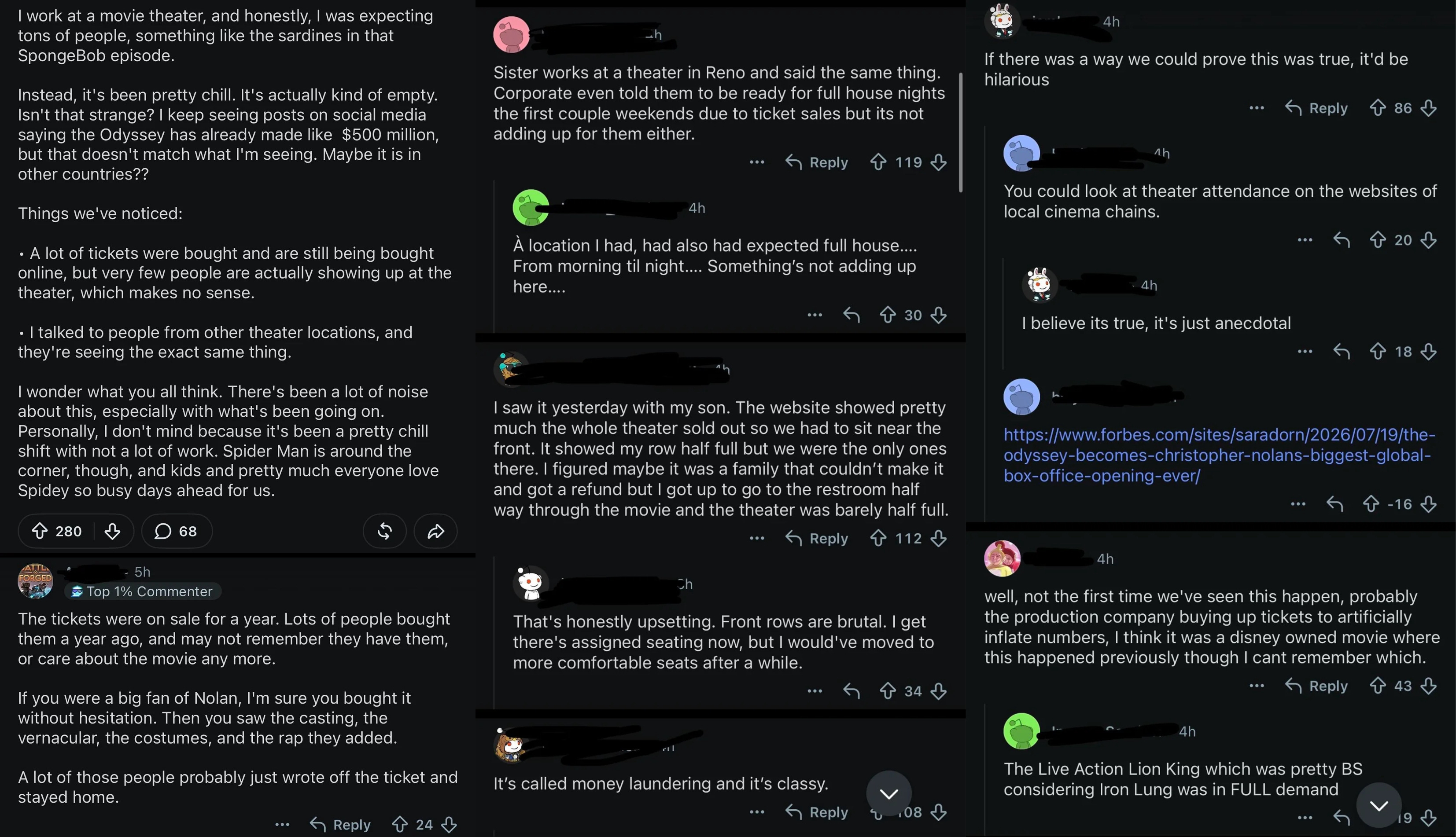
The box office claim started with people who work at or go to theaters. One self-identified theater employee posted that they’d braced for huge crowds and instead found the auditorium mostly empty, writing that “it’s actually kind of empty” and wondering why it didn’t match the headlines.
Others chimed in with the same story: showings marked sold out online, then near-empty in person.
A common refrain across the posts was some version of “something’s not adding up here.” A moviegoer described a screening that showed nearly sold out on the website but was barely half full in the room.
From there, the leap was quick: if seats are paid for but bodies aren’t in them, someone must be buying tickets nobody uses.
It’s a real observation. The interpretation is where it gets shaky.

The Rotten Tomatoes math
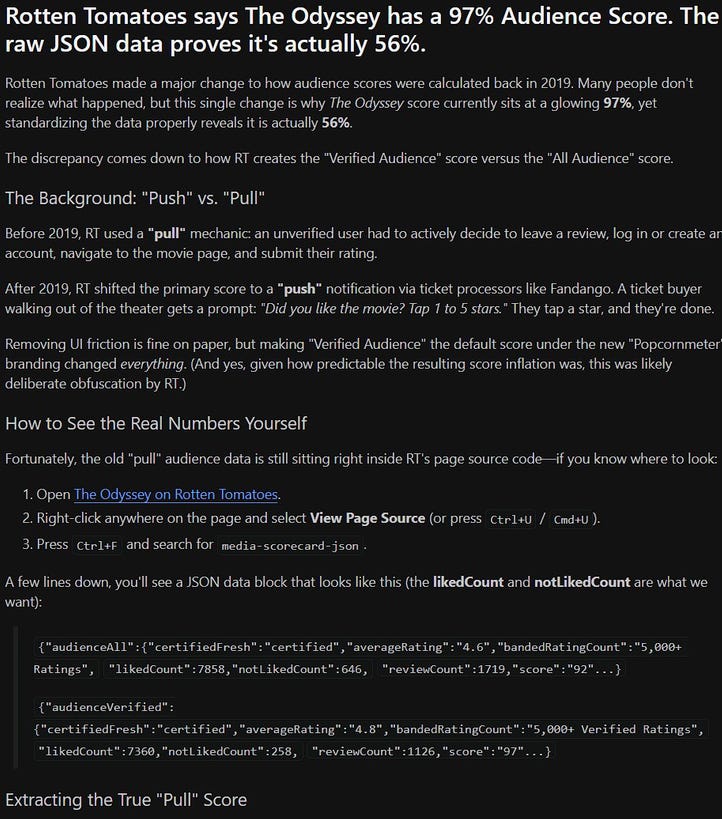
The second claim is more technical. A viral breakdown pointed out that The Odyssey‘s Rotten Tomatoes audience score sits at 97%, then dug into the site’s raw page data to argue the “real” number is 56%.
The breakdown separated out users whose ratings weren’t “verified” through ticket purchases, calculated that only about 56% of that specific group liked the film, and declared that the honest score.
The claim is that the friendly 97% is an artifact of the system, and the 56% is the truth the site is hiding.
The simpler explanations?
On the box office, The Odyssey‘s numbers don’t come from Universal. They come from Comscore, the independent firm that tracks ticket sales for every studio, and the figures are reported by trade outlets like Deadline. By those counts, the film opened to more than $124 million in the US and over $264 million worldwide, the biggest opening weekend of Nolan’s career. That’s not a studio’s press release. It’s the same neutral scorekeeper that counts every other movie.
The empty seats may have a boring cause. Tickets for The Odyssey‘s premium IMAX showings went on sale a full year in advance, and many buyers grabbed them then. A year later, plenty of those people forgot, lost interest, or simply didn’t go, leaving paid-for seats empty.
Commenters in the very threads spreading the theory pointed this out, noting the tickets “were on sale for a year” and that early buyers may not even remember owning them. One person watching a half-empty room isn’t seeing fraud. They’re seeing no-shows.
Rotten Tomatoes switched its audience score to that “verified” system on purpose, specifically to fight review-bombing, where people tank a film’s score without buying a ticket or seeing it. The 97% reflects verified ticket-buyers. The 56% the breakdown calculates is the unverified pool, which is exactly the group RT built the system to de-emphasize.
Studios have been caught before
Now, the part that keeps this from being crazy. Hollywood has absolutely faked things to make movies look better, and audiences are right to remember it.
In 2001, Sony got caught inventing a film critic. “David Manning” was a fake reviewer, credited to a small Connecticut newspaper, whose glowing blurbs the studio slapped on ads for underperforming movies. When it was exposed, Sony paid a settlement of more than $1.5 million to moviegoers who said they’d been tricked into buying tickets.
More recently, a 2023 investigation revealed a PR firm called Bunker 15 paying low-level critics for positive Rotten Tomatoes reviews and burying negative ones, gaming the scores of films to flip them from rotten to fresh. Rotten Tomatoes delisted some of the firm’s titles in response.
So the instinct that studios massage perception isn’t paranoia. It’s history.
Marketing budgets exist to shape how a movie looks before you’ve seen it, and cultivating reviews and favorable buzz is routine.
Renting out theaters and bulk-buying tickets, a practice called four-walling, is a real thing too, mostly used for awards runs. The idea that a studio would nudge the numbers isn’t fantasy.
What’s (probably) going on
The gap between “studios manipulate perception” and “The Odyssey is committing hundreds of millions in box office fraud” is enormous, though. Faking a critic or buying a few reviews is cheap and hard to catch.
Fabricating a record opening tracked by an independent firm the entire industry relies on would be incredibly difficult. Not impossible per se, but extremely, extremely unlikely.
The Odyssey is one of the most argued-about movies of the year, and heavily debated films always draw this kind of forensic attention.
Studios earned a measure of that distrust the hard way.
But a suspicion, even a reasonable one, isn’t always a case.
Article compiled and edited by Derek Gibbs (entertainment editor) and the Clownfish TV newsroom.
D/REZZED is part of Clownfish TV. For more news, views, and rants on gaming, tech, and pop culture, visit clownfishtv.com. Watch the show on YouTube at @ClownfishTV where new episodes drop daily. Subscribe to the Clownfish TV podcast on Apple Podcasts, Spotify, iHeart, and wherever else you get your podcasts. Sign up for the free newsletter at more.clownfishtv.com.
Hat Tips:
Social media users on X and Reddit — the empty-theater reports, the “something’s not adding up” observations, and the year-long-presale counterpoint raised within the same threads
Deadline / Forbes — The Odyssey’s Comscore-tracked $124M+ US and $264M+ global opening, Nolan’s biggest ever
Rotten Tomatoes / IndieWire / ScreenRant — how the verified Popcornmeter works and why it was built to counter review-bombing
Newsweek / CBS News — the 2001 David Manning fake-critic scandal and Sony’s settlement
Vulture / Dexerto — the 2023 Bunker 15 report on paid Rotten Tomatoes reviews