

The Xbox purge is here: 3,200 jobs cut and studios sold as Microsoft “resets” gaming
Microsoft is cutting 3,200 Xbox jobs and offloading five studios in the biggest restructuring in Xbox history, announced today. The new CEO says the business “is not healthy.” The brutal backdrop: it’s happening while Microsoft pours $100 billion into AI. Here’s the full breakdown.
The axe has fallen on Xbox, hard. Microsoft announced today that it’s cutting roughly 3,200 jobs from its gaming division and offloading multiple studios, in what its own leadership is calling the biggest restructuring in Xbox history.
It’s a brutal day for the games industry, and the context makes it sting even more. Here’s exactly what’s happening, why, and the glaring contradiction sitting at the center of it all.
The cuts, by the numbers
Let’s start with the grim details.
Microsoft is eliminating about 3,200 jobs across Xbox, roughly 20% of the entire division, over the next year. Around 1,600 of those cuts are happening immediately, with the rest rolling out over the coming 12 months. It’s part of a wider round of roughly 4,800 total job cuts at Microsoft, with the rest hitting its sales and consulting arms.
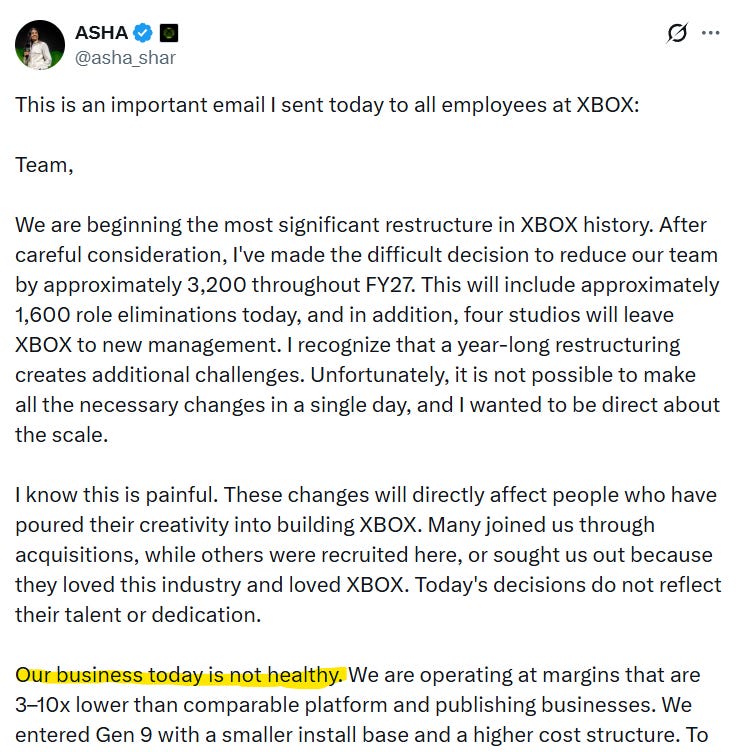
For Xbox specifically, this is the third major wave of gaming layoffs since Microsoft’s massive Activision Blizzard acquisition, and it lands after the company already cut more than 15,000 jobs company-wide across 2025. In other words, this isn’t a one-off. It’s the latest, and one of the largest, in a relentless series.
Studios on the chopping block
Here’s the part that hurts creatively.
Beyond the layoffs, Microsoft is divesting four of its game studios and beginning the process to part with a fifth. According to reporting, the studios facing closure, sale, or spin-off include some genuinely beloved, acclaimed names: Compulsion Games (South of Midnight), Double Fine (Psychonauts), Ninja Theory (Hellblade), Arkane, and Undead Labs (State of Decay).
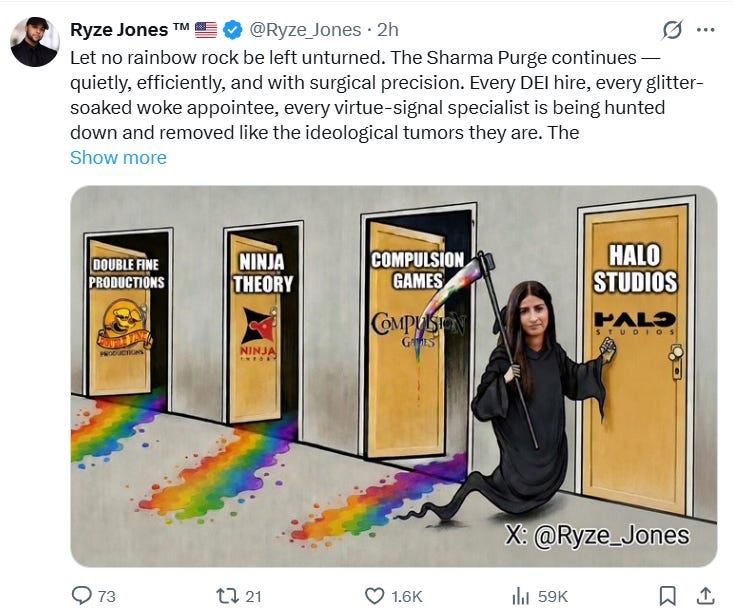
That’s a staggering list. These are award-winning, creatively respected studios, exactly the kind of prestige developers Microsoft spent years acquiring. Now they’re being cut loose as the company narrows its focus to its biggest money-makers, with reports indicating franchises like Minecraft and The Elder Scrolls are being prioritized as the growth engines going forward.
Why? The new CEO says Xbox “is not healthy”
Here’s the reasoning from the top.
The overhaul is being driven by Asha Sharma, who took over as Microsoft Gaming CEO in February 2026 after the retirement of longtime Xbox boss Phil Spencer. Her message to staff was blunt. “Our business today is not healthy,” Sharma wrote. “We must reset Xbox.”
The financial case is real. According to Sharma, Xbox is operating at profit margins three to ten times lower than comparable Microsoft businesses. She noted the company spent around $20 billion on gaming over five years (not even counting the Activision purchase), while revenue actually declined by nearly half a billion dollars over that span. By the cold logic of a spreadsheet, something had to give.
The contradiction nobody can ignore
Here’s the part that has workers and fans furious.
These cuts are happening while Microsoft spends money like never before, just not on games. The company is on pace to spend more than $100 billion on AI and cloud infrastructure this fiscal year, up from $88.7 billion, with roughly two-thirds of that going toward AI chips.
Let that contrast land. Microsoft is telling thousands of game developers there’s no room for them in the budget, in the same breath that it commits nine-figure billions to AI. To make it worse, part of what’s squeezing Xbox is a shortage of memory chips (DRAM), driven by that very same AI-infrastructure boom, which has spiked console component costs and made hardware harder to produce. In a real sense, Microsoft’s AI obsession is directly cannibalizing its own gaming division. The people paying the price are the developers.
Workers are pushing back
The layoffs haven’t gone unchallenged. The Communications Workers of America (CWA), which represents thousands of unionized Microsoft gaming employees, has condemned the cuts, with Microsoft reportedly rejecting a layoff-protection proposal before the reductions began. As one union representative put it, workers “will not be treated as disposable.”
There’s a small silver lining: employees at unionized studios like ZeniMax, Raven Software, and Blizzard’s QA team ratified contracts that include layoff-notice requirements and recall rights, real, concrete protections that non-unionized colleagues don’t have. In an industry that’s shed tens of thousands of jobs in recent years, it’s a stark, timely argument for why game-industry unionization has been gaining steam.
What it means for players and Xbox’s future
For all the pain, Sharma’s strategy is coming into focus: a leaner Xbox that spends roughly the same on content but concentrates it on proven winners rather than a sprawling portfolio of prestige studios. She’s already lowered the price of Game Pass (after an earlier $10 hike reportedly cost the service millions of subscribers) and signaled that exclusives are coming back. The goal is a smaller, more profitable, more focused Xbox.
Whether that works is the multi-billion-dollar question. Microsoft is betting that trimming the fat makes gaming sustainable. The risk is that it’s cutting muscle, gutting the creative, acclaimed studios that gave Xbox its identity, in pursuit of margins, and alienating the very players and developers who made the brand matter.
Xbox layoffs 2026: what it comes down to
Today’s Xbox purge, 3,200 jobs gone and five studios cast off, is a genuinely dark day for the games industry, and one more entry in a grim, years-long pattern of cuts. Microsoft’s business case isn’t fake; Xbox’s margins really are ugly, and the spreadsheet really is brutal. But the timing tells its own story.
A company spending north of $100 billion on AI, while telling thousands of game developers there’s no longer room for them, is making a very clear statement about its priorities. Maybe a leaner Xbox emerges stronger.
But for the people who lost their jobs today, and the studios being shown the door, the message from Microsoft is hard to misread: in the age of AI, even a beloved gaming empire is just another line item to be cut.
Want More Clownfish TV?
This article was brought to you in part by The Reefers of more.clownfishtv.com. Free subscribers get articles like this one in their inbox. Paid subscribers get the full Clownfish TV podcast feed, livestreams, and members-only episodes that never hit YouTube.
D/REZZED is part of Clownfish TV. For more news, views, and rants on gaming, tech, and pop culture, watch @ClownfishTV on YouTube and find the podcast on Apple Podcasts, Spotify, and iHeart.
Article compiled and edited by Derek Gibbs (entertainment editor) and the Clownfish TV newsroom.
Hat Tips:
Bloomberg and GeekWire (July 6, 2026), verified for the breaking specifics (the 3,200 Xbox job cuts representing ~20% of the division, the ~1,600 immediate cuts with the rest over 12 months, the broader 4,800 total Microsoft cuts, CEO Asha Sharma’s “our business today is not healthy... we must reset Xbox” statement, the 3-to-10-times-lower margins, and Brad Smith’s comments)
Variety and Aftermath (July 6, 2026), verified for the studio divestitures (four studios sold with a fifth in process), the content-spend strategy (roughly flat spend concentrated on Minecraft and The Elder Scrolls), Sharma succeeding Phil Spencer in February 2026, the $20 billion in gaming spend against declining revenue, and the Game Pass price-hike subscriber losses cited by strategy chief Matthew Ball
TechTimes and MLQ/Bloomberg reporting (July 2026), verified for the AI-capex contrast (Microsoft’s $100 billion-plus AI/cloud spend this fiscal year, roughly two-thirds on AI chips, the ~30% stock slide wiping ~$1.2 trillion in market value), the DRAM/component shortage driven by AI demand raising console costs, the reported studios facing closure or sale (Compulsion Games, Double Fine, Ninja Theory, Arkane, Undead Labs), and the CWA union’s condemnation and the contractual protections at unionized studios