

Tired of Adobe? This free tool makes GIMP feel like Photoshop
A free, open-source patch called PhotoGIMP transforms the free editor GIMP into a near-clone of Photoshop, same layout, same shortcuts, no subscription. After years of Adobe’s price hikes, cancellation traps, and AI controversies, it might finally be the off-ramp creatives have wanted. Here’s the full story.
For years, ditching Photoshop meant giving up the muscle memory you’d spent a decade building. A free tool just erased that excuse. It’s called PhotoGIMP, and it turns the free, open-source editor GIMP into something that looks and feels remarkably like Adobe’s flagship, no subscription required.
Given how much goodwill Adobe has torched with creatives lately, the timing couldn’t be worse for the software giant. Here’s what PhotoGIMP is, why it matters, and why Adobe should be paying attention.
What is PhotoGIMP?
Let’s start with what it actually does.
PhotoGIMP is a free patch (built by the Brazilian tech team behind the Diolinux blog) that reconfigures GIMP, the long-running free image editor, to mirror the Photoshop experience. Importantly, it’s not a hack or a pirated copy of Photoshop. It’s a set of configuration files, licensed under the open-source GPL-3.0, that you copy into GIMP to change how it looks and behaves.
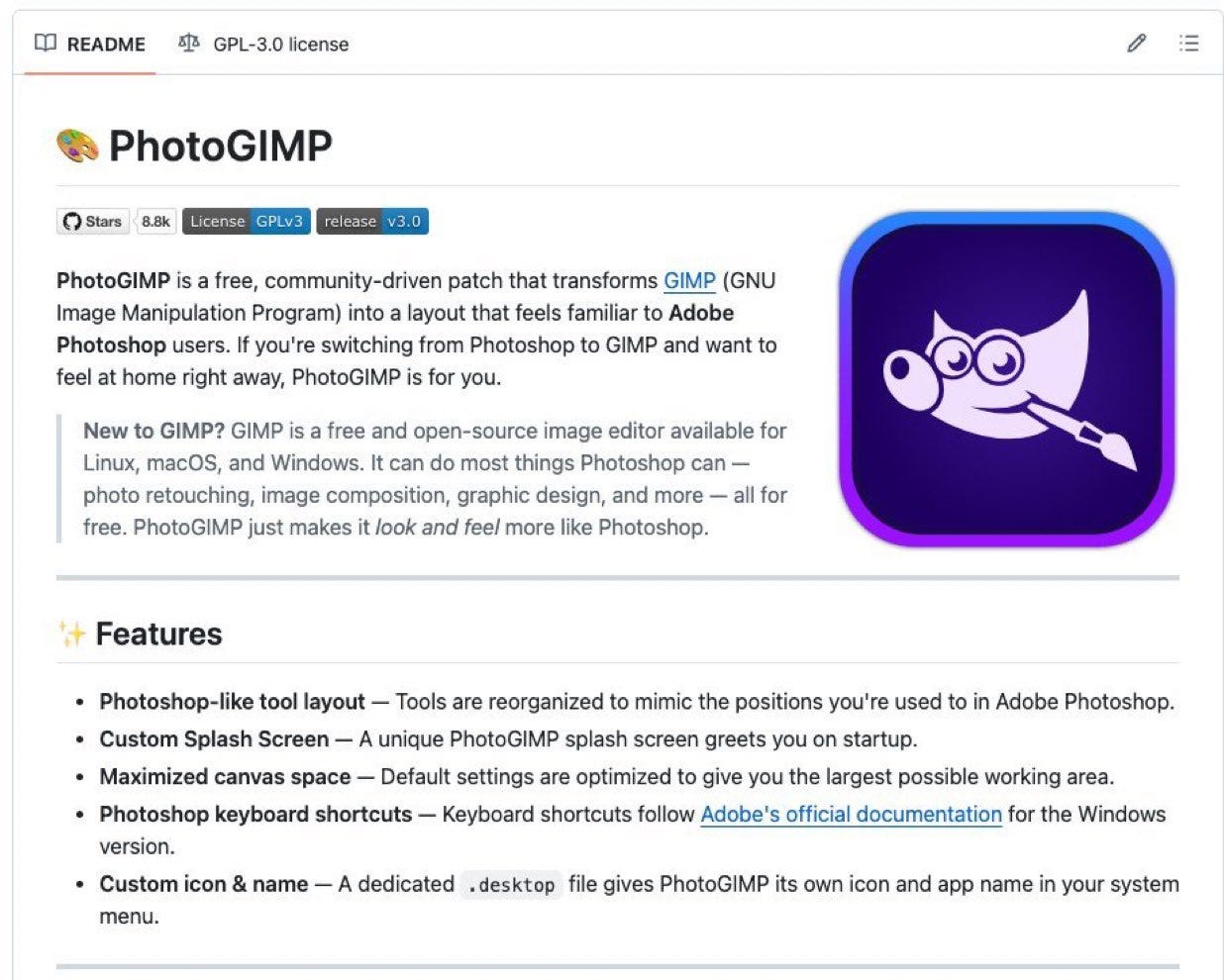
After applying it, GIMP gets:
A Photoshop-style interface and dark theme, with tools arranged in the positions Photoshop users expect.
Photoshop keyboard shortcuts, mapped to match Adobe’s own documentation. Ctrl+T, Ctrl+J, Ctrl+Shift+N, they all work like you’re used to.
A maximized canvas and cleaner default layout.
The whole point is muscle memory. If you already know Photoshop, your hands know how to use PhotoGIMP without relearning anything. It’s blown up accordingly, sitting at over 12,000 stars on GitHub, with a passionate community translating and maintaining it.
One honest clarification
Here’s an important distinction, because accuracy matters.
PhotoGIMP doesn’t add Photoshop’s features to GIMP, it changes GIMP’s interface to feel like Photoshop. The actual editing power under the hood is still GIMP’s. The good news is that GIMP has quietly become genuinely capable, especially since the major GIMP 3.0 update added long-requested features like non-destructive editing.
So the honest pitch isn’t “PhotoGIMP is literally Photoshop for free.” It’s “PhotoGIMP lets you use a legitimately powerful free editor without having to relearn where everything is.” For a huge number of users, students, hobbyists, small creators, freelancers doing everyday design and photo work, that combination is more than enough.
Why Adobe should genuinely be nervous
Here’s the part that makes this more than a fun tech tip.
PhotoGIMP isn’t new, but it lands at a moment when Adobe has spent years alienating the exact creatives it depends on. The reasons the “Cancel Adobe” movement keeps growing are well-documented:
The subscription trap. In 2012, Adobe killed the option to buy Photoshop outright, moving everyone to Creative Cloud subscriptions. A single-app Photoshop plan now runs roughly $23 a month (around $276 a year), and the full suite is far more. You never own anything, you just rent, forever.
The FTC lawsuit. In June 2024, the Federal Trade Commission sued Adobe and two executives, alleging the company hid steep early-termination fees and deliberately made canceling a nightmare, “dark patterns,” dropped calls, endless transfers. In one unsealed filing, the FTC pointed to internal comments suggesting Adobe knew clearer disclosures “would hurt Adobe’s bottom line.” Adobe denies the claims and is fighting them in court, but the reputational damage was done.
The AI and terms-of-service uproar. In 2024, Adobe updated its terms with broad language about accessing user content, and creatives panicked that their work would be fed to Adobe’s AI. Adobe walked it back and insisted it “doesn’t train generative AI on customer content”, but trust had already cracked. It didn’t help that recent price hikes were pitched partly as necessary to fund Adobe’s AI features, leaving many users feeling like they were being charged more for AI bloat they never asked for.
Put it together, and you get a creative class that, in the words of one widely-shared reaction, has trouble finding “a single person who is rooting for Adobe.”
No more excuses to stay locked in
Here’s the bigger point, and it’s about ownership.
The real value of something like PhotoGIMP isn’t just saving money, it’s independence. When your entire creative workflow is chained to a subscription, you’re a hostage. Miss a payment and your tools stop working. Prices go up? You pay or you lose access to your own craft. Don’t like a new AI feature or a terms change? Tough. That’s the deal with rented software.
A free, offline, open-source alternative flips that. PhotoGIMP and GIMP run entirely on your machine, no account, no cloud, no telemetry, no monthly bill, and you can uninstall without a trace. For creators who’ve grown wary of being locked into an ecosystem that keeps raising prices and changing the rules, the appeal is obvious. Own your tools. Own your work.
But let’s be fair to Photoshop
Here’s the honest other side, because it’s not a total knockout.
To be clear, this doesn’t mean Photoshop is dead or that GIMP is objectively better. For high-end professional work, Photoshop still holds real advantages: certain advanced features, superior handling of some pro workflows, deep industry-standard integration, and compatibility that many studios and teams simply require. If you’re a working pro whose clients and collaborators all live in Adobe’s ecosystem, switching isn’t always practical, and the subscription, for all its faults, does fund constant updates.
For a lot of professionals, Photoshop remains the right tool, and that’s fine. The point isn’t that everyone should abandon Adobe. It’s that the excuse of “GIMP is too unfamiliar to bother” no longer holds. Now the choice is an actual choice, not a trap.
PhotoGIMP vs. Photoshop: the bottom line
PhotoGIMP is a small tool with a big message: the days of Adobe’s captive audience may be numbered. By making a genuinely powerful free editor feel instantly familiar to Photoshop users, it removes the single biggest barrier to leaving, the fear of relearning everything from scratch.
Adobe still makes excellent software, and pros with specific needs have real reasons to stay. But for the huge middle of the market, students, hobbyists, freelancers, small businesses, and anyone simply tired of subscriptions, AI bloat, and being treated like a wallet on autopay, PhotoGIMP is proof that a free, own-it alternative is closer and easier than they thought. After years of burning goodwill, Adobe has handed its critics every reason to look for the door. Tools like this one just made the door a lot easier to find.
Sometimes the best upgrade isn’t a new feature. It’s not paying rent anymore.
Want More Clownfish TV?
This article was brought to you in part by The Reefers of more.clownfishtv.com. Free subscribers get articles like this one in their inbox. Paid subscribers get the full Clownfish TV podcast feed, livestreams, and members-only episodes that never hit YouTube.
D/REZZED is part of Clownfish TV. For more news, views, and rants on gaming, tech, and pop culture, watch @ClownfishTV on YouTube and find the podcast on Apple Podcasts, Spotify, and iHeart.
Article compiled and edited by Derek Gibbs (entertainment editor) and the Clownfish TV newsroom.
Hat Tips:
Diolinux/PhotoGIMP (GitHub) and GIGAZINE (2025-2026), verified for PhotoGIMP’s details (the GPL-3.0 open-source config patch for GIMP 3.0+ built by the Diolinux team, the Photoshop-style interface, tool layout, and keyboard shortcuts mapped to Adobe’s documentation, the 12,000-plus GitHub stars, cross-platform support, and the clarification that it modifies GIMP’s interface rather than adding Photoshop’s features)
Federal Trade Commission and The Register (June-July 2024), verified for the FTC lawsuit against Adobe and executives David Wadhwani and Maninder Sawhney (the hidden early-termination fees on the “annual paid monthly” plan, the difficult cancellation process and “dark patterns,” the ROSCA allegations, the unsealed internal comments about disclosures hurting Adobe’s bottom line, and Adobe’s denial and intent to fight in court)
Slate and ASI Central (2024), verified for the broader Adobe backlash (the 2024 terms-of-service update and creator panic over AI training, Adobe’s “we don’t train generative AI on customer content” clarification, the internal employee acknowledgment of “Cancel Adobe” sentiment, the price hikes pitched as funding AI integration, the 2012 shift from perpetual licenses to subscriptions, and subscriptions accounting for roughly 95% of Adobe’s revenue)