

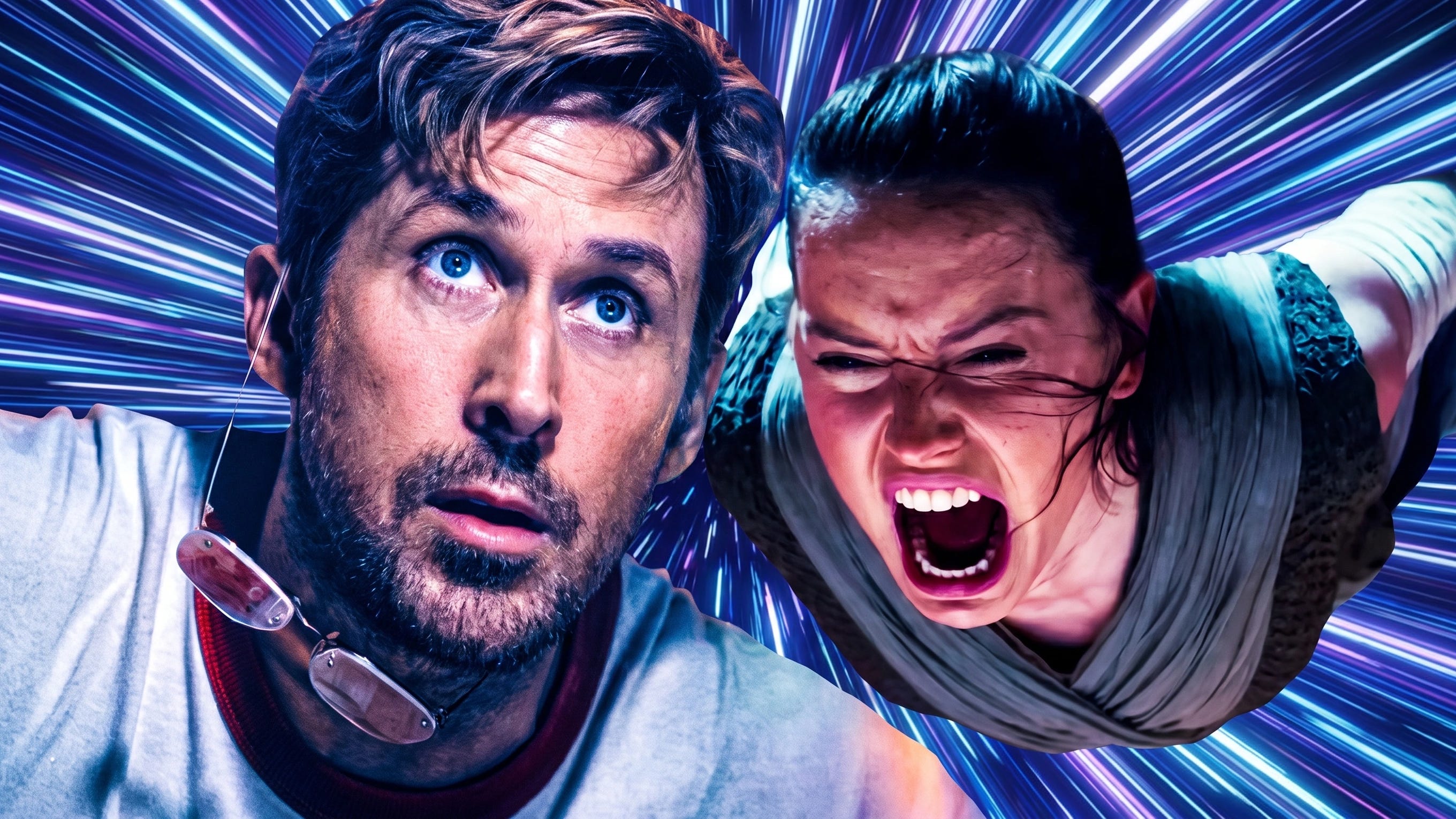
Star Wars: Starfighter is Disney’s big-screen reset with Ryan Gosling. But rumors suggest it could connect to the divisive sequel trilogy, maybe even set up a Rey film. Here’s why that would be a risky move, and why even a star like Gosling isn’t a guaranteed win.
Star Wars is finally roaring back to theaters, and Disney is banking on Star Wars: Starfighter, a fresh, standalone film starring Ryan Gosling, to reignite the franchise on the big screen. On paper, it’s a smart reset.
But there’s a rumor swirling that could undercut all of that: the idea that Starfighter might connect back to the polarizing sequel trilogy, possibly even setting up a future Rey movie.
If Disney goes that route, here’s why it could be a serious mistake.
What Starfighter actually is
Let’s start with the facts.
Directed by Shawn Levy (Deadpool & Wolverine), Star Wars: Starfighter hits theaters May 28, 2027. It stars Ryan Gosling and is set roughly five years after The Rise of Skywalker, making it the furthest-forward point on the live-action Star Wars timeline so far.
Crucially, Lucasfilm has been clear that it’s a standalone film with all-new characters, describing it as “neither a sequel nor a prequel.”
That’s a deliberate, and smart, choice: a clean jumping-on point that doesn’t require homework. Which is exactly why the rumors about a sequel-trilogy connection are worth examining.
The rumor: a bridge to a Rey movie?
Here’s the speculation, clearly labeled as speculation.
Because Starfighter is set after The Rise of Skywalker, fans and outlets have speculated that it could feature some sequel-era characters, and that if Daisy Ridley’s Rey were to appear, the film might quietly plant seeds for the long-in-development (and long-stalled) Rey movie, currently known as New Jedi Order.
To be clear: this is unconfirmed fan speculation, not a confirmed plan. Nothing official ties Starfighter to a Rey trilogy. But it’s a persistent enough rumor to raise a real question: should Disney build its big cinematic comeback as a bridge to the sequel era?
History suggests that would be playing with fire.
Why leaning on the sequels is risky
Here’s the core of the argument.
The sequel trilogy, The Force Awakens, The Last Jedi, and The Rise of Skywalker, remains one of the most divisive chapters in Star Wars history. While it had its defenders and made significant money, it also fractured the fanbase, drew intense criticism over its inconsistent storytelling and planning, and left a chunk of the audience feeling burned by how the saga wrapped up.
Disney itself seems well aware of this. In the years since, the studio has noticeably steered its theatrical ambitions away from the sequel era, letting the Rey follow-up languish in development while pushing other projects.
When a company spends years quietly distancing itself from a story, chaining a high-profile comeback film directly to that same story seems to work against its own instincts. Why remind a divided audience of the exact thing that divided them?
The warning sign: even Mando underperformed
Here’s the most important evidence, and it’s a sobering one for Disney.
If you want proof that Star Wars can’t coast on brand loyalty alone, look at The Mandalorian & Grogu. That film had arguably the most goodwill of any recent Star Wars project, built on the beloved Disney+ series, headlined by fan-favorites Din Djarin and Grogu, and largely free of the sequel-trilogy baggage.
And yet, it underperformed. Despite grossing around $340 million worldwide, it posted the worst opening of any Star Wars film of the Disney era, and became the lowest-grossing live-action Star Wars movie to date, likely losing money at the box office before merchandise.
Think about that: even the most beloved, most crowd-pleasing corner of modern Star Wars couldn’t guarantee blockbuster numbers. If Mando and Grogu underwhelmed, betting the comeback on a connection to the far more divisive sequel trilogy looks even shakier.
And Ryan Gosling isn’t a guaranteed draw
Here’s the other uncomfortable truth.
Ryan Gosling is a genuine movie star and a huge get for Starfighter, no question. But being a great actor and being a reliable box-office draw aren’t the same thing, and Gosling’s own track record proves it.
Look at The Fall Guy (2024). It was a charming, well-reviewed action-comedy that earned an A- CinemaScore, with exit polls showing Gosling himself was the main reason people bought tickets. And it still underperformed, grossing about $181 million against a large budget and reportedly losing the studio around $50 million.
It’s part of a pattern: several Gosling-led films (Blade Runner 2049, First Man, The Nice Guys) earned acclaim but modest returns. His biggest hits, Barbie, La La Land, tend to be ones where he’s supporting a bigger draw or riding an existing phenomenon.
Gosling is a fantastic asset, but he’s not a magic box-office guarantee, especially carrying an original lead role.
The smarter path forward
None of this means Starfighter is doomed, far from it. In fact, everything about its stated approach is encouraging: a standalone story, new characters, a talented director, and a clean break from the baggage. That’s precisely the reset the franchise needs. The film could absolutely be great, and a fresh start is exactly how you win back a fatigued audience.
The risk isn’t Starfighter itself, it’s if Disney can’t resist the urge to tie it back to the past. The winning move is to let it stand on its own two feet, prove that new Star Wars stories can work, and earn the audience’s trust back before revisiting the most contested era of the franchise. Use Starfighter to look forward, not backward.
Star Wars: Starfighter: what it comes down to
Star Wars: Starfighter has a real chance to be the fresh start the franchise desperately needs, a standalone adventure that reminds people why they fell in love with a galaxy far, far away in the first place.
But that potential could be undercut if Disney uses it as a stealth launchpad for the divisive sequel era.
The lesson from Mando & Grogu’s underwhelming run, and from Gosling’s own hit-or-miss box office, is that nothing about Star Wars is guaranteed anymore. Goodwill has limits. Star power has limits.
The safest bet is a genuinely good, self-contained film that stands entirely on its own. If Starfighter does that, it wins.
If it becomes a two-hour setup for a Rey trilogy nobody’s sure they wanted, Disney may find out the hard way that the past isn’t always worth revisiting.
Sometimes the best way forward is to stop looking back.
Let the past die. Kill it if you have to.
Want More Clownfish TV?
This article was brought to you in part by The Reefers of more.clownfishtv.com. Free subscribers get articles like this one in their inbox. Paid subscribers get the full Clownfish TV podcast feed, livestreams, and members-only episodes that never hit YouTube.
D/REZZED is part of Clownfish TV. For more news, views, and rants on gaming, tech, and pop culture, watch @ClownfishTV on YouTube and find the podcast on Apple Podcasts, Spotify, and iHeart.
Article compiled and edited by Derek Gibbs (entertainment editor) and the Clownfish TV newsroom.
Hat Tips:
Variety, The Hollywood Reporter, and Wikipedia (2025-2026), verified for Starfighter’s details (the May 28, 2027 release, Ryan Gosling starring, Shawn Levy directing, the setting roughly five years after The Rise of Skywalker, and Lucasfilm’s description of it as a standalone with all-new characters that is “neither a sequel nor a prequel”), and the unconfirmed speculation about a possible sequel-era or Rey (New Jedi Order) connection
Variety, Deadline, and Wikipedia (May-July 2026), verified for The Mandalorian & Grogu’s box office (roughly $340 million worldwide, the worst opening weekend of any Disney-era Star Wars film at $82 million three-day, its status as the lowest-grossing live-action Star Wars film, its ~$165 million budget and likely theatrical loss before merchandise, and its A- CinemaScore)
Wikipedia, Variety, Deadline, and Screen Rant (2024), verified for The Fall Guy’s performance (roughly $181 million worldwide against a $125-150 million budget, a reported ~$50 million loss for Universal despite an A- CinemaScore and strong reviews, exit polling showing Gosling as the primary draw, and the broader pattern of acclaimed-but-underperforming Gosling-led films like Blade Runner 2049 and First Man)