


Bluesky was supposed to be the civilized alternative to old Twitter. A place where people could escape the chaos of Elon Musk‘s X without the toxicity, harassment, or right-wing voices that many on the left found exhausting. Instead, for many users it has become a more insular version of Twitter circa 2017, complete with aggressive pile-ons, purity tests, and an ideological monoculture so concentrated that even its own progressive defenders are now publicly diagnosing the problem.
Two of the most pointed recent critiques have come not from conservatives or X loyalists, but from Mark Cuban, one of Bluesky’s most-financially-invested high-profile boosters, and James Ball, the Pulitzer-winning progressive British journalist whose data analysis sparked a Bluesky pile-on over Easter weekend that proved his own point.
The history
Bluesky began in 2019 as an internal research project at Twitter, initiated by then-CEO Jack Dorsey. The goal was to build a decentralized social network that would give users more control over their feeds and moderation. After Dorsey stepped down and Elon Musk acquired Twitter (rebranded as X), Bluesky spun out as its own company in 2021 with Jay Graber as CEO.
It launched to the public in a limited way in 2023 and saw explosive growth in late 2024 and early 2025, particularly after the U.S. election, as many left-leaning users and journalists migrated from X. Bluesky grew from 13 million users in October 2024 to 40.2 million by November 2025. The current registered user count is roughly 43 million, per TechCrunch. The platform runs no ads and has so far stayed largely free of the AI-generated slop that has taken over much of the open social web.
That part of the story is genuinely impressive. The engagement story is not.
The numbers tell the engagement story
Total user count is still climbing slowly. Active daily participation, however, has been moving in the opposite direction since early 2025.
According to market intelligence firm Similarweb, as reported by Forbes in late January 2026, Bluesky’s daily active users on mobile devices dropped 39.8% year-over-year as of October 2025. The platform peaked at roughly 6 million daily mobile users in March 2025 and fell to about 3.5 million by October.
The decline stands in stark contrast to its competitors over the same period. X dropped 13.3% YoY, a meaningful but much smaller decline. Meta’s Threads grew 53% in daily active users and eventually overtook X in mobile daily usage. Truth Social grew 32%.
Bluesky’s own internal posting numbers paint a similar picture. On February 28, 2025, Bluesky had more than 1 million unique daily posters. By early June 2025, that number had fallen below 670,000.
James Ball did the long math, and got brigaded for it
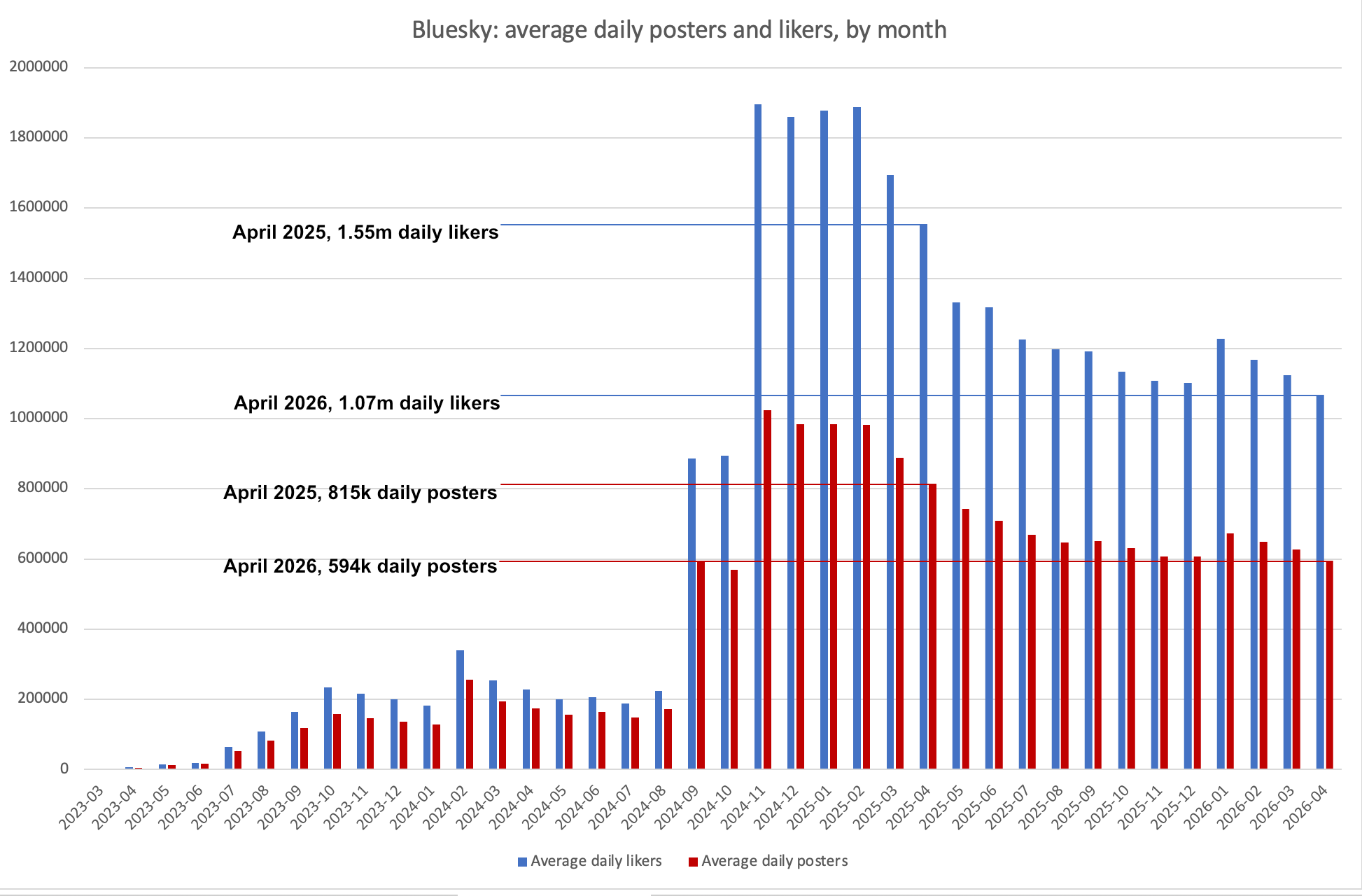
On Good Friday, April 3, 2026, the British journalist James Ball posted a thread examining Bluesky’s user data on his own Bluesky account. The chart he posted showed daily likers falling from 1.6 million a year earlier to roughly 1.1 million. His framing was direct. “The network is shrinking, not growing. It’s shrinking a lot.”
The reaction proved his point. The first post in his thread drew 870 replies and 1,044 quote posts. As Ball put it dryly in his Easter Sunday follow-up essay on his Substack, Techtris, “I made myself the main character of Bluesky. That’s never a good sign.”
In that follow-up, Ball laid out a longer and harder-to-dismiss analysis. Averaging Bluesky’s daily likers and daily posters by month, going back to the platform’s founding, the picture he saw was not ambiguous.
“In the first few days of April 2026, average daily posters had fallen to the level of September 2024, handing back everything the site had gained since Trump’s election win,” Ball wrote. “Absent that small spike [from the Grok nudifying scandal in January 2026], Bluesky has on average, since early 2025, been losing about 4% of likers and 5% of posters every month.”
Ball is not a right-wing critic looking for a “left-wing intolerance” hook. He explicitly headed off that framing in his piece. “I define myself as left-wing, even if others disagree: I want taxes to be higher, I want good public services, I want a generous welfare state, I want meaningful checks on corporate power.”
His structural argument is the part that should worry Bluesky most. The platform runs no ads and has no subscription model. It is being kept alive by investor money. “Investors don’t put much money into shrinking social networks,” Ball wrote. “Bluesky doesn’t have that luxury. It grows or it dies.”
Ball also acknowledged the cultural component directly. “Bluesky tends to gleefully chase off power users who dip their toes in the water. Let’s be clear: some prominently liberal of heterodox commentators entered Bluesky with incredibly obvious bad faith, their ‘left-wing intolerance’ articles already pre-written in their heads. Screw those guys. But Bluesky is a text-based social network. The people who are real freaks for posting opinions in writing all the time tend to be journalists. And journalists tend to have a following. The outright hostility to growing the tent a bit is probably one of Bluesky’s obstacles to growth.”
Ball noted what he called “the gleeful brigading of the victim of the day” and “certain Bluesky subcultures [that] enjoy brigading as a bloodsport, and regard high follower accounts as the most fun prey.”
He still uses Bluesky and wants it to survive. He just does not think the math supports the current trajectory.
Even Mark Cuban can’t defend the culture anymore
The other most damaging recent critique came in June 2025 from Mark Cuban, the billionaire investor and former Shark Tank star who had been one of the platform’s loudest cheerleaders.
Cuban was one of the highest-profile X-to-Bluesky converts in November 2024. His initial post on the platform set the tone of the migration. “Hello Less Hateful World.” He went further by financially backing Skylight, a video app built on Bluesky’s underlying AT Protocol.
By June 8, 2025, his tone had completely shifted.
“The lack of diversity of thought here is really hurting usage,” Cuban wrote, linking to a Washington Post opinion piece headlined “The Bluesky bubble hurts liberals and their causes.”
His most pointed observation followed. “The replies on here may not be as racist as Twitter, but they damn sure are hateful. Talk AI: FU, AI sucks go away. Talk Business: Go away. Talk Healthcare: Crickets. Engagement went from great convos on many topics, to agree with me or you are a nazi fascist. We are forcing posts to X.”
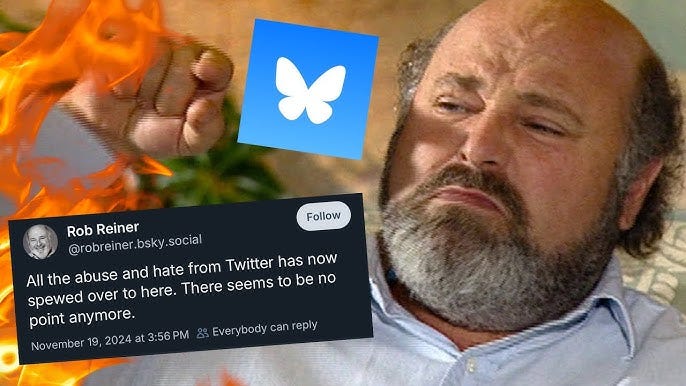
He added that the culture had become punitive even for ideologically aligned users. “Even if you agree with 95% of what a person is saying on a topic, if there is one point that you might call out as being more of a gray area, they will call you a fascist etc.”
Cuban explicitly said he wanted Bluesky to succeed. “I want an alternative to Twitter to survive and thrive. I think it’s important for BS to grow as a way to offset or diminish the cultural and political impact that Twitter has. This is why I care.”
When one of the platform’s biggest financial backers and Ball, one of its most respected progressive journalist users, are publicly making the same diagnosis from completely different angles, that is a serious signal.
The CEO change and internal turmoil
In March 2026, Jay Graber stepped down as CEO and moved into the role of Chief Innovation Officer. Toni Schneider, former CEO of Automattic (the parent company of WordPress.com) and a partner at venture firm True Ventures, took over as interim CEO. Both Automattic and True Ventures are existing investors in Bluesky.
Graber framed the change as a matter of company maturity in her March 9, 2026 announcement blog post. “After several intense and incredible years building Bluesky from the ground up, I’ve decided to step back as CEO and transition to a new role as Bluesky’s Chief Innovation Officer.” She said the company now needed “a seasoned operator focused on scaling and execution.”
Dorsey had already left the Bluesky board in May 2024 and has been notably quiet about the platform since. Reports suggest he grew disillusioned with how the platform evolved away from his original decentralized vision.
In the weeks after Graber’s transition, Bluesky closed a Series B funding round, bringing total disclosed funding to roughly $123 million. The company did not disclose an updated valuation. That funding round is meaningful in light of Ball’s diagnosis. Investors are still buying in, but the runway is finite.
Mark Hamill has had two pile-ons in 13 months
The dynamic Cuban and Ball described has played out repeatedly with some of Bluesky’s highest-profile users. Mark Hamill, the Star Wars actor and one of the platform’s most-followed celebrities, has been on the receiving end twice in just over a year.
In April 2025, Hamill promoted The King of Kings, the Angel Studios animated film in which he voices King Herod alongside Oscar Isaac as Jesus, Kenneth Branagh as Charles Dickens, Pierce Brosnan as Pontius Pilate, Forest Whitaker as Peter, Ben Kingsley as Caiaphas, and Uma Thurman as Catherine Dickens. The film was a commercial hit, grossing $83.5 million worldwide against a $25 million budget and becoming the highest-opening animated Biblical movie ever.
Hamill’s Bluesky promo post read, “Witness the glory of ‘the greatest story ever told’ all through the wide-eyed eyes of wonder of a small boy (& his cat). An amazing cast in an awesome family film for children of all ages!”
The backlash was immediate. Documented Bluesky replies included “Love you, Mark... but no. Religious nuts are already ruining our country. I prefer your other fantasy work,” “Hey Mark... were usually with ya on your VO gigs... but Angel Studios? I mean, have you read about them? These guys are bad news,” and “Teaching children about white jesus. Not cool bro.”
Within days, Hamill resumed posting more actively on X.
A year later, in May 2026, Hamill was at the center of a much bigger controversy, this one going in the opposite political direction. On the evening of Wednesday, May 7, 2026, he posted an AI-generated image on Bluesky depicting President Donald Trump lying in a shallow grave surrounded by daisies. The headstone read “Donald J. Trump 1946-2024,” and the words “If Only” were written across the bottom.
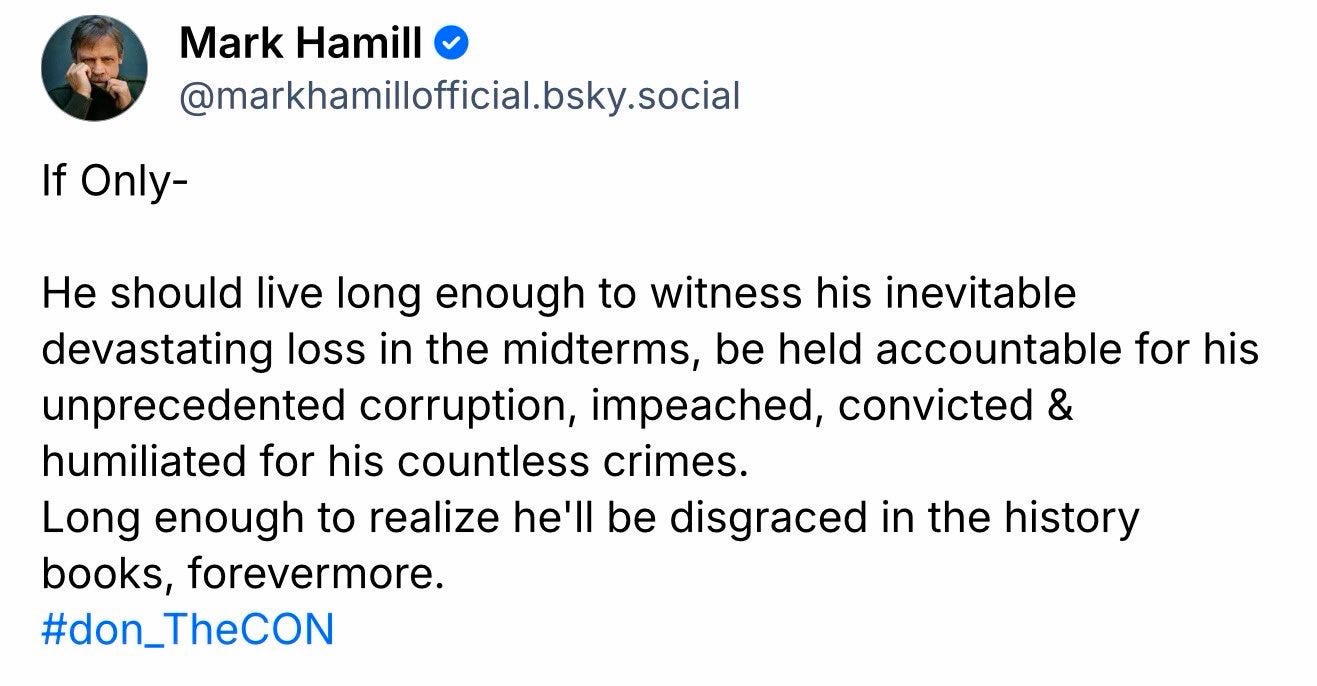
The caption read, in part, “If Only - He should live long enough to witness his inevitable devastating loss in the midterms, be held accountable for his unprecedented corruption, impeached, convicted & humiliated for his countless crimes. Long enough to realize he’ll be disgraced in the history books, forevermore.”
The post came roughly two weeks after a shooter opened fire outside the Washington Hilton during the White House Correspondents’ Association dinner. The White House response on X was direct.
“Mark Hamill is one sick individual. These Radical Left lunatics just can’t help themselves. This kind of rhetoric is exactly what has inspired three assassination attempts in two years against our President.”
By Thursday afternoon, Hamill had deleted the original post and issued a partial apology, also on Bluesky. “Accurate Edit for Clarity: ‘He should live long enough to... be held accountable for his... crimes.’ Actually, I was wishing him the opposite of dead, but apologize if you found the image inappropriate.”
The two Hamill episodes capture the asymmetry of Bluesky’s current moderation environment. In April 2025 he was dogpiled by his own users for promoting a religious movie they did not like. In May 2026 he posted content that drew sharp condemnation from outside the platform and required a public retraction.
The Bluesky team pushes back on the framing
Not everyone agrees with the “echo chamber” framing. TechCrunch, which had published the original reporting on Cuban’s criticism, ran a follow-up piece in June 2025 titled “Bluesky backlash misses the point,” arguing that Bluesky’s brand has become unfairly conflated with the broader AT Protocol network it spearheaded. The piece noted that over 500 interoperable third-party apps now run on the AT Protocol ecosystem, and that pigeon-holing the brand as “the liberal alternative to X” undersells the technical achievement of building a decentralized network at scale.
In his blog post taking over the CEO role, Schneider emphasized this broader ecosystem framing. “Bluesky has cracked a case that stumped the industry for years: How to create a social network that has the best of both worlds. The personal freedom and ownership of decentralized, with the simplicity and reach of centralized.”
The 2026 roadmap published by Bluesky’s head of product Alex Benzer in late January acknowledged the engagement problem head-on, promising improvements to the Discover feed, follower recommendations, real-time features, longer video uploads, and better thread creation tools.
Musk and X CEO Linda Yaccarino have predictably capitalized on the unrest. Musk has described Bluesky users as “a bunch of super judgy hall monitors.” Yaccarino has framed X as “the true global town square.” Both characterizations are self-serving, but the underlying data on engagement and culture criticism is real, and now coming from prominent users on the platform’s own ideological side.
The bottom line
Bluesky has built something real. 43 million registered users, no ads, no algorithmic AI slop, a healthy AT Protocol ecosystem with hundreds of third-party apps, and a daily core community that does treat the platform as their primary social home. That is a significant achievement for a small independent company that took on Meta and Musk simultaneously.
But Ball’s structural argument is the one that matters most. “Bluesky doesn’t have that luxury. It grows or it dies.” A 40% year-over-year drop in daily active users, an estimated 4 to 5 percent monthly compounding decline in posters and likers, and a culture that even left-leaning power users describe as actively hostile to staying on the platform are not the conditions under which a venture-funded social network reverses a downward trend without major changes.
Whether Schneider, Benzer, and the new leadership can broaden the conversation enough to retain users in the next twelve months, or whether Bluesky stabilizes as a smaller and more ideologically self-selecting community of around three to five million daily active users, is the actual open question. The Cuban, Ball, and Hamill moments are not the cause of the decline. They are early warning indicators that some of the platform’s most committed boosters have already noticed the same thing the engagement data has been showing for over a year.
As Ball put it on Easter Sunday, “Maybe you don’t care if Bluesky dies, though accelerationism makes even less sense for social media than it does for real-world politics. But staying the same isn’t really an option. The choices, alas, are grow or die. Right now, Bluesky’s heading towards the latter.”
Article compiled and edited by Derek Gibbs (entertainment editor) and the Clownfish TV newsroom.
D/REZZED is part of Clownfish TV. For more news, views, and rants on gaming and tech, visit clownfishtv.com. Watch the show on YouTube at @ClownfishTV where new episodes drop daily. Subscribe to the Clownfish TV podcast on Apple Podcasts, Spotify, iHeart, and wherever else you get your podcasts. Sign up for the free newsletter at more.clownfishtv.com.
Hat Tips:
James Ball / Techtris (April 5, 2026), “Is Bluesky dying?” Substack essay including verified daily liker and poster trend analysis and the 4-5% monthly decline calculation
TechCrunch, CNBC, Bluesky‘s official blog, MediaPost, BusinessToday, and Dataconomy, March 9-10, 2026 coverage of Jay Graber stepping down as CEO and Toni Schneider taking over as interim CEO
Forbes, Similarweb, Business Insider, and Techbuzz, October 2025 daily active user data showing the 39.8% year-over-year decline
Business Insider (June 9, 2025), Mark Cuban’s verified Bluesky posts including “lack of diversity of thought,” “agree with me or you are a Nazi fascist,” and the “We are forcing posts to X” series
Men’s Journal, Yahoo Finance, Fortune, Fox News, and TechCrunch coverage of the Mark Cuban Bluesky echo chamber commentary in June 2025
RedState, Fandom Pulse, and Animation Magazine, coverage of the April 2025 Mark Hamill King of Kings Bluesky backlash, with verified Hamill promo post and verified user replies
Variety, NBC News, Washington Times, Global News, Euronews, and International Business Times, coverage of the May 7, 2026 Mark Hamill AI Trump grave image, the verified Hamill caption, the verified White House response, and Hamill’s verified apology post
TechCrunch (June 12, 2025), “Bluesky backlash misses the point” alternative framing on the AT Protocol ecosystem
Sprout Social, Backlinko, Skyscraper, Social Media Today, and Statista, Bluesky growth and engagement statistics through 2025-2026
Schneider and Benzer’s January 2026 Bluesky roadmap posts, plus TechCrunch and Techbuzz coverage of the 2026 roadmap announcements