

YouTube is urging UK creators to fight proposed rules that could bury their videos
The UK wants to force YouTube to boost public broadcasters like the BBC in its feeds, and YouTube is warning creators it could push their videos down. Here’s what’s actually being proposed, why both sides have a point, and how creators can weigh in before the deadline.
YouTube is sounding the alarm to its UK creators, and urging them to push back against a government proposal that could reshape what gets seen on the platform.
The plan would require YouTube to give favored placement to certain broadcasters, and YouTube warns that means everyone else, including independent creators, could get buried. Here’s what’s actually on the table, the real arguments on both sides, and what creators can do about it.
What the UK is actually proposing
Let’s start with the plan itself, because the details matter.
The UK government has opened a public consultation (a “green paper” titled “Watch This Space”) exploring rules that would require major platforms, YouTube, Facebook, and TikTok, to give “prominence” to public service broadcasters. In plain terms, that means boosting content from the BBC, ITV, Channel 4, Channel 5, and others so it appears more prominently in feeds and search results.
The idea builds on the UK’s Media Act 2024, which already guarantees those broadcasters top placement on smart TVs (it’s why the first channels you find on a UK telly are the BBC, ITV, and so on). This proposal would extend that same “findability” principle to social and video platforms.
One important note: this is a consultation, not a law yet. No final decisions have been made, and the government says it prefers voluntary deals with platforms before resorting to regulation.
(But where there’s smoke… there’s usually fire.)
Why the government wants this
Here’s the case for the rules, and it’s not unreasonable.
The government and the UK’s media regulator, Ofcom, argue this is about protecting trusted journalism. Their reasoning:
Social media is now where people get news. It’s the main news source for a majority of UK adults, and for around three-quarters of those aged 16 to 24.
Reliable news is getting buried. Ofcom warns that authoritative, regulated news is increasingly hard to find amid an ocean of algorithm-driven content, and that “time is running out” for public service media.
It’s about democracy and quality. Officials frame it as ensuring accurate journalism (and UK-made children’s content) stays accessible, rather than being drowned out by global viral content and AI-generated slop.
In short: as audiences flee traditional TV for YouTube, the government wants to make sure trusted British news doesn’t vanish from view.
Why YouTube (and creators) are pushing back
Here’s the other side, and it’s just as substantive.
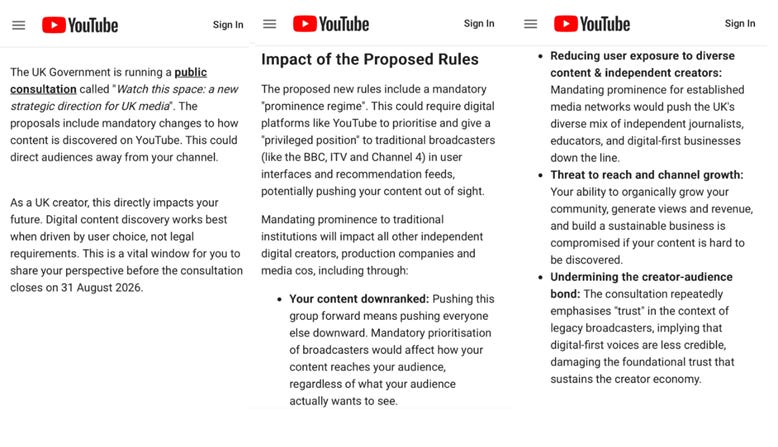
YouTube strongly opposes the plan. David Wheeldon, YouTube’s senior director of government affairs for Europe, argued the rules would “distort what audiences actually choose to watch,” forcing the platform to prioritize “government-picked channels over what viewers came to see.” He called it unfair to users, creators, and journalism alike.
But here’s the part that hits creators directly. Algorithmic feeds have finite space. When a regulator forces a platform to elevate a specific set of broadcasters, that amplification has to come from somewhere.
Every slot handed to the BBC or ITV is a slot taken away from someone else, and that “someone else” is often independent creators, the very people who drive the engagement YouTube runs on.
So YouTube’s warning to creators isn’t just corporate self-interest. If these rules pass, a UK creator’s videos really could get pushed down in feeds and search to make room for mandated broadcaster content. That’s a direct threat to their reach, and their income.
The genuine tension at the heart of this
Here’s why this is such a thorny debate, both sides have a real point.
It comes down to two competing ideas of fairness:
The government’s version: reliable, regulated, accountable news deserves a guaranteed “floor” of visibility, because a healthy democracy needs citizens to be able to find trustworthy information, not just whatever the algorithm serves up.
The platform-and-creator version: feeds should reflect what users actually choose to watch, and the government shouldn’t get to decide which channels win. Mandating visibility for favored outlets overrides audience preference and demotes independent voices.
Both positions have genuine force, which is exactly what makes this so contentious. Is it protecting trusted journalism, or is it the government putting its thumb on the scale of what you see? Reasonable people land on both sides, and even the broadcasters aren’t fully united on whether it should be compulsory (Channel 4’s interim chief said he’s “very happy to work with YouTube” without being forced to by law).
What UK creators can do about it
Here’s the actionable part, if you’re a creator with a stake in this.
Because this is still a consultation, creators (and the public) can actually weigh in before any decisions are made. The government is accepting responses through its official consultation form, and the window is open now.
The deadline to submit feedback is August 31.
YouTube is actively encouraging its UK creators to make their voices heard, arguing that creators have a real stake in whether these prominence rules become law. Whatever side you’re on, it’s a rare chance to directly influence a policy while it’s still being written.
UK YouTube algorithm rules: what happens next
The UK’s proposal to force YouTube to boost public broadcasters is still just a consultation, but it’s a genuinely significant one, and YouTube is treating it as a real threat, rallying creators to oppose it before the August 31 deadline. The government frames it as protecting trusted news in a fractured media world; YouTube and creators frame it as the state overriding what audiences choose and squeezing out independent voices.
Both things are true at once, which is what makes this one of the more interesting platform-versus-government fights in a while. It touches the biggest questions in the creator economy: who decides what gets seen, how much power algorithms should have, and whether governments should intervene to prop up traditional media in a world that’s moved on.
For now, nothing’s decided, and the people with the most to lose, the creators, actually have a say. The smart move is to use it.
Want More Clownfish TV?
This article was brought to you in part by The Reefers of more.clownfishtv.com. Free subscribers get articles like this one in their inbox. Paid subscribers get the full Clownfish TV podcast feed, livestreams, and members-only episodes that never hit YouTube.
D/REZZED is part of Clownfish TV. For more news, views, and rants on gaming, tech, and pop culture, watch @ClownfishTV on YouTube and find the podcast on Apple Podcasts, Spotify, and iHeart.
Article compiled and edited by Derek Gibbs (entertainment editor) and the Clownfish TV newsroom.
Hat Tips:
Dexerto and The News (July 2026), the originating coverage, verified for YouTube urging UK creators to oppose the proposed prominence rules, the “Watch This Space” green paper and consultation, the changed-discoverability warning to creators, and the August 31 response deadline via the official UK Government form
TechTimes and WhatsTrending (June-July 2026), verified for the specifics of the proposal (requiring YouTube, Meta, and TikTok to give prominent placement to BBC, ITV, Channel 4 and other public service broadcasters), YouTube’s David Wheeldon arguing the rules would prioritize “government-picked channels over what viewers came to see,” the finite-feed-space structural problem that demotes independent creators, and Channel 4’s openness to voluntary cooperation
Deadline, GOV.UK, and Ofcom (2025-2026), verified for the policy background (the Media Act 2024, Ofcom’s “Future of Public Service Media” report and its “time is running out” warning, YouTube being the UK’s second-most-watched service behind the BBC, the statistic that social media is the main news source for ~75% of 16-24-year-olds, and the January 2026 BBC-YouTube voluntary partnership)